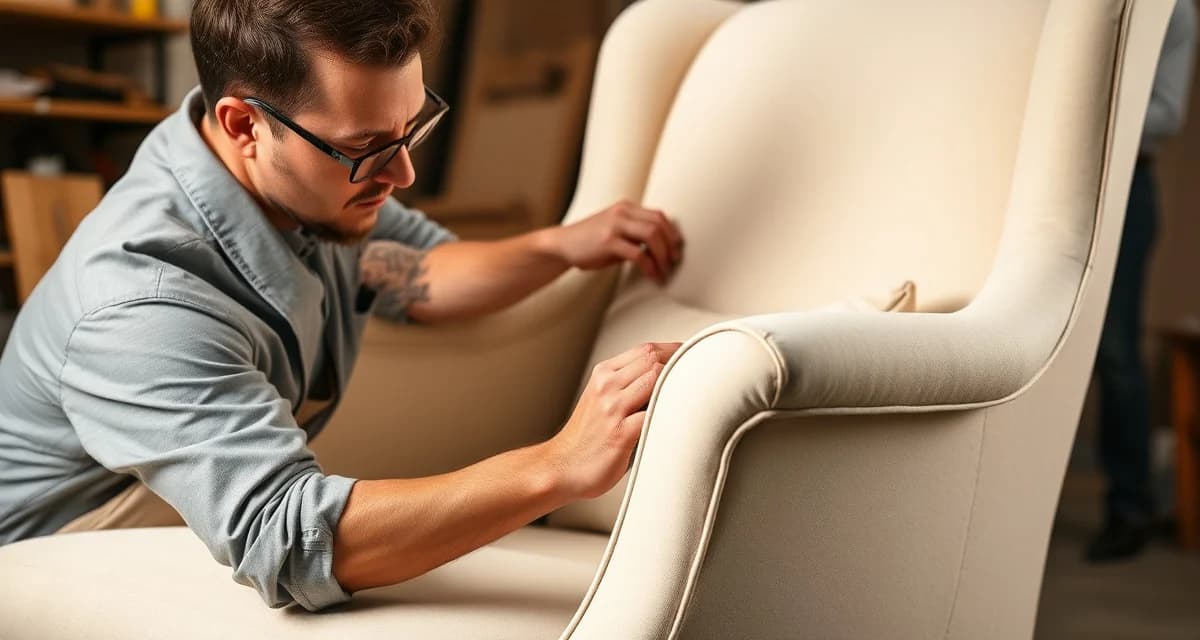
Club Chair Reupholstery Guide: T-Cushion and Tight Seat Options
T-cushion club chairs require a different inside arm installation than tight-seat chairs. Wrong method causes pull marks at the front arm post, visible diagonal tension lines that are the most common professional failure on club chairs. The pull marks happen because the inside arm on a T-cushion chair needs to extend forward past the arm post to create the T-shape extension, and if you install it the same way as a tight-seat inside arm, you create tension in the wrong direction.
TL;DR
- Successful reupholstery starts with a thorough frame and spring assessment before any fabric is ordered.
- Professional technique follows a consistent panel sequence: strip, repair frame, replace foam, then install fabric panels in the correct order.
- Pattern fabric requires centering and repeat alignment decisions made before cutting; errors discovered after cutting are expensive to correct.
- Professional labor time ranges from 4-6 hours depending on furniture style and fabric complexity.
- Foam selection matters as much as fabric selection; the right density and ILD creates the correct seating profile and longevity.
- Consistent tension on all panels and quality welt cording are the marks of professional finishing.
Identifying Your Club Chair Configuration
Club chairs come in four main configurations:
Tight seat, tight back: No loose cushions. Seat and back are upholstered directly to the frame. Clean, minimal look. Less common in new furniture but common in older club chairs being reupholstered.
Tight seat, pillow back: Fixed seat, loose back cushions. The seat surface is upholstered directly to the frame, but the back cushions are removable.
T-cushion seat, tight back: The seat has a T-shaped loose cushion that extends forward between the arm posts. The back is upholstered directly to the frame.
T-cushion seat, loose back cushions: Both the seat (T-shaped) and the back cushions are loose and removable. The most common configuration for residential club chairs.
Tight-Seat Club Chair Installation Sequence
1. Seat platform fabric. Install the deck fabric over the seat platform, tucking at all edges and stapling to the seat frame rails.
2. Inside arms (both). The inside arm runs from the arm platform, up the inside face of the arm, and over the arm crest. It doesn't need to extend past the front arm post on a tight-seat chair. Tuck the back edge of each inside arm behind the inside back (going in later). Staple or tuck-tack at the front arm post.
3. Inside back. Install the inside back, tucking at the sides behind the inside arms and at the bottom into the seat deck.
4. Outside arms. Close the outside arm panels using blind tack at the top rail and front post.
5. Outside back. Close the outside back.
6. Front arm panels. Apply the decorative facing to the front of each arm.
7. Dust cover.
T-Cushion Club Chair Installation Sequence
The T-cushion configuration requires modifications at the inside arm installation.
1. Inside arms, extended version. For a T-cushion chair, the inside arm must extend around and past the front arm post to create the T-shape extension area. Cut the inside arm panel larger than for a tight-seat, it needs to wrap forward of the arm post to create the front face of the T-extension.
At the front arm post, cut a diagonal relief slit in the inside arm fabric to allow the fabric to fold around the post. Fold the excess fabric forward around the post and secure. The inside arm fabric should extend approximately 6-8 inches forward of the arm post to create the T-extension wall.
The pull-mark prevention: Pull the inside arm fabric around the front arm post from the arm face side, not from the extension side. Pulling from the extension creates tension directed toward the arm post, which creates diagonal pull marks on the arm face. Pulling from the arm face and then folding the extension creates clean tension in both directions.
2. Inside back. Tuck at sides behind the inside arms.
3. T-cushion assembly. The T-cushion is assembled off the chair. The seat portion is standard rectangular. The T-extension adds two rectangular panels (one on each side) at the front of the seat. The inside walls of the T-extension are covered by the inside arm panel extension from step 1.
4. Outside arms, outside back, front arm panels, dust cover. Same as tight-seat sequence.
Inside Arm Installation Details
The inside arm installation is where most club chair quality problems originate.
Grain alignment: The inside arm fabric grain should run front-to-back (the selvedge perpendicular to the arm length). This puts the strongest fabric grain in the direction of greatest stress.
Arm crest tension: Pull the fabric over the arm crest and down the outside arm before any stapling. Find the tension that makes the inside arm face look smooth and flat, then staple at that tension. Recheck after each staple position.
Tuck depth at back: The inside arm tucks behind the inside back at the back of the chair. The tuck needs to be deep enough to hold, typically 3-4 inches. Too shallow and the inside arm pulls free when the chair is used.
For related chair technique, the how to reupholster a chair guide covers barrel chairs and wing chairs. Fabric yardage for club chairs is calculated through the club chair fabric yardage calculator.
Frequently Asked Questions
How do I reupholster a T-cushion club chair?
The key difference from tight-seat installation is the inside arm panel, which must extend forward past the front arm post to create the T-extension wall. Cut the inside arm larger than for a tight seat. At the front arm post, cut a diagonal relief slit and fold the arm fabric around the post, pulling from the arm face side (not the extension side) to avoid diagonal pull marks. Assemble the T-cushion separately off the chair and install it last.
What is the difference between a tight seat and T-cushion club chair?
A tight-seat club chair has the seat fabric upholstered directly to the frame with no removable cushion. A T-cushion club chair has a loose seat cushion shaped like the letter T, with the top of the T extending forward between the front arm posts. This T-extension creates the characteristic "over the arm" sitting area. The T-cushion configuration requires different inside arm installation that accounts for the fabric wrapping forward of the arm post.
How long does club chair reupholstery take?
A tight-seat club chair typically takes 4-6 hours for an experienced upholsterer. A T-cushion club chair takes 5-7 hours because the T-cushion construction and the extended inside arm installation add 1-2 hours. Club chairs with carved wood frames or ornate show-wood details add another 30-60 minutes for careful edge work at the frame interfaces.
What tools are required for professional reupholstery?
Professional reupholstery requires a heavy-duty staple gun (pneumatic or electric), a staple remover and tack puller, quality scissors and a rotary cutter, a sewing machine capable of sewing upholstery-weight fabric, foam cutting tools, and regulator pins for manipulating stuffing. For tufted work, a curved needle and tufting twine are also required. The quality of your tools directly affects the quality of the finished work, particularly at seams and edges.
How do I handle pattern matching across multiple panels?
Establish the dominant panel first (usually the inside back) and center the pattern motif there. Then cut each subsequent panel so the pattern aligns with the adjacent panel at the seam. Mark the pattern alignment point on each piece before cutting. For complex pieces, some upholsterers make a cutting plan on paper showing where each panel falls in the pattern before cutting any fabric. This investment in planning prevents the most common and costly pattern-matching errors.
Related Articles
Sources
- National Upholstery Association
- Association of Master Upholsterers and Soft Furnishers (AMUSF)
- Upholstered Furniture Action Council (UFAC)
- Furniture Today (trade publication)
Get Started with StitchDesk
Accurate reupholstery quotes require knowing your labor time, material costs, and overhead for each job type. StitchDesk helps upholstery shops build detailed, professional quotes that account for all cost factors, so every job is priced to cover costs and generate profit. Try StitchDesk free and bring accuracy to every estimate you send.