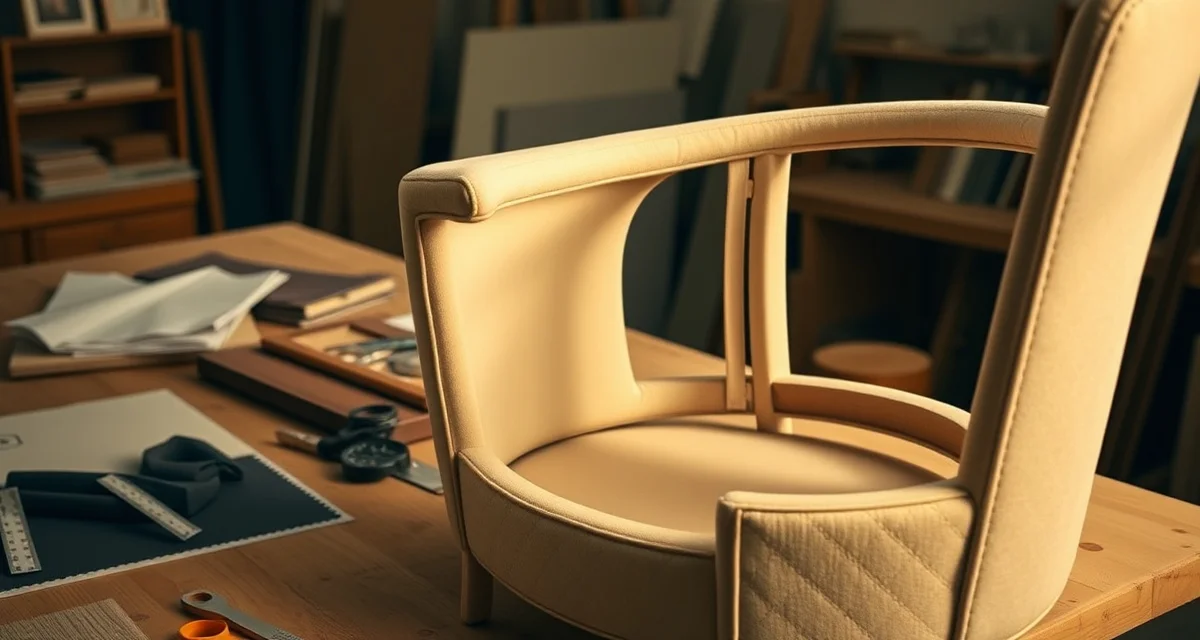
Barrel Chair Reupholstery Yardage: Curved Back Calculation Made Easy
Barrel chairs have 8-10 unique cut pieces versus 5-6 for a flat-back chair. Shops that use generic chair estimates always run short, not by a little, but by 1-2 yards on average. The curved back geometry is the culprit.
This guide explains barrel chair reupholstery yardage step by step, including exactly how the curved back changes your cutting requirements compared to a standard flat-back chair.
TL;DR
- Barrel Chair yardage depends on fabric width, construction details, pattern repeat, and nap direction.
- Plain 54-inch fabric requires a baseline calculation plus 10-15% waste allowance for a standard barrel chair job.
- Patterned fabric adds 20-35% to base yardage depending on repeat size and the number of cutting zones that must align.
- Directional fabrics add 15-25% over plain fabric because layout optimization is restricted by nap direction.
- Always verify fabric width before finalizing yardage; COM fabric often comes in non-standard widths.
- Calculating yardage at the quote stage, not mid-job, eliminates reorders and protects your profit margin.
What Makes a Barrel Chair Different
A barrel chair has a continuously curved back and sides. Unlike a standard wingback or club chair where the back is a distinct flat panel and the sides are separate arms, a barrel chair's back curves around into the sides in one continuous shape.
That continuous curve is visually elegant. It's also a calculating challenge.
On a flat-back chair, you measure the inside back (height × width), outside back (height × width), and arms separately. On a barrel chair, the inside back flows directly into the inside arm areas: there's no seam at the corner, or there's a curved seam that requires a shaped panel cut.
The curve factor adds 15-25% to standard chair yardage. This comes from several places:
- Shaped panel waste: When you cut a curved panel from a rectangular piece of fabric, the areas outside the curve become offcuts you can't use.
- Additional pieces: The curved inside panel must often be cut from multiple shaped pieces that are sewn together, because a single flat cut can't wrap around the barrel curve cleanly. This seaming creates additional waste.
- Bias cutting requirements: On some barrel chair styles, the back panel must be cut on a slight bias to wrap smoothly around the curve. Bias cuts waste fabric at both ends of each cut piece.
The Panel Count: Why Barrel Chairs Are Complex
A flat-back chair typically has 5-6 main cut pieces:
- Inside back
- Outside back
- Two inside arms
- Two outside arms
- Seat
(Plus cushion pieces and welt)
A barrel chair typically has 8-10 main cut pieces:
- Inside back/arm panel (may be one continuous piece or 2-3 shaped pieces)
- Outside back/arm panel (similar complexity)
- Top rail panel (if the barrel has a visible top edge)
- Front arm panels (where the barrel curves forward)
- Seat
- Seat boxing (front and sides)
(Plus cushion pieces, welt, and the additional transition pieces at the curve points)
Calculating Barrel Chair Yardage
Step 1: Measure the inside back/arm curve
For a barrel chair, measure along the curve, not straight across. Use a flexible tape measure and follow the inside surface from the seat level up and around to where the arm meets the front edge. This measurement will be notably larger than the straight-line width.
Step 2: Add the curve factor
Multiply your measured inside back dimension by 1.2-1.3 to account for the bias cutting waste on curved panels.
Step 3: Calculate all panels at inflated dimensions
Use the larger, curve-adjusted dimensions for all back and arm calculations.
Step 4: Sum and add standard waste
Add your standard waste factor (10-12% for a plain woven fabric) on top.
For a standard barrel chair in solid fabric:
- Base calculation before curve factor: ~4 yards
- After 20% curve factor: 4.8 yards
- After 12% waste factor: 5.4 yards
- Practical order: 5.5-6 yards
Yardage by Barrel Chair Size
| Barrel Chair Type | Yardage (54" solid fabric) |
|---|---|
| Small accent barrel (28"-seat width) | 4.5-5.5 yards |
| Standard barrel (32" seat width) | 5.5-7 yards |
| Large barrel/swivel barrel | 6.5-8 yards |
| Tufted barrel chair | 7-9 yards |
The fabric yardage calculator barrel chair should input barrel style as a distinct category, not use a generic chair template.
Pattern Repeats on Barrel Chairs
Pattern repeats are particularly tricky on barrel chairs because the pattern needs to flow continuously around the curve. A stripe or geometric that looks clean on a flat back will appear to "bend" around the barrel if not planned carefully.
For geometric and stripe patterns on barrel chairs, the safest approach is to run the pattern vertically (following the curve) rather than horizontally. Horizontal patterns on a curved back can be matched at the front-facing seam, but it requires extremely precise cutting.
Add 30-40% to solid fabric yardage for any patterned barrel chair. The barrel chair reupholstery guide has a pattern layout guide specific to curved back panels.
FAQ
How many yards to reupholster a barrel chair?
A standard barrel chair needs 5.5-7 yards of 54-inch solid fabric. Small accent barrel chairs need 4.5-5.5 yards. Large or swivel barrel chairs need 6.5-8 yards. Tufted barrel chairs need 7-9 yards. These figures include the curve factor. Don't use a standard chair estimate (typically 3.5-5 yards) for a barrel chair, as you'll consistently run short.
What makes barrel chairs harder to calculate than standard chairs?
Barrel chairs have 8-10 cut pieces versus 5-6 on a flat-back chair, because the continuous curve requires additional shaped transition pieces. The curved panels waste fabric at their edges when cut from rectangular fabric. Some panels must be cut on a bias or from shaped pieces. The combination of additional pieces and shaped-cutting waste adds 15-25% to yardage compared to a flat-back chair of similar seat dimensions.
What fabrics work well for barrel chairs?
Fabrics with good drape and some stretch help barrel chairs upholster cleanly around the curve. Velvet is a popular choice for barrel chairs: it drapes well and the pile helps the fabric conform smoothly to the curve. Medium-weight wovens work well when cut with proper allowances. Avoid stiff fabrics (heavy canvas, tightly woven upholstery duck) on tight barrel curves, as they don't flex enough to lay smooth on the inside of the curve without wrinkling.
What is the biggest factor in yardage variation for this piece?
Pattern repeat is the biggest source of yardage variation. On plain fabric, the baseline calculation plus a 10-15% waste buffer is usually sufficient. Add a 13-inch pattern repeat and you may need 15-20% more. Add a 27-inch pattern repeat and the additional yardage can be 25-35% over the plain fabric calculation. Nap direction is the second-largest factor, typically adding 15-25% over plain fabric because layout optimization is restricted.
Sources
- National Upholstery Association
- Association of Master Upholsterers and Soft Furnishers (AMUSF)
- Upholstered Furniture Action Council (UFAC)
- Furniture Today (trade publication)
Get Started with StitchDesk
Getting yardage right on barrel chair jobs is the difference between a profitable quote and an expensive reorder. StitchDesk's fabric calculator accounts for all the variables that cause errors: pattern repeat by zone, nap direction, fabric width, and cushion configuration. Start a free trial and see how accurate yardage calculation affects your bottom line.