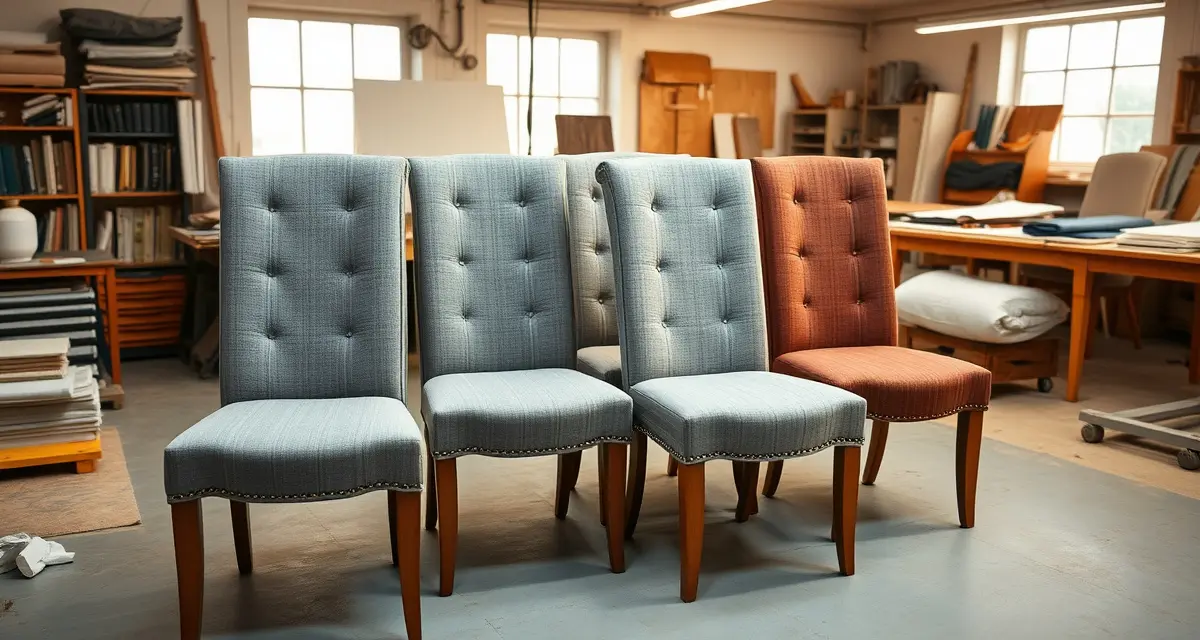
Dining Chair Reupholstery Guide: Full Set Production Tips
Batch-reupholstering dining chairs is 40 percent faster per chair than doing them one at a time. That's not a small efficiency, on a set of 8 chairs, the batch approach saves 40-60 minutes of total labor compared to individual sequential processing. For a shop doing 4-5 dining sets per month, the cumulative time savings pay for themselves in about a week.
This guide covers the professional batch workflow, pattern consistency techniques, and how to handle the variations in dining chair styles.
TL;DR
- Successful reupholstery starts with a thorough frame and spring assessment before any fabric is ordered.
- Professional technique follows a consistent panel sequence: strip, repair frame, replace foam, then install fabric panels in the correct order.
- Pattern fabric requires centering and repeat alignment decisions made before cutting; errors discovered after cutting are expensive to correct.
- Professional labor time ranges from 12-20 hours depending on furniture style and fabric complexity.
- Foam selection matters as much as fabric selection; the right density and ILD creates the correct seating profile and longevity.
- Consistent tension on all panels and quality welt cording are the marks of professional finishing.
The Assembly-Line Batch Workflow
The efficiency gain from batch processing comes from eliminating context-switching. Every time you finish one chair and set up for the next, you lose 2-4 minutes of overhead. Multiply that by 8 chairs and you've lost 16-32 minutes just in setup transitions.
The 5-stage batch workflow:
Stage 1: All teardown (full set)
Remove all seat pads from all chairs simultaneously. Pull all staples from all seat pads in sequence. This stage takes the same total time as doing teardown on each chair individually, but you stay in teardown mode the entire time, same tool, same body position, same mental state.
Stage 2: Foam assessment and preparation (full set)
Assess foam on all pads before cutting any fabric. Decide which pads need new foam. Order foam for the set if needed. By doing all assessments first, you avoid the situation where you've cut and upholstered 6 chairs and then realize you need to wait for foam for the other 2.
Stage 3: Cut all fabric panels (full set)
Lay out the fabric and cut panels for all chairs in the set before upholstering any of them. This is the biggest time-saver: the cut setup (measuring, marking, positioning) happens once for the full set rather than once per chair. For a patterned fabric, you can see and plan pattern positioning across all chairs at once.
Stage 4: Upholster all seats
With all panels cut and foam ready, work through all chairs in sequence. Each chair takes 10-15 minutes at this stage because all the prep work is done.
Stage 5: Reattach all seats
Final stage: reattach seat pads to all chairs in sequence.
Pattern Consistency Across a Dining Set
For clients with patterned fabric, pattern consistency is the detail that separates professional results from amateur ones. When 6 chairs push back from the table, the pattern should appear consistent across all seat pads.
The pattern anchor method:
- Mark the center of one seat pad
- Choose a specific point in the fabric pattern to center at this mark (typically a motif center or pattern repeat midpoint)
- Cut this first pad with the pattern precisely positioned
- Use the first cut as a template for all remaining pads, aligning the pattern position
Cutting from a consistent template ensures every pad in the set has identical pattern placement.
Pattern repeat waste on dining sets: With consistent pattern placement, you can't cut pads side by side and rotate them to save fabric. Each pad needs to be positioned identically in the pattern. For a 9-inch pattern repeat and a 20-inch seat pad, you need 27 inches per pad (next multiple of 9 above 20) rather than the raw 20 inches. On a set of 8 chairs, that's 16 inches of additional fabric vs the minimum calculation, about 0.5 yards.
Dining Chair Style Variations
Drop-in seat pad (most common): The seat pad lifts out with 4 screws from underneath. This is the quickest configuration. The batch workflow above applies directly.
Fixed upholstered seat: The seat fabric is stapled directly to the chair frame, not to a removable pad. Requires working in place on each chair. You can still batch teardown and batch reattachment, but the upholstery stage is done one chair at a time.
Seat and back (full chair upholstery): Both seat and back panels are upholstered. The back is typically accessible from the rear of the chair. Batch the teardown (all seat teardown, then all back teardown), batch the cutting, then upholster one full chair at a time starting with the back panel and finishing with the seat.
Carved show-wood backs: Chairs with decorative carved wood backs visible around the upholstered back panel require extra care at every edge touching the wood. Hand-stitch or carefully fold-tack at all show-wood interfaces.
Quality Check for Sets
Before delivering a dining set, stand the chairs in a row and view them from the front at standing height and from seated height. Confirm:
- Pattern position is consistent across all seat pads (if patterned)
- Fabric tension appears identical across all chairs (no one chair that looks tighter or looser)
- Corner fold style is consistent (all mitered or all pleated, not a mix)
- Seat height is identical across the set after reinstallation
Set inconsistency is almost always visible when chairs are viewed together. The quality check at this stage costs 5 minutes and prevents the callback that costs an hour.
For yardage calculation on dining chair sets, use the dining chair fabric yardage calculator. Technique guidance for individual chair styles is in the how to reupholster dining chairs guide.
Frequently Asked Questions
How do I efficiently reupholster a set of 6 dining chairs?
Use the 5-stage assembly-line batch workflow: complete all teardown across the full set, assess and prepare all foam, cut all fabric panels, upholster all seats in sequence, then reattach all seats. This batch approach is 30-40% faster per chair than completing each chair individually because it eliminates repetitive tool and task switching. For a set of 6, the batch method saves approximately 30-45 minutes of total labor.
What is the fastest way to reupholster dining chair seats?
The fastest setup is: remove all seats from all chairs (pre-drill the seat mounting holes if needed), pull all staples from all seats at once, cut all new fabric panels in one session with a consistent pattern template, then work through all reupholstery in sequence. Pre-cutting eliminates per-chair measuring time. Working in an uninterrupted sequence eliminates setup overhead between chairs. An experienced upholsterer using this approach averages 12-15 minutes per drop-in seat pad.
How do I match fabric patterns across a dining set?
Mark the center of one seat pad and position the pattern at that center point precisely as you want it to appear. Cut this first pad as your pattern template. For all subsequent pads, position the fabric pattern identically to the first cut before stapling. Use chalk marks or pins to register the pattern position before committing to staples. Consistent pattern placement across a full set requires that all pads be cut with the pattern at the same position relative to the pad center.
What tools are required for professional reupholstery?
Professional reupholstery requires a heavy-duty staple gun (pneumatic or electric), a staple remover and tack puller, quality scissors and a rotary cutter, a sewing machine capable of sewing upholstery-weight fabric, foam cutting tools, and regulator pins for manipulating stuffing. For tufted work, a curved needle and tufting twine are also required. The quality of your tools directly affects the quality of the finished work, particularly at seams and edges.
Related Articles
Sources
- National Upholstery Association
- Association of Master Upholsterers and Soft Furnishers (AMUSF)
- Upholstered Furniture Action Council (UFAC)
- Furniture Today (trade publication)
Get Started with StitchDesk
Accurate reupholstery quotes require knowing your labor time, material costs, and overhead for each job type. StitchDesk helps upholstery shops build detailed, professional quotes that account for all cost factors, so every job is priced to cover costs and generate profit. Try StitchDesk free and bring accuracy to every estimate you send.