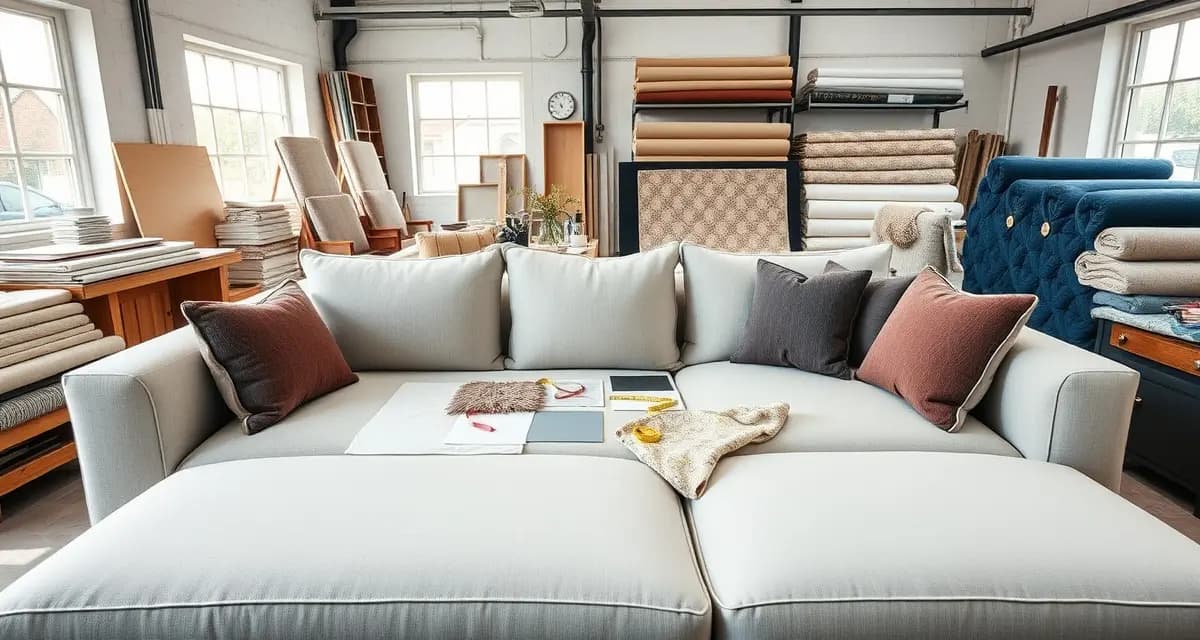
How Many Yards of Fabric to Reupholster a Sectional?
A 3-piece sectional needs 20-30 yards. An L-shaped sectional needs 28-40 yards. A U-shaped sectional needs 40-60 yards. The corner unit alone adds 5-8 yards, the most under-estimated piece in any sectional reupholstery project.
TL;DR
- Sectional yardage depends on fabric width, construction details, pattern repeat, and nap direction.
- Plain 54-inch fabric requires a baseline calculation plus 10-15% waste allowance for a standard sectional job.
- Patterned fabric adds 20-35% to base yardage depending on repeat size and the number of cutting zones that must align.
- Directional fabrics add 15-25% over plain fabric because layout optimization is restricted by nap direction.
- Always verify fabric width before finalizing yardage; COM fabric often comes in non-standard widths.
- Calculating yardage at the quote stage, not mid-job, eliminates reorders and protects your profit margin.
Yardage by Configuration
| Sectional Type | Solid fabric (54-inch) | Patterned fabric (+estimate) |
|---|---|---|
| 3-piece (sofa + 2 chairs) | 20-28 yards | Add 5-8 yards |
| 3-piece with corner unit | 25-33 yards | Add 6-10 yards |
| L-shape (standard) | 28-38 yards | Add 8-12 yards |
| L-shape (deep seat) | 33-43 yards | Add 10-14 yards |
| U-shape (5-6 pieces) | 40-55 yards | Add 12-18 yards |
| U-shape (large, 7+ pieces) | 50-65 yards | Add 15-22 yards |
These figures are for standard cushioned sectionals. Tufted construction, skirts, and high-pile fabrics all add additional yardage above these ranges.
The Corner Unit Problem
The corner unit is the most consistently misquoted element of any sectional job. Here's why:
A corner unit doesn't break down cleanly into rectangles. The diagonal corner creates odd-shaped panels that require inefficient cuts. A corner unit that visually looks like "just two chair backs joined at an angle" actually requires 5-8 yards to cut cleanly without waste.
Shops that estimate sectional yardage by multiplying the per-seat yardage of a regular sofa by the number of pieces will always be short on corner unit jobs. Treat the corner unit as a separate calculation.
L-Shaped vs U-Shaped: What Changes
An L-shape has one corner unit (adds 5-8 yards). A U-shape has two corner units (adds 10-16 yards). Beyond the corner count, U-shapes are also physically longer, adding body yardage proportionally.
For a U-shaped sectional with two curved or angled corner units, adding 12-18 yards for the corners alone is not uncommon.
Pattern Repeat on Sectionals
Pattern repeat is particularly expensive on sectionals because the pattern must align across the entire length of the assembled piece. Every individual unit needs to start its cut at the same position in the repeat so that when the sectional is assembled, the design flows continuously.
On an L-shaped sectional with a 14-inch repeat, the pattern overage can reach 12-15 yards above the base solid-fabric calculation. This surprises clients who chose the fabric thinking it wasn't a complex pattern.
For Professional Shops
Sectionals are the highest-risk quotes for fabric shortfalls. The wide range in the table above reflects real variation based on seat depth, cushion count, corner configuration, and fabric width. Quoting "around 30 yards" for an L-shaped sectional and then ordering that amount is how shortfalls happen.
Use the sectional yardage calculator for piece-by-piece calculations that account for the specific configuration in front of you. The corner unit must be measured and calculated independently, not estimated as a fraction of the adjacent pieces.
Frequently Asked Questions
How many yards for an L-shaped sectional?
An L-shaped sectional typically needs 28-40 yards in solid fabric, with the wide range reflecting differences in seat depth, cushion count, and arm style. The corner unit alone accounts for 5-8 of those yards. In a patterned fabric with a medium repeat, add 8-12 yards to the solid-fabric total. Order from the high end of the calculated range on sectionals: the cost of being 2 yards over is far lower than the cost of a mid-job shortfall on a large order.
Is a sectional more yardage than a sofa?
Much more. A standard 3-cushion sofa needs 13-18 yards. A 3-piece sectional of comparable style needs 20-28 yards. An L-shaped sectional needs 28-40 yards. The corner unit is the main driver of the difference, it's essentially an additional complex piece beyond what a standard sofa contains. The more corner units in a sectional configuration, the greater the yardage premium over an equivalent linear sofa.
How does pattern affect sectional yardage?
Pattern repeat has the largest impact on sectionals of any furniture type because the pattern must align continuously across the entire assembled length. An L-shaped sectional 120 inches long with a 14-inch pattern repeat requires the pattern to flow from the first piece to the last without interruption. This means cuts must be positioned to start at the same repeat position on every piece, which produces considerably more waste than solid-fabric cutting. On a large sectional, pattern repeat additions of 12-18 yards above the base yardage are common.
What is the biggest factor in yardage variation for this piece?
Pattern repeat is the biggest source of yardage variation. On plain fabric, the baseline calculation plus a 10-15% waste buffer is usually sufficient. Add a 13-inch pattern repeat and you may need 15-20% more. Add a 27-inch pattern repeat and the additional yardage can be 25-35% over the plain fabric calculation. Nap direction is the second-largest factor, typically adding 15-25% over plain fabric because layout optimization is restricted.
What should I do if I run short on fabric mid-job?
Stop cutting immediately when you realize you may run short. Calculate exactly how much additional fabric you need before contacting the supplier or client. If reordering from the same dye lot is possible, do so as quickly as possible because dye lots change. If a dye lot match is not available, contact the client before proceeding; visible dye lot differences on the same piece are unacceptable and must be disclosed. Document the situation and response in writing.
Related Articles
Sources
- National Upholstery Association
- Association of Master Upholsterers and Soft Furnishers (AMUSF)
- Upholstered Furniture Action Council (UFAC)
- Furniture Today (trade publication)
Get Started with StitchDesk
Getting yardage right on sectional jobs is the difference between a profitable quote and an expensive reorder. StitchDesk's fabric calculator accounts for all the variables that cause errors: pattern repeat by zone, nap direction, fabric width, and cushion configuration. Start a free trial and see how accurate yardage calculation affects your bottom line.