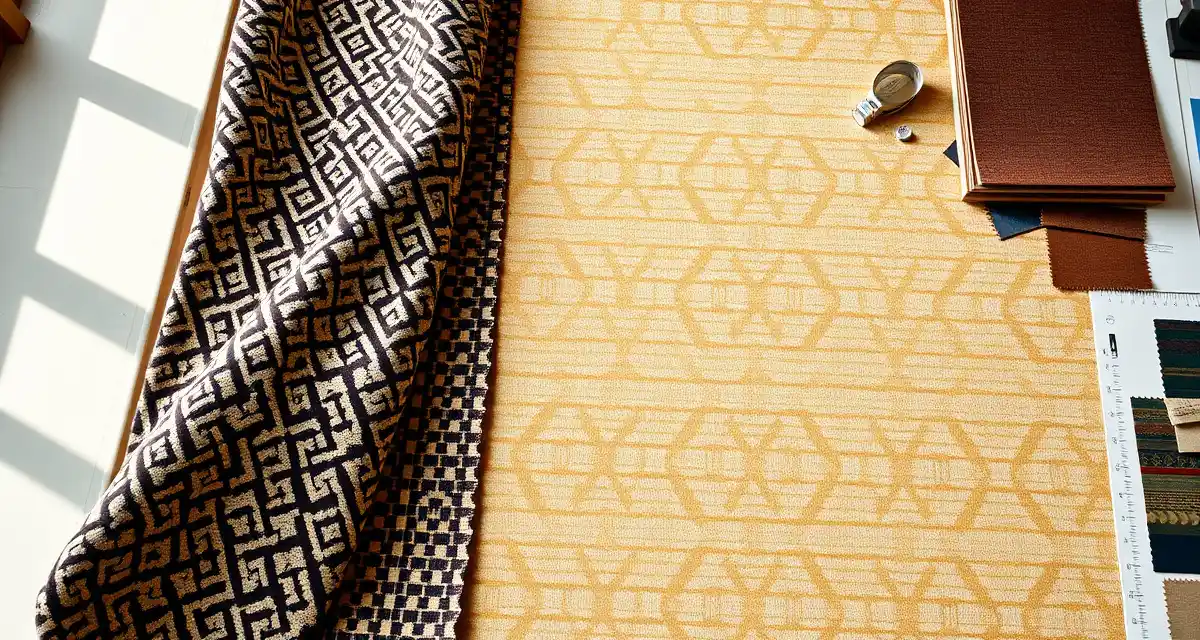
The Complete Guide to Pattern Repeats in Upholstery Fabric
Upholstery shops lose $50-150 per pattern job by guessing yardage instead of calculating repeat offset. That's not a minor inefficiency, across 2-3 patterned jobs per week, it's $5,000-20,000 per year in margin erosion.
This guide covers everything you need to know about pattern repeats in upholstery fabric: what they are, how to calculate the extra yardage they require, when to charge more, and how to handle every major pattern type.
TL;DR
- Pattern repeat is the most common source of fabric waste and yardage underestimation in upholstery shops.
- Each cutting zone on a piece must start at the same point in the repeat, meaning waste accumulates across every panel.
- A 27-inch vertical repeat on a 3-cushion sofa can add 4-6 yards of fabric over the same sofa in plain fabric.
- Horizontal and vertical repeats must both be planned; a plaid or geometric with both adds more waste than a single-axis repeat.
- Pattern centering decisions (where the motif falls on the seat face) should be made at the quoting stage, not after cutting begins.
- Always quote pattern repeat work with a zone-by-zone calculation, not a flat percentage buffer.
What Is a Pattern Repeat in Fabric?
A pattern repeat is the distance after which a pattern exactly duplicates itself. Every patterned fabric has at least one repeat, in some cases, two: a horizontal repeat and a vertical repeat.
The simplest repeats are small and geometrically regular: a 3-inch plaid has a 3-inch repeat in both directions. The most complex repeats are large-scale organic patterns: a 27-inch botanical damask with a half-drop repeat structure.
For upholstery, what matters isn't just that a pattern repeats, it's that the pattern must align at all visible seams. The sofa back cushion must show the same section of the repeat as the back panel. The seat cushions must align with each other. Adjacent panels must be pattern-matched at their seams.
This alignment requirement is what creates extra yardage. Between each aligned cut piece, there's wasted fabric, the portion of the repeat that falls between the end of one piece and the start of the next matching position.
Horizontal vs Vertical Repeats
Most patterns have both a horizontal and a vertical repeat. For upholstery, both matter.
Horizontal Repeat
The horizontal repeat is the distance from one point in the pattern to the next identical point across the fabric width. A fabric with a 13-inch horizontal repeat has a pattern unit that repeats every 13 inches across the width of the fabric.
Horizontal repeat primarily affects how you position panels side by side across the width of the fabric. On a wide piece like a sofa back, the horizontal repeat determines where the pattern falls at the seam between the inside back and the outside arm panels.
Vertical Repeat
The vertical repeat is the distance from one point in the pattern to the next identical point along the length of the fabric bolt. A 13-inch vertical repeat means the same pattern motif appears again every 13 inches down the bolt.
Vertical repeat determines how much extra fabric you need between cut pieces. When you finish cutting one panel, the next panel must start at the next full repeat position, the partial repeat between panels is waste.
Straight Match vs Half-Drop
A straight match pattern repeats on a simple grid: every pattern unit is directly above the next, and at the same horizontal position. When you cut two identical pieces side by side, they align without any offset.
A half-drop pattern staggers every other vertical repeat by half the repeat distance. Imagine a floral pattern where the flower positions alternate left-right as you move down the bolt. Half-drop patterns require cutting alternating pieces from staggered repeat positions, adding 15-20% more waste than a straight-match pattern of the same repeat size.
How to Calculate Extra Yardage for Pattern Repeats
The formula for pattern repeat extra yardage:
Extra yards = (Number of cuts × pattern repeat) ÷ 36
A sofa back might have 5-6 major cut pieces. With a 13-inch repeat:
- 6 cuts × 13 inches = 78 inches of extra fabric
- 78 ÷ 36 = 2.2 yards of extra fabric
For a 27-inch repeat:
- 6 cuts × 27 inches = 162 inches
- 162 ÷ 36 = 4.5 yards extra
For a half-drop repeat: multiply this result by 1.15-1.20.
These additions go on top of your base yardage calculation, not instead of it. A sofa needing 13 base yards with a 27-inch repeat needs 13 + 4.5 = 17.5 yards minimum.
The pattern repeat calculator upholstery takes the guesswork out of this math. You enter the repeat size and the number of pieces, and it calculates the exact extra yardage.
Pattern Repeat Yardage by Repeat Size
| Repeat Size | Match Type | Extra Yardage on Sofa | Extra Yardage on Chair |
|---|---|---|---|
| Under 6 inches | Straight | 0.5-1 yard | 0.25-0.5 yards |
| 6-9 inches | Straight | 1-2 yards | 0.5-1 yard |
| 9-13 inches | Straight | 2-3 yards | 0.75-1.5 yards |
| 13-18 inches | Straight | 3-4.5 yards | 1.25-2 yards |
| 18-27 inches | Straight | 4.5-6 yards | 2-3 yards |
| 27+ inches | Straight | 6-9 yards | 3-5 yards |
| 9-13 inches | Half-drop | 2.5-3.5 yards | 1-1.75 yards |
| 18-27 inches | Half-drop | 5.5-7.5 yards | 2.5-4 yards |
Pattern Centering: The Hidden Cost
Beyond matching the repeat at seams, many clients expect patterns to be centered on the furniture. A large floral centered on the sofa back means the focal point of the pattern should be at the visual center of the back panel.
Centering adds yardage beyond the repeat waste because you can't position the center panel wherever you want in the repeat, you have to position it at the center-motif location in the repeat, which may not line up with where your cut would naturally fall.
Centering a large floral on a sofa back adds 1.5-2.5 yards over rail-to-rail placement. Rail-to-rail (starting the pattern at the edge of the fabric) is more yardage-efficient but doesn't guarantee a centered appearance.
When to Charge More for Pattern Matching
Pattern matching takes time and generates fabric waste that solid fabric jobs don't. It's entirely reasonable to charge a premium for pattern work. Here's a framework:
Small repeat (under 9 inches): Add 15-20% to fabric cost for waste, plus a small labor surcharge (15-30 minutes per piece for a simple sofa).
Medium repeat (9-18 inches): Add 25-35% to fabric cost for waste. Labor surcharge of 30-60 minutes for careful alignment and waste management.
Large repeat (18-27 inches): Add 40-50% to fabric cost. Labor surcharge of 1-2 hours for planning, centering, and methodical cutting.
Extra-large repeat (27+ inches) or half-drop: Add 50-75% to fabric cost. Labor surcharge of 2-3+ hours. These jobs require a cutting plan prepared in advance, not improvised.
Always communicate pattern premium to clients upfront. Show them the extra yardage and labor numbers, not just the total. Clients who understand why their pattern fabric costs more are more likely to accept the quote than those who see a large number with no explanation.
Pattern Type Considerations
Geometric Patterns
Geometric patterns (chevrons, diamonds, hexagons) often have strict horizontal and vertical matching requirements at every seam. They can be especially unforgiving, a slight misalignment on a geometric is immediately obvious. Budget for careful alignment on all visible seams.
Some geometric patterns can be railroaded (turned 90 degrees) to save yardage. Stripes and some simple geometrics work as railroaded. Complex geometrics usually can't be railroaded because rotating the pattern 90 degrees changes how it reads on vertical vs horizontal surfaces.
Stripes
Stripes have a repeat determined by the stripe pattern width. Horizontal stripes must align at all vertical seams; vertical stripes must align at all horizontal seams. Railroading vertical stripes can save 1-3 yards on a sofa by eliminating seam-to-seam stripe alignment requirements.
Florals
Large-scale florals are the most common source of major pattern underestimates. The repeat is large, the centering expectation is high, and any misalignment is obvious on a busy botanical pattern. Always calculate large florals with a centering premium.
Plaids and Tartans
Plaids require matching in both horizontal and vertical directions simultaneously. This is the most complex pattern matching scenario in upholstery. Large-scale tartans on a sofa can require 8-12 yards more than the solid-fabric equivalent.
Using the Pattern Repeat Calculator
The most important step is using a fabric yardage calculator that accepts pattern repeat as an input, not a manual estimate. Spreadsheets require you to do the alignment math manually for each piece, and most shops skip it or get it wrong.
A purpose-built pattern repeat calculator shows you the alignment of each piece on the fabric before you commit to an order quantity. This lets you optimize the cutting plan and potentially reduce waste by reordering how pieces are cut from the bolt.
Related Articles
FAQ
What is a pattern repeat in fabric?
A pattern repeat is the distance after which a woven or printed pattern exactly repeats itself on a fabric bolt. Fabrics have horizontal repeats (across the width) and vertical repeats (along the length). In upholstery, the vertical repeat determines how much extra fabric is needed between cut pieces to maintain pattern alignment at all seams. The larger the repeat, the more extra yardage is required.
How do I calculate yardage for a fabric with a 13-inch repeat?
Calculate your base yardage for the piece as if using a solid fabric. Then count the number of major cut pieces (typically 8-12 for a sofa). Multiply the number of cuts by the repeat size in inches: 10 cuts × 13 inches = 130 inches. Divide by 36 for yards: 130 ÷ 36 = 3.6 yards extra. Add this to your base yardage. For a sofa needing 13 base yards: 13 + 3.6 = 16.6 yards, rounded to 17 yards.
When should I charge extra for pattern matching?
Charge extra for any fabric with a pattern repeat over 9 inches. The extra charge covers two real costs: the additional fabric waste (which you've already factored into the yardage) and the additional labor for planning, centering, and carefully aligned cutting. For large-scale repeats (18+ inches) or half-drop patterns, the labor premium should be meaningful, these jobs take 1-3 extra hours compared to a solid fabric job. Present the surcharge as a line item with an explanation, not buried in the total.
How do I calculate yardage for a large pattern repeat?
Calculate each cutting zone separately. For each zone, round up to the next full repeat. Sum the adjusted zones and add a 15-20% buffer. For a 27-inch repeat, a seat cushion panel that measures 22 inches still requires a full 27-inch repeat allocation, wasting 5 inches. Multiply this across 8-12 zones on a sofa and the waste adds up to 4-6 yards over the plain-fabric calculation. Zone-by-zone calculation is the only reliable method.
Should I charge extra for pattern repeat work?
Yes. Pattern repeat work adds material cost (extra yardage) and labor cost (planning time, careful alignment during cutting and installation). Both should be reflected in the quote. For clients providing COM fabric with a pattern repeat, calculate and communicate the additional yardage requirement before accepting the fabric. For shop-supplied fabric, build the pattern repeat waste into your material cost and add a pattern complexity labor charge.
Sources
- National Upholstery Association
- Association of Master Upholsterers and Soft Furnishers (AMUSF)
- Upholstered Furniture Action Council (UFAC)
- Furniture Today (trade publication)
Get Started with StitchDesk
Pattern repeat work is where fabric errors are most common and most costly. StitchDesk's yardage calculator handles pattern repeats zone by zone, not as a flat buffer, so your quotes for patterned fabric are accurate before the first cut. Start a free trial and eliminate the most expensive source of fabric waste in your shop.