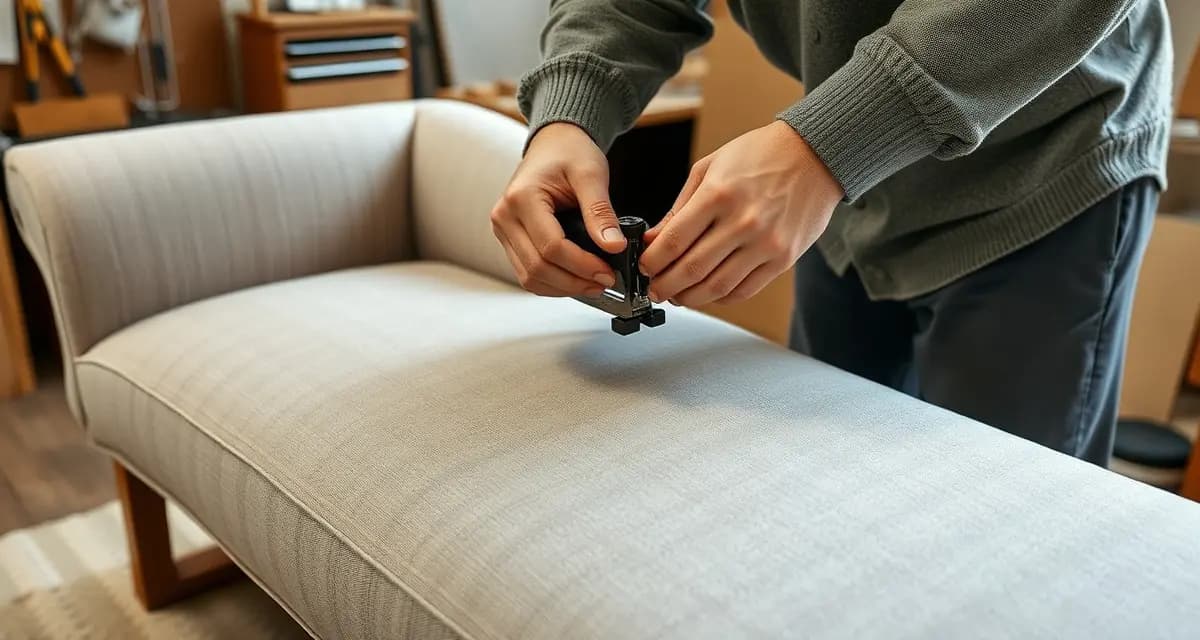
How to Reupholster a Chaise Lounge: Long Piece Expert Guide
Chaise fabric tension failures almost always occur at the transition between the seat and extended foot section. This is the point where the chaise's length changes from a supported center section to a cantilevered extension, and where the weight distribution under the fabric changes. Fabric stapled with consistent tension across the full length doesn't account for this transition, and the result is visible sag or rippling at the midpoint of the piece.
This guide covers the correct tension management approach and panel sequence for chaise lounge reupholstery.
TL;DR
- Successful reupholstery starts with a thorough frame and spring assessment before any fabric is ordered.
- Professional technique follows a consistent panel sequence: strip, repair frame, replace foam, then install fabric panels in the correct order.
- Pattern fabric requires centering and repeat alignment decisions made before cutting; errors discovered after cutting are expensive to correct.
- Professional labor time ranges from 12-20 hours depending on furniture style and fabric complexity.
- Foam selection matters as much as fabric selection; the right density and ILD creates the correct seating profile and longevity.
- Consistent tension on all panels and quality welt cording are the marks of professional finishing.
Understanding the Chaise Format
A chaise lounge is essentially a chair with an extended seat platform that supports the full length of the body. The format has two key differences from a standard sofa or chair:
Length: A standard chaise is 60-72 inches long (compared to 30-36 for an armchair). Managing consistent fabric tension over this length requires a different stapling strategy than shorter pieces.
Arm position: Chaises typically have one arm (at the head end) or no arms. The single-arm or no-arm design means the inside panels have fewer boundaries and reference points than a fully armed sofa or chair.
The foot section: The extended foot area of the chaise is typically unsupported below, while the seat section has the main frame rails running underneath. The fabric behavior over these two zones is different, which is why the transition between them is a tension failure point.
Pre-Work Assessment
Before teardown, study how the existing fabric manages the seat-to-foot transition:
- Is there a seam at the transition, or is the seat fabric continuous?
- Is there a welt or decorative detail at the transition?
- Does the current fabric show any tension marks, sagging, or pulling at the midpoint?
If the current fabric shows failure at this point, the original construction had a tension error. Don't replicate it. Plan your stapling to address it.
Teardown and Measurement
Tear down from the outside panels inward: dust cover, outside back (if present), outside arm (if present), then inside panels.
On the chaise seat, measure the fabric in two zones:
- From the seat back to the transition point (typically where the seat deck ends and the foot extension begins)
- From the transition point to the foot end
These measurements tell you where the transition falls on your replacement fabric and let you plan tension management before cutting.
Fabric Tension Management
The center-anchor method: Don't start stapling at either end of the chaise. Start at the center of the seat section, the midpoint of the main seat zone.
Anchor the fabric at the center of both the front and back rails at the seat midpoint. From this anchor, work outward in both directions: toward the back (arm end) and toward the foot. Working from center outward in both directions distributes tension evenly across the full length.
The transition zone: At the seat-to-foot transition, pay special attention. As you approach this zone from the seat side, increase staple density (closer spacing between staples). The higher staple density distributes tension more evenly across the material change point.
The foot section: Continue from the transition zone outward to the foot end. The foot section often has less frame support, so pull the fabric to a consistent visual tension, not tighter than the seat section, but consistent.
Checking as you go: At the transition zone, lay a straightedge across the surface. Any visible undulation or ripple means uneven tension. Correct it by adding staples on the low-tension side before the fabric is fully committed.
Panel Installation Sequence
Chaise with one arm (head end):
- Seat deck and foot extension, one continuous panel or seamed at transition
- Inside arm (head end)
- Inside back (the back panel at the head end, typically short and angled)
- Leg/foot cushion or extension pad (if separate)
- Outside arm
- Outside back (if present)
- Dust cover
Armless chaise (often used with Ottoman or as part of sectional):
- Seat deck and foot extension
- Inside back (head end)
- Side boxing (the side panels running the full length)
- Foot end panel (closing panel at the foot)
- Outside back (if applicable)
- Dust cover
Extended-piece technique: On a chaise with a seam at the seat-to-foot transition, don't sew the seam before installation. Staple the seat section first, then pull and position the foot extension section before sewing the seam in place. This allows you to fine-tune the relative tension of the two sections before they're permanently joined.
Cushion Configuration
Many chaises have a loose seat cushion and/or a loose back cushion in addition to the fixed upholstery. These can be sized and constructed the same way as sofa cushions.
The foot section may or may not have a separate cushion, measure the client's current configuration and replicate it unless they request a change.
If the chaise has a bolster at the head end in addition to a seat cushion, calculate and construct the bolster separately. Bolsters are cylindrical cushions that add 0.5-1 yard of fabric per bolster.
For chaise fabric yardage including all zones, use the fabric yardage calculator for chaises. The chaise reupholstery guide covers advanced chaise styles including sectional chaise pieces.
Frequently Asked Questions
How do I reupholster a chaise lounge?
Start with a complete teardown, saving all old panels as templates. The critical technique is center-anchor tension management: begin stapling at the center of the seat section (not at either end), anchor at both front and back rails, then work outward in both directions toward the back and foot end. Increase staple density at the seat-to-foot transition where tension failure is most common. Install inside panels before outside closing panels. Add the dust cover last after checking tension and surface consistency across the full length.
What order do I work on a chaise?
Install panels in this order: seat deck and foot extension first (as one panel or two seamed), then inside arm (if the chaise has one), inside back, leg extension pad if separate, outside arm, outside back, and dust cover. The key rule is all inside-facing panels before outside closing panels. For the seat and foot panels, work from center outward to manage length-related tension distribution.
How do I handle the extended foot section of a chaise?
The foot section should have consistent tension with the seat section, neither looser nor tighter. To achieve this, use the center-anchor method rather than starting at the foot end. When you reach the foot section after working outward from center, maintain the same pull tension you used on the seat section. At the transition between sections, increase staple density (space staples closer together) to prevent the transition from becoming a visible tension break point.
What tools are required for professional reupholstery?
Professional reupholstery requires a heavy-duty staple gun (pneumatic or electric), a staple remover and tack puller, quality scissors and a rotary cutter, a sewing machine capable of sewing upholstery-weight fabric, foam cutting tools, and regulator pins for manipulating stuffing. For tufted work, a curved needle and tufting twine are also required. The quality of your tools directly affects the quality of the finished work, particularly at seams and edges.
How do I handle pattern matching across multiple panels?
Establish the dominant panel first (usually the inside back) and center the pattern motif there. Then cut each subsequent panel so the pattern aligns with the adjacent panel at the seam. Mark the pattern alignment point on each piece before cutting. For complex pieces, some upholsterers make a cutting plan on paper showing where each panel falls in the pattern before cutting any fabric. This investment in planning prevents the most common and costly pattern-matching errors.
Related Articles
- Can I Reupholster a Sofa Myself? Honest Assessment Guide
- Poolside and Patio Chaise Lounge Fabric Yardage
Sources
- National Upholstery Association
- Association of Master Upholsterers and Soft Furnishers (AMUSF)
- Upholstered Furniture Action Council (UFAC)
- Furniture Today (trade publication)
Get Started with StitchDesk
Accurate reupholstery quotes require knowing your labor time, material costs, and overhead for each job type. StitchDesk helps upholstery shops build detailed, professional quotes that account for all cost factors, so every job is priced to cover costs and generate profit. Try StitchDesk free and bring accuracy to every estimate you send.