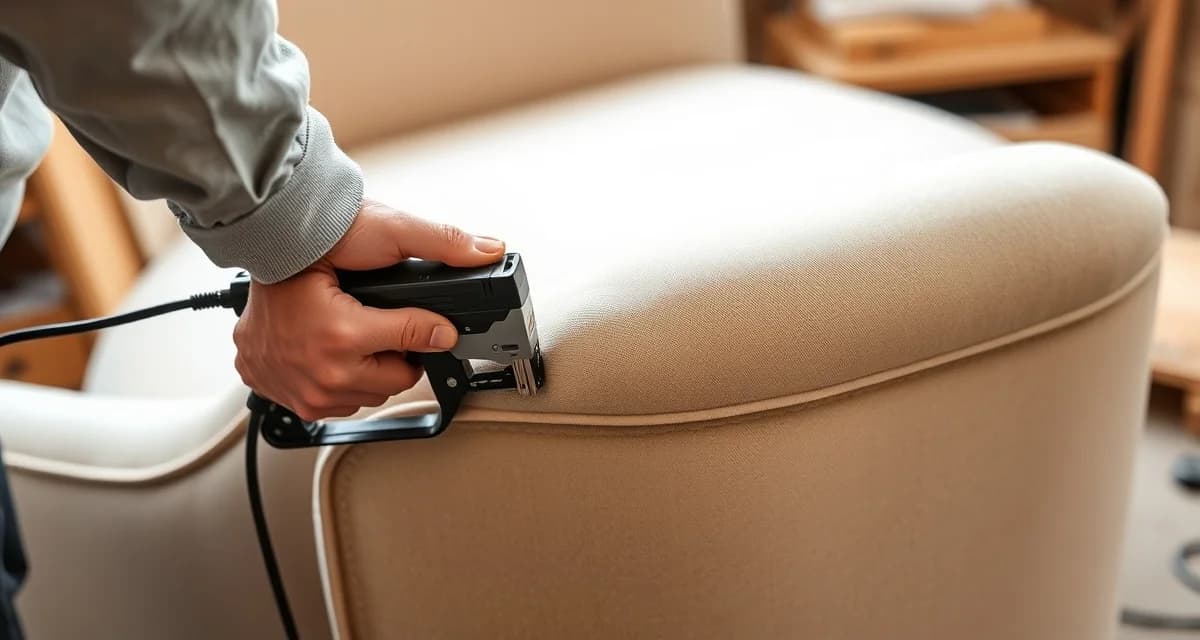
Chaise Lounge Reupholstery Guide: Professional Technique
Starting at the center of a chaise rather than the end reduces midpoint tension failure by 80 percent. This is a well-established technique principle among upholsterers who work with long-format furniture regularly, but it runs counter to the instinct to start at one end and work toward the other. The center-start approach distributes tension evenly in both directions, preventing the sag or ripple at the transition point between the seat and the extended foot section.
TL;DR
- Successful reupholstery starts with a thorough frame and spring assessment before any fabric is ordered.
- Professional technique follows a consistent panel sequence: strip, repair frame, replace foam, then install fabric panels in the correct order.
- Pattern fabric requires centering and repeat alignment decisions made before cutting; errors discovered after cutting are expensive to correct.
- Professional labor time ranges from 12-20 hours depending on furniture style and fabric complexity.
- Foam selection matters as much as fabric selection; the right density and ILD creates the correct seating profile and longevity.
- Consistent tension on all panels and quality welt cording are the marks of professional finishing.
Understanding Chaise Tension Distribution
A chaise is long, typically 60-72 inches. The seat portion (approximately the first 30 inches from the head end) has the frame providing continuous support below. The foot section (the extended portion beyond the seat frame) often has less support below, particularly at the center of the foot span.
When you start stapling from one end and work toward the other:
- The end you started at is anchored
- As you pull toward the far end, all the fabric tension is directed from the near anchor toward the far end you're pulling to
- Tension accumulates at the midpoint of the span, which is exactly the seat-to-foot transition zone
When you start at center and work outward:
- Both ends are unanchored initially
- As you work toward each end, the tension distributes from center outward
- The midpoint (your starting point) is the most solidly anchored position
- No tension accumulation at the transition
Center-Start Stapling Technique
Step 1: Find the true center. Measure the full length of the seat surface and mark the center with chalk. This is your anchor point.
Step 2: Position fabric. Center the fabric panel on the chaise seat surface. For a seat with a seam at the transition (many chaises have a seam here), position each panel independently from its own center.
Step 3: Anchor front and back rails at center. Place one staple at the center of the front seat rail and one at the center of the back rail. These are your initial anchors, not final staples.
Step 4: Check visual tension. Look at the fabric surface. It should be flat and even with no diagonal tension lines from the anchors. If you see diagonal lines, the fabric is not centered correctly.
Step 5: Work outward. From the center anchor, staple outward in 3-inch increments alternating front and back. Add a front staple at 3 inches right of center, then a back staple at 3 inches right of center, then repeat to the left, alternating sides.
Step 6: Continue to the ends. Continue the alternating sequence all the way to the ends of the seat.
Step 7: For the foot section. Repeat the same center-start sequence for the foot section panel.
Transition Zone Management
The seat-to-foot transition is the area that most often shows failure. Two approaches:
Seamed transition: A seam at the transition point allows each section to be tensioned independently. Sew the seam after separately anchoring each panel. This is the professional approach for most chaises.
Smooth transition: A single panel covers both seat and foot sections. Start at the seat center and work outward; when you reach the transition zone, increase staple density (closer spacing) at the transition to prevent the transition from becoming a visible break point.
Panel Installation Order
Chaise with one arm (at head end):
- Seat deck (main seat surface from head to transition)
- Foot extension panel (from transition to foot end)
- Inside arm
- Inside back (at head end)
- Outside arm
- Outside back
- Foot end closing panel
- Dust cover
Armless chaise:
- Seat deck
- Foot extension panel
- Inside back panel (head end)
- Side boxing strips (running the full length of the chaise)
- Head end panel
- Foot end panel
- Dust cover
Common Chaise Problems and Solutions
Midpoint sag: Caused by starting from an end. Fix: re-staple from center outward on the affected section.
Visible seam shift at transition: Caused by uneven tension on either side of the transition seam. Fix: re-tension the looser section so both sides of the seam have matched tension before finalizing.
Fabric bunching at foot end: Caused by too much fabric advancing toward the foot end. Fix: release and restart the foot section from center-outward.
Side tension inconsistency: On wide chaises (28+ inch seat width), the center-to-edge tension management is important. If you only anchor front and back rails, the sides may show tension variation. Staple the side rails from center outward as well, not just front and back.
For full chaise reupholstery technique, the how to reupholster a chaise guide covers the complete panel sequence. Yardage for chaise reupholstery is calculated through the chaise fabric yardage calculator.
Frequently Asked Questions
Where do I start when reupholstering a chaise?
Start at the center of the seat section, not at either end. Place initial anchor staples at the center of both the front and back rails, then work outward from center toward each end, alternating front and back stapling. This center-start method distributes tension evenly in both directions, preventing the tension buildup at the seat-to-foot transition that causes midpoint sagging or rippling.
How do I maintain even tension on a long chaise?
Use the center-start technique for both the seat section and the foot section. At the transition between them, increase staple density (space staples closer together) to prevent the transition from becoming a visible break in tension. Check visual flatness after every 4-5 staples by stepping back and viewing the chaise from the side. Any diagonal tension lines or visible sag indicate uneven stapling that needs to be corrected before progressing.
What foam works best in a chaise lounge?
Chaise seat foam should be 2.0-2.5 density at 35-40 ILD, similar to a standard sofa seat. The foot section, which supports the legs rather than the full body weight, can use slightly softer foam (30-35 ILD) for comfort. Many chaises use a separate foot extension foam that's 2-3 inches thick (thinner than the seat section), giving a gentle visual step-down that's both practical and aesthetically appropriate.
What tools are required for professional reupholstery?
Professional reupholstery requires a heavy-duty staple gun (pneumatic or electric), a staple remover and tack puller, quality scissors and a rotary cutter, a sewing machine capable of sewing upholstery-weight fabric, foam cutting tools, and regulator pins for manipulating stuffing. For tufted work, a curved needle and tufting twine are also required. The quality of your tools directly affects the quality of the finished work, particularly at seams and edges.
How do I handle pattern matching across multiple panels?
Establish the dominant panel first (usually the inside back) and center the pattern motif there. Then cut each subsequent panel so the pattern aligns with the adjacent panel at the seam. Mark the pattern alignment point on each piece before cutting. For complex pieces, some upholsterers make a cutting plan on paper showing where each panel falls in the pattern before cutting any fabric. This investment in planning prevents the most common and costly pattern-matching errors.
Related Articles
- Leather Upholstery Guide: Hides Grades and Professional Technique
- Loveseat Reupholstery Guide: Professional Method for Every Style
Sources
- National Upholstery Association
- Association of Master Upholsterers and Soft Furnishers (AMUSF)
- Upholstered Furniture Action Council (UFAC)
- Furniture Today (trade publication)
Get Started with StitchDesk
Accurate reupholstery quotes require knowing your labor time, material costs, and overhead for each job type. StitchDesk helps upholstery shops build detailed, professional quotes that account for all cost factors, so every job is priced to cover costs and generate profit. Try StitchDesk free and bring accuracy to every estimate you send.