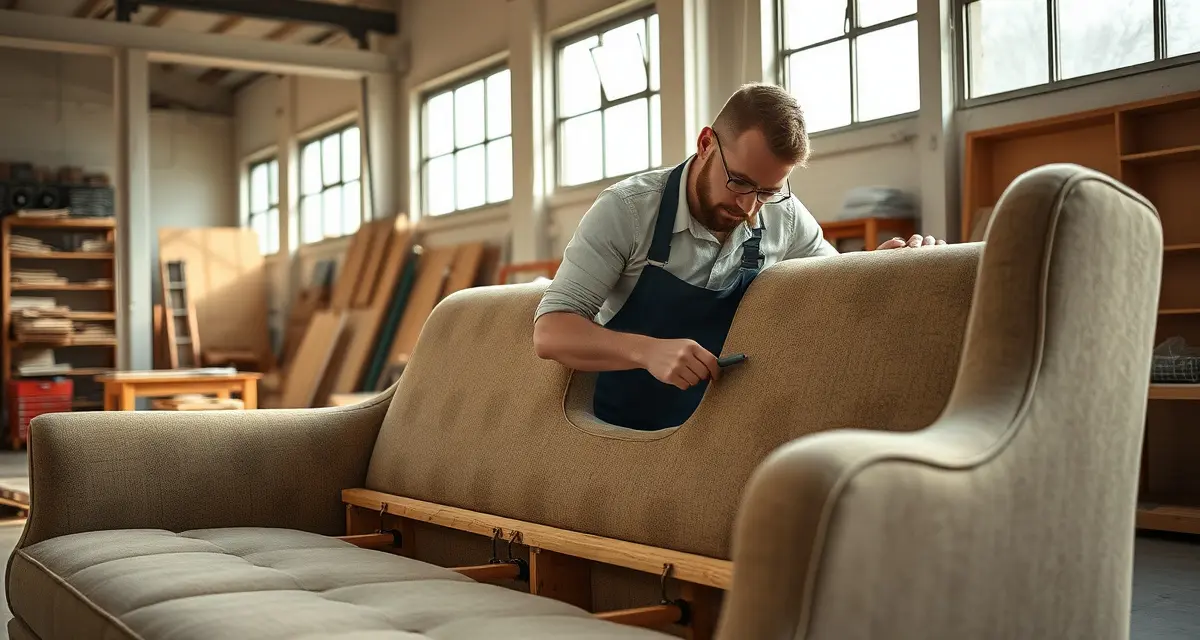
How to Reupholster a Sofa: Complete Professional Guide
Shops that inspect frames before quoting avoid the 1-in-8 job where the frame needs repair before reupholstery starts. That's roughly one bad surprise every two weeks at a busy shop, a job where the client drops off a piece expecting a fabric change and you discover broken frame joints, failed springs, or sagging webbing that has to be addressed before a single panel of fabric goes on. If you inspect at drop-off and quote it correctly, that surprise becomes a profitable add-on. If you inspect after you've started tearing down, it's a scope negotiation you're having with a client whose furniture is already disassembled.
This guide covers the complete professional sofa reupholstery process from drop-off inspection to finished delivery, with specific technique notes for different sofa styles.
TL;DR
- Successful reupholstery starts with a thorough frame and spring assessment before any fabric is ordered.
- Professional technique follows a consistent panel sequence: strip, repair frame, replace foam, then install fabric panels in the correct order.
- Pattern fabric requires centering and repeat alignment decisions made before cutting; errors discovered after cutting are expensive to correct.
- Professional labor time ranges from 1-2 hours depending on furniture style and fabric complexity.
- Foam selection matters as much as fabric selection; the right density and ILD creates the correct seating profile and longevity.
- Consistent tension on all panels and quality welt cording are the marks of professional finishing.
Frame Inspection: Before You Quote
When the sofa comes in, spend 10 minutes on frame inspection before anything else.
Spring assessment: Flip the sofa onto its back. Look at the spring deck from below. On 8-way hand-tied coil spring sofas (common in traditional pieces), check whether any springs have come untied or are listing to one side. Retying is straightforward but takes 1-2 hours. Budget for it in your quote.
On sinuous (no-sag) spring sofas, check whether any spring clips have popped free from the rail. This is a 15-minute repair if you catch it early.
Frame joint inspection: Push firmly on the arms and back. Any creaking, rocking, or visible movement at joints indicates loose or failed corner blocks. These need to be reglued and reclamped before reupholstery, doing it after is difficult. Factor 1-2 hours into your quote for regluing if you find loose joints.
Webbing assessment: On sofas with webbing (interlaced jute, rubber, or synthetic webbing across the seat frame), check the tension. Webbing that sags more than 1 inch when you press on it needs to be replaced. This is typically 1-2 hours for a sofa.
Frame integrity: Look for broken rails, cracked corner blocks, or areas where the frame has been previously repaired. A frame with structural failure needs more than a reupholstery appointment.
Documentation: Photograph anything you find during inspection and note it on the intake form. If the frame needs work, get written approval from the client before proceeding. StitchDesk's job intake checklist has a frame inspection section that feeds directly into the quote adjustment workflow.
Tear-Down Process
With inspection complete and the quote approved, begin tear-down.
Document first: Before removing any fabric, photograph the sofa from all angles, front, back, both sides, close-ups of arms and back junction. These photos are your reference for reassembly. You'll thank yourself when you're trying to remember whether the outside arm was attached before or after the inside back.
Pull all staples and tacks: Work methodically, starting from the final-applied panels and working backward. On most sofas, this means starting with the dust cover (cambric) on the bottom, then the outside back, then outside arms, then the main body.
Use a tack puller or flathead screwdriver for staples. Don't rush, staples embedded in the frame can catch thread and tear fabric if left in place during reassembly.
Save your pieces: The old panels are your cutting templates. Even if the fabric is completely worn out, the shape of each piece is perfect. Keep every piece and label them: "inside back," "outside left arm," "seat deck," etc.
Assess what can stay: Not everything needs to come off. On some sofas, the deck webbing or sinuous springs may be in good condition. Interior foam that's still performing doesn't always need full replacement. Each zone is a judgment call.
Foam Replacement and Selection
Foam selection is where many residential shops lose quality on sofa jobs. Using whatever density is on hand leads to sofas that feel wrong for their style.
Seat foam: Sofa seat cushions need high-resilience foam, not standard foam. The difference is in how the foam recovers after compression. Standard foam flattens and stays flat. High-resilience foam springs back fully.
For seat cushions:
- 1.8 density, 35-38 ILD: Economy range, appropriate for light-use sofas
- 2.0 density, 35-40 ILD: Standard residential quality
- 2.5 density, 35-40 ILD: High-quality residential, the right choice for any sofa you want to reflect well on your shop
For back cushions:
- 1.5-1.8 density, 28-32 ILD: Back cushions need to be softer than seat cushions
- Fiber fill wrapping over foam creates the cloud-like feel clients love in pillow-back sofas
Seat deck foam (the fixed foam layer under loose cushions): 2.0+ density, 25-30 ILD. Soft enough to not create a hard landing spot, firm enough to support the cushion above it.
Dacron wrap: Most sofas benefit from 1-2 layers of Dacron polyester wrap over seat foam. This creates the rounded cushion shape and adds that first-touch softness before the foam's resistance is felt.
Fabric Cutting
With tear-down complete and foam selected, cut your fabric from the old panels.
Lay out all old panels on the new fabric: Before cutting a single piece, lay all panels on the fabric and determine the most efficient arrangement. Look for pattern placement if applicable. Find the arrangement that uses the least fabric before you commit to cuts.
Mark pile direction: For any fabric with nap (velvet, chenille), mark the top of each panel before cutting. All panels must run the same direction, typically pile running downward from top to bottom of each panel.
Add seam allowance: Your old panels are the finished size. Add seam allowance (1/2 inch for sewn seams, 3-4 inches for stapled wrap edges) to each piece as you cut.
Cut welt cord bias strips: If your sofa has welted seams, cut bias strips for welt cord. Standard welt strip width is 1.5-2 inches for 3/32-inch cord.
Panel Installation Sequence
Panel sequence matters enormously. Installing panels in the wrong order makes certain panels impossible to attach cleanly, or requires stapling into areas that will show in the finished piece.
Standard sofa installation sequence:
- Deck: Install the seat platform fabric first
- Inside arms: Both sides, working from the front rail to the back
- Inside back: After inside arms are in, the inside back tucks behind and over them
- Seat cushions: Assemble and stuff seat cushions off the frame
- Back cushions: Assemble and stuff back cushions
- Outside arms: After inside panels are complete, close the arms from outside
- Outside back: Close the back last
- Dust cover (cambric): Bottom cover as the final step
On specific sofa styles, this sequence changes:
Lawson sofa (straight arms, three cushions): Follow standard sequence. The arm-to-back junction is typically handled with a sewn seam rather than an independent welt.
Chesterfield sofa (tufted, tight back and seat): Tufting happens during the back installation, not at the end. Mark button positions before attaching the inside back. Button through the foam and frame in sequence from center outward. Seat tufting follows the same center-outward sequence.
Camelback sofa (hump-shaped back rail): The curved back rail requires extra attention at the top edge. Score the top back edge with evenly spaced notches to allow the fabric to follow the curve without puckering. Spacing notches every inch prevents visible tension marks.
Rolled arm sofa: Install the arm boxing (the rounded profile) before the inside and outside arm panels. The boxing piece creates the curved form that other panels attach to.
Welt Cord Installation
Welt cord is sewn to main panels before assembly, not added after. Position and sew all welt before beginning installation.
Standard welt placement: At the junctions between inside back and inside arm, along the outside arm front edge, and at the outside back perimeter. On traditional sofas, welt often appears at every visible seam junction.
Matching welt to pattern: On patterned fabric, cut welt strips at a 45-degree bias. Bias-cut welt doesn't distort pattern at seam lines the way straight-cut welt can.
Avoiding welt gaps: Welt cord under-pulled at corners creates visible gaps in the finished welt line. Pull welt firmly around corners before stapling. The cord compresses slightly at the corner but the fabric cover should look continuous.
Closing Panels Professionally
The outside arm and outside back are the visible finished surfaces. Their attachment method affects the finished quality considerably.
Blind tack method: Most professional sofa upholsterers blind-tack the outside panels. Tack a cardboard tacking strip (or metal tacking strip) at the edge of the panel attachment point. Fold the fabric over the strip and it tucks under invisibly. This creates a cleaner finish than hand-stitched closing seams.
Hand stitch closing: Some traditional sofas and all antique work close outside panels with a hand-stitched ladder stitch or slip stitch. This is appropriate where blind tacking would create visible bulk at the seam line.
Hot glue closing: Appropriate for some lighter commercial work and for attachment points where stapling and stitching are both impractical. Not the right choice for visible seam lines on quality residential work.
Quality Check Before Delivery
Before the sofa goes back to the client, check:
- All seam lines: no visible staples, consistent welt lines, no puckers or tension marks
- Cushion uniformity: all cushions same height, same fill, same cover tension
- Pattern alignment: any pattern matches at seams and across cushion pairs
- Bottom dust cover: no holes, fully stapled at perimeter
- Arm symmetry: both arms look identical from the front
- Leg reattachment: all legs tight and level
The sofa fabric yardage calculator handles the measurement and ordering side before you begin. StitchDesk's 7-stage job tracker moves the sofa through each production stage from intake through QC to ready-for-pickup, so nothing falls through the cracks when you're managing multiple jobs simultaneously.
Frequently Asked Questions
How long does it take to reupholster a sofa?
A standard 3-cushion sofa takes an experienced upholsterer 12-16 hours of total work time, including tear-down, foam, cutting, and assembly. Complex styles add time: a Chesterfield with full tufting takes 18-24 hours. An 8-way hand-tied traditional sofa with spring repair adds 2-4 hours. A simple tight-back sofa with no cushions can be done in 8-10 hours. Most professional shops build a 2-3 day production time (not working hours) into sofa scheduling to allow for foam curing, fabric conditioning, and quality review.
What tools do I need to reupholster a sofa?
Essential tools include: upholstery staple gun (manual or pneumatic), tack puller, upholstery needles (various curved and straight), heavy thread, scissors or fabric shears, sewing machine with walking foot, foam knife or electric carving knife, marking chalk, and straight pins. A pneumatic stapler is the single biggest productivity upgrade once you're doing more than 10 sofas per month, it reduces arm fatigue and speeds stapling considerably. Additional tools for quality work: tacking strips, cambric for dust covers, and spring tying twine for traditional sofas.
How do I know if a sofa frame is worth reupholstering?
Assess three things: frame integrity, structural completeness, and relative cost. A frame with solid hardwood construction, no broken rails, and repairable joints is worth reupholstering. A frame made of particleboard or MDF that has swelled, broken, or delaminated is typically not worth the investment. As a general rule, the frame should be worth at least 30-40% of the reupholstery cost to justify the project. A $3,000 sofa that needs $800 in reupholstery makes sense. A $150 big-box sofa that needs $700 in reupholstery typically doesn't.
What tools are required for professional reupholstery?
Professional reupholstery requires a heavy-duty staple gun (pneumatic or electric), a staple remover and tack puller, quality scissors and a rotary cutter, a sewing machine capable of sewing upholstery-weight fabric, foam cutting tools, and regulator pins for manipulating stuffing. For tufted work, a curved needle and tufting twine are also required. The quality of your tools directly affects the quality of the finished work, particularly at seams and edges.
Sources
- National Upholstery Association
- Association of Master Upholsterers and Soft Furnishers (AMUSF)
- Upholstered Furniture Action Council (UFAC)
- Furniture Today (trade publication)
Get Started with StitchDesk
Accurate reupholstery quotes require knowing your labor time, material costs, and overhead for each job type. StitchDesk helps upholstery shops build detailed, professional quotes that account for all cost factors, so every job is priced to cover costs and generate profit. Try StitchDesk free and bring accuracy to every estimate you send.