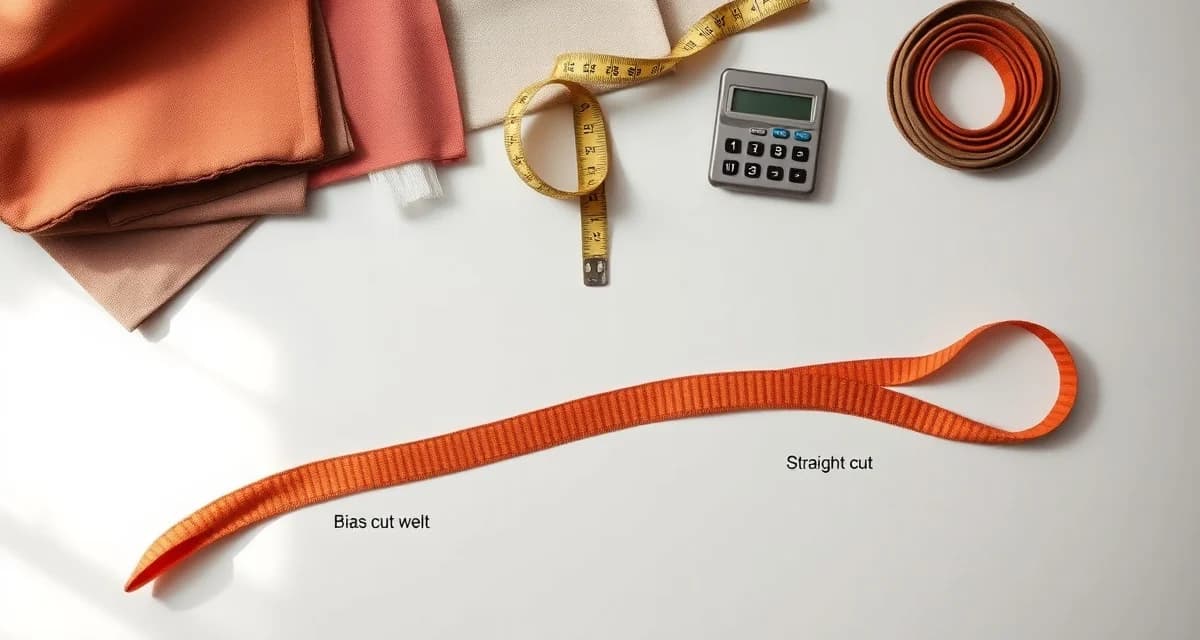
Welt and Cording Yardage Calculator for Upholstery: Cut on the Bias
Bias-cut welt on a sofa uses 0.5-0.75 yards more than straight-cut welt. That's almost never mentioned in yardage guides, welt is treated as a rounding error. But on a fully welted sofa with 25-30 linear feet of welt, the difference is real and it affects your order.
The welt cording yardage calculator handles what no competitor tool does: separate welt yardage calculation with a straight-cut vs bias-cut toggle that shows the exact yardage difference and optimal cutting strip layout.
TL;DR
- Accurate yardage calculation for welt cording jobs prevents costly fabric shortfalls and over-ordering that erode margin.
- Pattern repeats are the most common source of yardage errors; always calculate each cutting zone separately, not as a flat percentage.
- Nap-direction fabrics (velvet, chenille, mohair) require 15-25% more yardage than the same job in plain fabric.
- Fabric width significantly affects yardage: the difference between 54-inch and 60-inch fabric can be 1-2 yards on the same piece.
- Always add a 10-15% buffer on plain fabric and 15-20% on patterned fabric to account for cutting waste.
- Entering measurements accurately at the quoting stage eliminates the need to reorder mid-job.
Straight-Cut vs Bias-Cut Welt: Why Both Exist
Straight-cut welt (also called self-welt or straight welt) is cut parallel to the fabric grain, along the length of the bolt. The strips are efficient to cut, you're cutting with the grain, and there's minimal waste between strips.
Bias-cut welt is cut at a 45-degree angle to the grain. The diagonal cut allows the welt to bend smoothly around curves without puckering. On curved seams, scrolled arms, barrel chair backs, rounded corners, bias-cut welt is much better. It also looks cleaner on corners.
The downside of bias-cut: each strip is cut diagonally across the fabric, which means the strip ends are on the bias edge. Joining bias-cut strips requires diagonal seams that waste the triangular corners. The 45-degree cutting geometry also means you can't nest strips as efficiently on the bolt.
How Much More Fabric Does Bias-Cut Welt Use?
On a standard 54-inch wide fabric, straight-cut welt strips yield:
Straight cut: From 1 yard of fabric (36" × 54"), cutting strips 1.5 inches wide parallel to selvage: 36 strips × 54 inches = 1,944 linear inches = 162 linear feet of welt strips. Divide 54" width by 1.5" per strip = 36 strips per 36" of length... wait, let me redo this clearly.
From 1 yard (36" length × 54" width): cut strips across the 54" width at 1.5" wide = 36 strips of 1.5" × 54" = 36 × 54 = 1,944 linear inches = 162 linear feet.
Wait, 1 yard is 36" length. Cutting across the 54" width: each strip is 54" long = 4.5 feet. Cut strips parallel to selvage running 36" long: 36" ÷ 1.5" = 24 strips per yard × 54" = 24 × 54" = 1,296 inches = 108 linear feet of welt per yard of fabric.
Bias cut: The diagonal adds approximately 40% more length to each strip compared to straight-cut... in practice, the usable yardage from bias-cut strips is approximately 70-75% of straight-cut. So 1 yard of fabric yields approximately 75-80 linear feet of bias-cut welt vs 108 linear feet of straight-cut.
For 25 feet of welt needed: straight-cut needs 0.23 yards; bias-cut needs 0.31 yards. For 30 feet: straight-cut 0.28 yards; bias-cut 0.38 yards.
That's the 0.5-0.75 yard difference per sofa when you add up all the welt runs.
Welt Yardage by Piece
To calculate welt yardage, first calculate total linear feet of welt for the piece.
Welt measurement guide:
- Sofa: Welt typically runs on cushion edges, arm seams, back seams, and often the front border seam. Total welt on a fully welted sofa: 25-35 linear feet.
- Loveseat: 20-28 linear feet
- Chair: 12-18 linear feet
- Ottoman: 5-10 linear feet
- Dining chair: 3-6 linear feet (seat perimeter)
Converting linear feet to yardage:
Straight-cut welt from 54" fabric: 108 linear feet per yard → divide linear feet needed by 108 for yards required.
Bias-cut welt from 54" fabric: approximately 78 linear feet per yard → divide linear feet needed by 78 for yards required.
Quick reference:
| Piece | Total Welt | Straight-Cut Fabric | Bias-Cut Fabric |
|---|---|---|---|
| Sofa (full welt) | 30 feet | 0.28 yards | 0.38 yards |
| Loveseat | 24 feet | 0.22 yards | 0.31 yards |
| Chair | 15 feet | 0.14 yards | 0.19 yards |
| Ottoman | 8 feet | 0.07 yards | 0.10 yards |
These are small individual numbers but they add up per job and per week.
When to Use Bias vs Straight-Cut Welt
Use bias-cut welt when:
- The piece has curved seams (barrel chairs, rounded arms, round ottomans)
- The welt runs around tight corners
- The client or design requires a particularly clean, refined finish
- You're working with a fabric that has a tendency to pucker at seams
Use straight-cut welt when:
- All seams are straight (tight-back sofas with track arms, square ottomans)
- Fabric cost is a concern and every yard counts
- The fabric's grain pattern means diagonal cuts would look different
Contrasting Welt and Self-Welt
Self-welt uses the same fabric as the body of the piece. Contrasting welt uses a different fabric, typically a solid in a complementary color.
If you're using contrasting welt, the welt yardage doesn't come from the main fabric order. You need a separate order of the contrasting fabric. Calculate welt yardage separately and order it from its own fabric specification.
The fabric yardage calculator should handle welt as a separate material input if you're using contrasting welt. The upholstery yardage estimator free can give you a quick welt estimate for a phone call.
FAQ
How much fabric do I need for welt on a sofa?
A fully welted sofa needs approximately 30 linear feet of welt cording. For straight-cut welt from 54-inch fabric, that's about 0.28-0.3 yards. For bias-cut welt, approximately 0.38-0.4 yards. Add welt yardage to your overall sofa fabric order, most shops forget to count it separately and end up either cutting short or dipping into other panels to make welt strips.
What is the difference between straight-cut and bias-cut welt?
Straight-cut welt strips are cut parallel to the fabric selvage. They're more yardage-efficient but can pucker around curves. Bias-cut welt strips are cut at 45 degrees to the grain. They use approximately 35-40% more fabric than straight-cut but bend smoothly around curves and corners without puckering. Bias-cut is the better choice for any piece with curved seams; straight-cut is fine for pieces with only straight or gently curved seams.
How do I calculate welt yardage for chairs and sofas?
First, measure the total linear feet of welt the piece requires by tracing all welted seams (cushion edges, arm seams, back seams, front borders). For a chair, this is typically 12-18 feet; for a sofa, 25-35 feet. Then divide by 108 for straight-cut welt yardage, or by 78 for bias-cut welt yardage (both at 54-inch wide fabric). Round up to the nearest quarter yard and add to your main fabric order.
Should I add a buffer to calculated yardage?
Yes. A 10-15% buffer is standard on plain fabric to account for cutting waste and minor errors. On patterned fabric, use 15-20% above the pattern-adjusted calculation. For COM fabric that cannot be reordered if you run short, some upholsterers increase the buffer to 20-25%. The cost of a modest buffer is far lower than the cost of sourcing additional fabric after cutting has begun.
Sources
- National Upholstery Association
- Association of Master Upholsterers and Soft Furnishers (AMUSF)
- Upholstered Furniture Action Council (UFAC)
- Furniture Today (trade publication)
Get Started with StitchDesk
Getting yardage right on welt cording jobs is the difference between a profitable quote and an expensive reorder. StitchDesk's fabric calculator accounts for all the variables that cause errors: pattern repeat by zone, nap direction, fabric width, and cushion configuration. Start a free trial and see how accurate yardage calculation affects your bottom line.