Upholstery Shop Ergonomics: Preventing Back and Wrist Injuries
Back pain is the number one reason experienced upholsterers leave the trade. Proper table height prevents 60% of chronic back cases. That's not an exaggerated claim, it's the finding that emerges consistently from occupational health research on craft and trade workers who perform sustained bent-over work. The upholsterer who works at a table 4 inches too short and bends slightly at the waist for 8 hours per day develops cumulative back strain that eventually becomes a condition that limits or ends their career.
Prevention requires only one thing: setting up your workspace ergonomically from the start, or correcting it now if it's wrong.
TL;DR
- A well-managed upholstery shop tracks every job from intake to delivery with documented status at each stage.
- Fabric management, including ordering, receiving, storing, and allocating by job, is operationally the most complex part of running an upholstery shop.
- Client communication (status updates, completion photos, delivery scheduling) reduces inbound calls and increases repeat business.
- Shops that document their workflow can train new employees faster and maintain consistent quality during growth periods.
- Measuring key metrics (jobs per week, average ticket, fabric waste rate) is the foundation of informed business decisions.
- Professional shop management tools pay for themselves through reduced errors and faster quoting, typically within the first quarter.
The Three High-Risk Tasks
1. Cutting: Table Height and Body Mechanics
The cutting table is where most back strain accumulates. Standing at a too-low cutting table for hours of fabric marking and cutting requires sustained forward flexion of the spine, the same movement that's the primary cause of disc problems in manufacturing workers.
Correct cutting table height: Elbow height minus 4 inches, measured while standing in your work shoes. For most people, this is 33-37 inches. See the upholstery cutting table guide for the full height calculation and adjustment options.
Body mechanics at the cutting table:
- Stand close enough to the table that your forearms can rest on it while marking, don't reach forward
- Shift your weight between feet rather than standing statically on one side
- When cutting large pieces, walk around the table rather than reaching across it
- Take a 2-minute stand-and-stretch break every 45 minutes of sustained table work
2. Stapling: Hand and Wrist Repetitive Stress
Upholstery stapling is highly repetitive, particularly on large jobs with hundreds or thousands of staple placements. Repetitive stapling with incorrect grip or wrist position generates cumulative stress in the wrist, hand, and forearm that leads to carpal tunnel syndrome and tendinitis.
Equipment choice:
- Pneumatic staple gun preferred over electric for high-volume work. Pneumatic guns have lighter trigger mechanisms and less grip force required per staple.
- Electric staple gun acceptable for occasional use. Manual staple guns should be avoided for any sustained professional upholstery work, the mechanical disadvantage requires significant force per staple and is a direct injury mechanism.
Grip and positioning:
- Hold the staple gun in a power grip (full-hand grip, not pinch grip)
- Keep the wrist as neutral as possible, not flexed up or bent down
- Use arm motion to position the gun rather than wrist flexion
- Let the gun do the work; don't add pushing force, a properly set pneumatic gun fires on trigger pressure alone
Volume management:
- Take a hand-shaking and wrist-rotation break every 20-30 minutes of sustained stapling
- If you feel wrist or forearm fatigue building, stop and rest before it becomes pain
- Pain is a late warning signal, not an early one, fatigue is the appropriate trigger to stop
3. Frame Handling: Lifting Mechanics
Upholstered furniture is heavy. A sofa frame can weigh 80-120 lbs. Incorrect lifting mechanics while repositioning pieces is an acute back injury risk, the kind that happens suddenly rather than accumulating slowly.
Safe lifting for furniture:
- Never twist while lifting. Position yourself to lift and then move, rather than lifting and rotating simultaneously
- Keep the piece as close to your body as possible during any manual movement
- For pieces too heavy to move alone, ask for help or use a furniture dolly, there's no single-person technique that makes lifting a 120 lb frame safe
Working height for covering:
- Use a table, horses, or a turntable to work at a height that keeps the piece at or near waist level
- Working on pieces set on the floor requires sustained kneeling or squatting, appropriate for brief positioning but not for sustained covering work
- A portable upholstery table or furniture horses brings most pieces to a height that allows working without back flexion
Sustained Static Postures: The Underestimated Risk
In addition to specific task risks, sustained static posture is an upholstery occupational risk. Standing in one position, sitting in a fixed position for sewing, or maintaining a bent-forward position at the covering table all create static muscle loading that causes fatigue and, over time, contributes to musculoskeletal problems.
Prevention:
- Change your working position every 45 minutes at minimum, stand to sew occasionally if you typically sit, walk around the piece, shift your body position
- Use an anti-fatigue mat at any standing work station (cutting table, covering area), anti-fatigue mats reduce fatigue buildup by 20-30% compared to standing on concrete
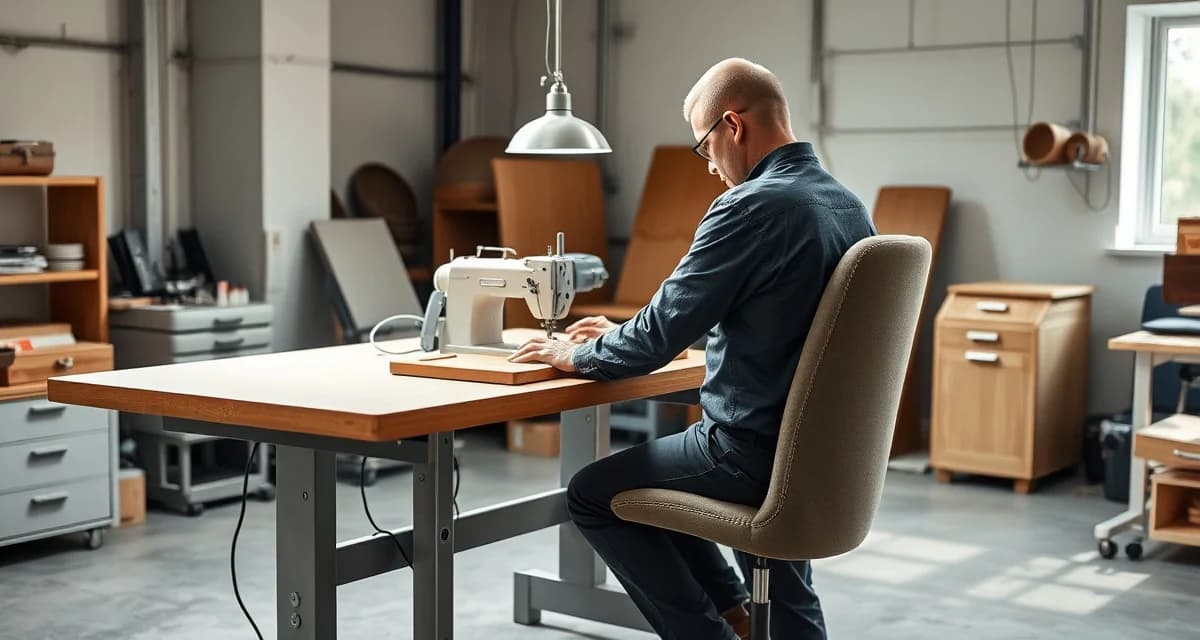
- For sewing work: ensure your chair height brings the sewing surface to forearm level when seated (see the upholstery workspace setup guide)
Return to Work After Injury
The most common professional mistake after a back or wrist injury: returning to full-volume work too quickly. Upholsterers who return to heavy work before full recovery re-injure at rates 2-3 times higher than those who gradually reintroduce work volume.
If you've experienced a significant injury, a week or two of reduced stapling volume, lighter pieces, and modified working positions is worth more than pushing through and extending the recovery period.
Equipment That Reduces Injury Risk
Anti-fatigue mat: $50-150. Placed at any standing work station, reduces cumulative fatigue and joint stress significantly over a full workday.
Pneumatic staple gun (vs electric or manual): $80-200. The reduced grip force required per staple directly reduces wrist/hand stress per unit of work.
Upholstery horses (furniture saw horses): $60-150 per pair. Brings pieces off the floor to a working height that eliminates the sustained bending-over posture required for floor-level work.
Good shop shoes with cushioning and arch support: $80-150. Standing 8 hours on concrete requires shoes with shock absorption. Fatigue from poor footwear accumulates into back and joint stress.
Related Articles
FAQ
How do I prevent back pain as an upholsterer?
Set your cutting table to your correct ergonomic height: elbow height minus 4 inches. Use furniture horses or an upholstery table to bring pieces to waist level during covering work rather than bending over pieces on the floor. Take 2-minute movement breaks every 45 minutes at any static work position. Use an anti-fatigue mat at standing work stations. Stand close enough to the cutting table that your forearms rest on it while working, reaching forward is what creates the sustained forward lean that generates back strain. These adjustments eliminate the primary mechanical cause of upholstery back pain.
What ergonomic equipment does an upholstery shop need?
The highest-priority ergonomic investments are: a cutting table at the correct height for your body (the single most important factor for back health), an anti-fatigue mat at standing work stations, a pneumatic staple gun (lower trigger force than electric or manual reduces hand and wrist stress), and furniture horses or an upholstery table to bring work to waist level. Good shop shoes with cushioning and arch support are worth the investment for anyone standing 6-8 hours per day on concrete. These items together represent $300-500 in equipment against years of injury prevention.
How do I avoid wrist injury from stapling?
Use a pneumatic staple gun with a properly adjusted pressure setting that fires reliably without requiring additional pushing force. Hold the gun in a full-hand grip rather than pinch grip. Keep your wrist as straight and neutral as possible, using arm movement to position the gun rather than wrist flexion. Take a hand-shake and wrist-rotation break every 20-30 minutes of sustained stapling. Stop when you feel fatigue, fatigue is the appropriate early warning, not pain. If you're experiencing consistent wrist pain or numbness, reduce stapling volume and see a healthcare provider before continuing at previous levels.
How do I track multiple jobs at different stages simultaneously?
A job tracking system, whether paper-based or software-based, should give you a clear view of every active job's current stage at a glance. The minimum useful stages are: intake received, fabric ordered, fabric received, work in progress, quality check, ready for pickup/delivery, completed. Software that shows all active jobs on a single dashboard with current stage and due date eliminates the mental overhead of tracking multiple jobs manually.
Sources
- National Upholstery Association
- Association of Master Upholsterers and Soft Furnishers (AMUSF)
- Upholstered Furniture Action Council (UFAC)
- Furniture Today (trade publication)
Get Started with StitchDesk
A well-run upholstery shop is built on consistent processes, accurate information, and clear client communication. StitchDesk gives you the tools to manage all three from intake to delivery, without the overhead of paper systems or generic software that does not understand the trade. Start a free trial and see how StitchDesk fits your workflow.