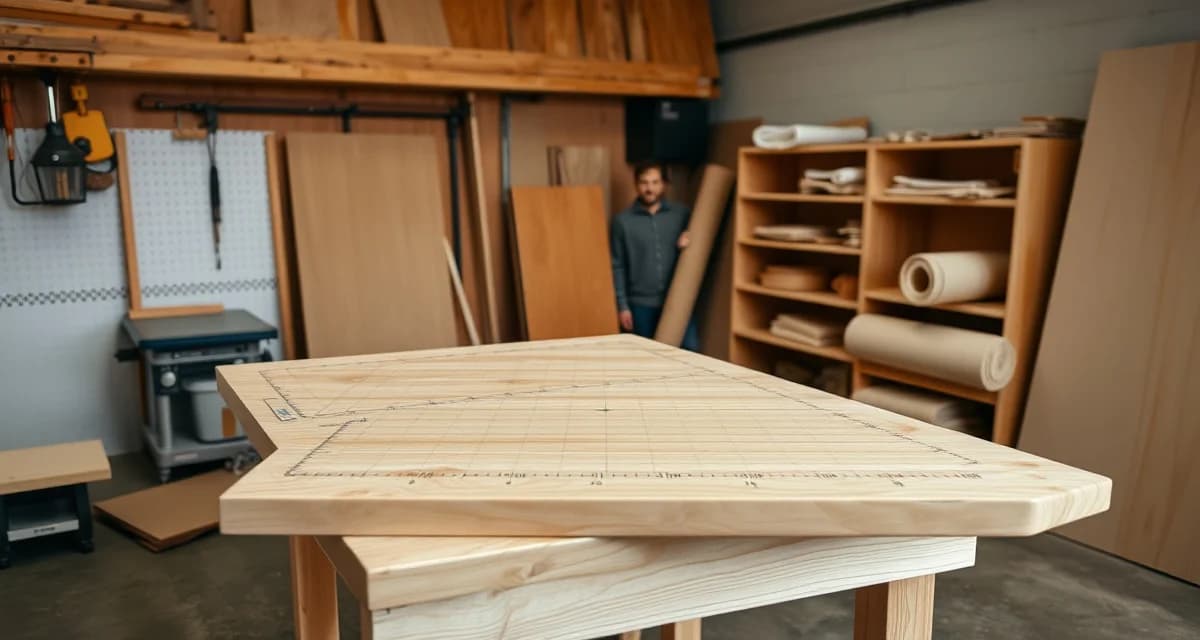
Upholstery Cutting Table: Height Width and Construction Guide
Working at a too-low cutting table causes back pain within 2 years. This is the most common occupational injury that upholsterers report, and it's almost entirely preventable through the single decision of cutting table height. The right height is specific to your body, not a standard number.
The cutting table is the piece of shop equipment you interact with most throughout the day. Getting it right, height, width, surface, and grid marking, improves both the quality of your cuts and your physical comfort through a long career.
TL;DR
- A well-managed upholstery shop tracks every job from intake to delivery with documented status at each stage.
- Fabric management, including ordering, receiving, storing, and allocating by job, is operationally the most complex part of running an upholstery shop.
- Client communication (status updates, completion photos, delivery scheduling) reduces inbound calls and increases repeat business.
- Shops that document their workflow can train new employees faster and maintain consistent quality during growth periods.
- Measuring key metrics (jobs per week, average ticket, fabric waste rate) is the foundation of informed business decisions.
- Professional shop management tools pay for themselves through reduced errors and faster quoting, typically within the first quarter.
Height: The Most Important Dimension
The formula for ideal cutting table height is: your elbow height minus 4 inches.
To measure your elbow height: stand in your work shoes on your shop floor with your arms hanging naturally at your sides. Measure from the floor to the crook of your elbow. Subtract 4 inches.
For most people, this is between 33 and 37 inches. Standard worktable height is 34-36 inches, which is close for many people but not precise enough to prevent the gradual strain that builds into chronic back problems.
Why 4 inches below elbow height? At this height, your forearms rest naturally on the table surface when you're pressing fabric and marking cuts, without hunching your shoulders or bending at the waist. The work comes to you rather than requiring you to lean down to it.
If you're shorter or taller than average, a standard table will require modifications. Options:
- Table too low: Add adjustable furniture feet or platform blocks under the legs to raise the table to your correct height
- Table too high: A custom-built table or adjustable-height workbench is the correct solution
Width: Working Reach and Fabric Width
Cutting table width should be 60-66 inches. Here's why:
Most upholstery fabric rolls are 54-60 inches wide. A table narrower than 54 inches means fabric overhangs the edge on at least one side, which makes it impossible to work with the fabric flat without having it hang and distort.
60-66 inches is the sweet spot: wide enough for standard 54-60 inch fabric to lie flat with 3-6 inches of table showing on each side, but narrow enough to reach across the center from either side without over-reaching.
A table wider than 66 inches means you can't reach the center from either edge, which forces you to walk around the table more frequently than necessary.
Length: Your Available Space
Length should be as long as your available space allows, with a minimum of 96 inches (8 feet). This length accommodates the longest single pieces you'll cut, the outside back of a large sofa, typically 7-8 feet unfolded, without needing to re-fold the fabric mid-cut.
If your space is limited, 84 inches (7 feet) is workable. Under 72 inches (6 feet) creates significant workflow friction with larger pieces.
Surface Material
The cutting table surface needs to provide three things: smoothness for fabric to slide, grip to keep fabric from shifting during marking, and durability against repeated rotary cutter use.
Best options:
Self-healing cutting mat (over a solid base): The gold standard for precision cutting. A large self-healing mat (60x36 inches or tiled to cover the full table) protects the table surface from rotary cutters, provides slight grip against fabric shifting, and can display a printed grid for square cuts. Replacement when the mat is worn to the point of visible tracking.
Plywood with a fabric top: 3/4-inch plywood covered with a tight-weave, low-stretch fabric (typically a canvas or similar) provides grip for fabric without the cost of a commercial cutting mat. The grid must be painted or taped on separately.
Commercial cutting table surface: Industrial upholstery shops often use a dense cork or compressed rubber surface designed for repeated cutting. Expensive but extremely durable.
What to avoid: Slick melamine or laminate surfaces, fabric slides too easily and doesn't stay square during marking. Soft wood surfaces, rotary cutters damage them and the surface damage leads to uneven cuts.
Grid Marking: The Efficiency Upgrade Most Shops Skip
A 1-inch grid marked on the cutting surface (either via cutting mat or painted onto a solid surface) makes square cuts significantly faster and more accurate.
Instead of measuring and marking every cut line on the fabric itself, you line up the fabric grain with the grid and cut along the grid lines. Right-angle cuts become immediate; no separate measuring step required.
For repetitive pieces (dining chair seats, all the same dimensions), a grid means you can set up and cut multiple pieces in sequence without re-measuring each one.
The grid should cover at minimum the central 36 inches of the table width. Marking a smaller area or corner only is less useful than a full-width grid.
Lighting Over the Cutting Table
The cutting table requires the best lighting in your shop. Fabric grain direction, nap direction on pile fabrics, and pattern alignment are all assessed at the cutting table, and all are significantly harder to evaluate under inadequate lighting.
Use daylight-balanced (5000K) overhead lighting directly above the cutting area. At least 50 foot-candles of illumination at the table surface is the minimum for accurate fabric inspection. Most fluorescent strip lighting provides 20-30 foot-candles, doubling the fixture density or upgrading to LED panels solves this.
See the upholstery workspace setup guide for how the cutting area fits into your full shop layout.
Related Articles
FAQ
What height should my upholstery cutting table be?
Your ideal cutting table height is your elbow height minus 4 inches. Stand upright in your work shoes on your shop floor and measure from the floor to the crook of your elbow. Subtract 4 inches, that's your target table height. For most people, this falls between 33 and 37 inches. Don't use a standard table height without checking it against this formula. Working at the wrong height for years is the most common cause of the chronic back problems that affect experienced upholsterers later in their careers.
How wide should an upholstery cutting table be?
60-66 inches. This width accommodates standard upholstery fabric (54-60 inches wide) lying flat with a few inches of table showing on each side, while remaining narrow enough to reach the center from either edge without over-reaching. A table under 54 inches is too narrow for standard fabric to lie flat. A table over 66 inches requires more walking around the table to access the full width. If your space allows only one dimension of the cutting table to be ideal, prioritize width over length.
What surface is best for an upholstery cutting table?
A large self-healing cutting mat over a solid base is the best choice: it protects the table surface from rotary cutter damage, provides slight grip that keeps fabric from shifting during marking, and can display a printed grid for square cuts. The mat requires occasional replacement as it wears. A plywood base with a painted or taped grid covered by a canvas-weave fabric is a practical lower-cost alternative. Avoid slick laminate or melamine surfaces, fabric slides and doesn't hold position accurately for marking.
How do I track multiple jobs at different stages simultaneously?
A job tracking system, whether paper-based or software-based, should give you a clear view of every active job's current stage at a glance. The minimum useful stages are: intake received, fabric ordered, fabric received, work in progress, quality check, ready for pickup/delivery, completed. Software that shows all active jobs on a single dashboard with current stage and due date eliminates the mental overhead of tracking multiple jobs manually.
Sources
- National Upholstery Association
- Association of Master Upholsterers and Soft Furnishers (AMUSF)
- Upholstered Furniture Action Council (UFAC)
- Furniture Today (trade publication)
Get Started with StitchDesk
A well-run upholstery shop is built on consistent processes, accurate information, and clear client communication. StitchDesk gives you the tools to manage all three from intake to delivery, without the overhead of paper systems or generic software that does not understand the trade. Start a free trial and see how StitchDesk fits your workflow.