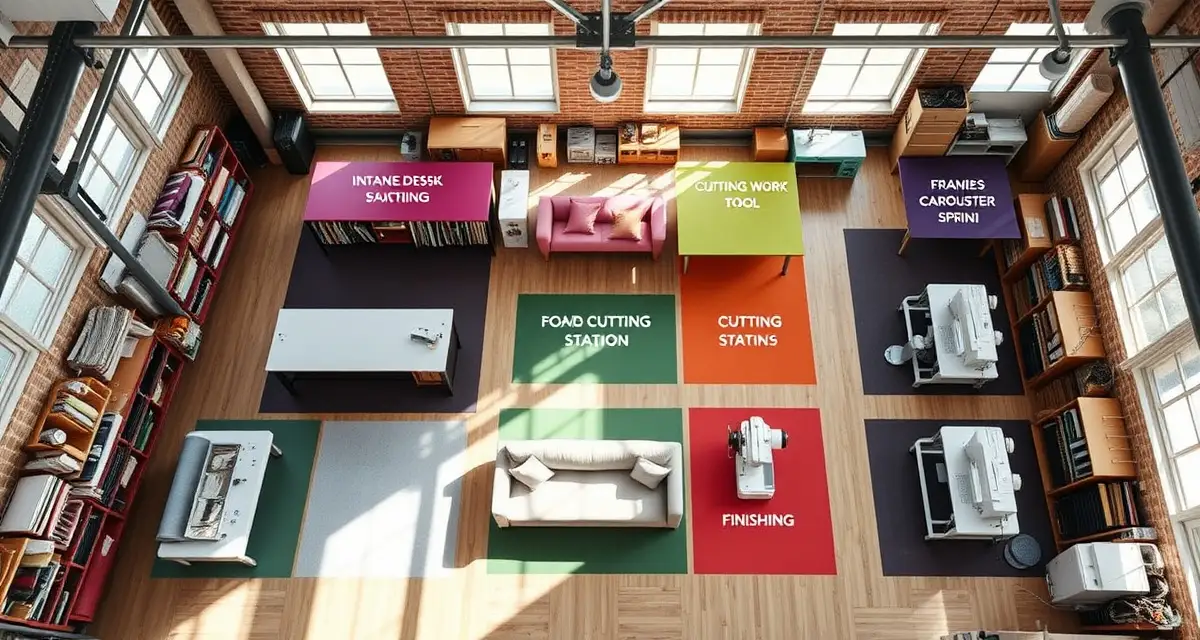
Upholstery Shop Workspace Setup: Layout for Productivity
Moving between zones 15 times per job is normal in a poorly organized shop. Zone layout cuts this to 7 moves. That reduction isn't about working differently, it's about not walking across the shop to get something you use every hour, because it's already where you need it.
Workspace setup is one of those decisions that shops make once (when they set up) and then live with for years. Making it intentional from the start, or reorganizing an existing shop based on how work actually flows, produces efficiency gains that compound daily.
TL;DR
- A well-managed upholstery shop tracks every job from intake to delivery with documented status at each stage.
- Fabric management, including ordering, receiving, storing, and allocating by job, is operationally the most complex part of running an upholstery shop.
- Client communication (status updates, completion photos, delivery scheduling) reduces inbound calls and increases repeat business.
- Shops that document their workflow can train new employees faster and maintain consistent quality during growth periods.
- Measuring key metrics (jobs per week, average ticket, fabric waste rate) is the foundation of informed business decisions.
- Professional shop management tools pay for themselves through reduced errors and faster quoting, typically within the first quarter.
The 7-Zone Layout Principle
Every upholstery shop workflow follows the same sequence: receive a piece, store and source fabric, cut fabric, prepare the frame, apply the covering, sew components, and stage for delivery. Seven zones, one direction.
The goal is to lay your shop out so that work moves consistently in one direction through these zones without backtracking. A piece that enters at one end of the shop and exits at the other (through the workflow) is in a well-organized space.
Zone 1: Intake and Client Area
Location: Near the entry, but separated from production by at least a visual boundary.
What belongs here: Space to set down incoming pieces, your intake form station (tablet or paper), and ideally a small area where clients can sit while you assess their piece.
What doesn't belong here: Active production pieces, fabric rolls, or tools. The intake area should be clean enough that it reads as professional when a client arrives.
Size: Enough floor space for the largest piece you typically receive, plus 3 feet of clear walking space around it.
Zone 2: Fabric Storage
Location: Adjacent to the cutting area (Zone 3). These two zones work together constantly, fabric should be at arm's reach from the cutting table.
What belongs here: Fabric rolls organized by category, your sample books, your fabric order records, and a basic inventory list.
Organization principle: Fabric you use most should be most accessible. Specialty rolls or rarely used inventory goes to back rows or upper shelves.
Critical detail: Fabric rolls stored on end (standing upright) in a bin or rack are easier to identify and retrieve than rolls stacked horizontally. You can see each roll's face without unrolling it.
Zone 3: Cutting Area
Location: Central in your shop, with clear floor space on at least three sides of the cutting table. Fabric storage (Zone 2) on one side, production area (Zone 4) on the other.
What belongs here: Cutting table at the correct height (see upholstery cutting table guide for height calculation), shears, rotary cutter and mat, chalk/markers, yardage calculator, and your cutting measurement template collection.
Table surface: A cutting table with a grid-marked surface (1-inch grid in at least one section) makes square cuts faster and more accurate. This is one of the most practical shop setup details many shops skip.
Lighting: This zone specifically needs excellent lighting. See the upholstery shop tools guide for daylight-balanced lighting recommendations, nap direction and fabric defects that are invisible under fluorescent are clear under 5000K daylight bulbs.
Zone 4: Frame and Foam Work Area
Location: Adjacent to the cutting area, with durable floor covering (foam dust and debris are inevitable).
What belongs here: Work table or horses for turning frames, your tack puller and hammer for tear-down, foam storage, foam cutting equipment, adhesive sprays, and a trash bin large enough for old fabric and foam.
Floor consideration: This zone gets the most mess. A commercial floor mat or easy-to-clean sealed concrete floor is practical. Foam dust and fabric debris are constant.
Ventilation: Foam cutting and spray adhesives both produce airborne particles and fumes. This zone needs the best ventilation in your shop. See the upholstery shop dust management guide for specifics.
Zone 5: Covering Area
Location: Central in the production flow. This is where most of your time is spent, so it should have the most intentional setup.
What belongs here: Covering table or horses at the correct height, your staple gun with a hanging cord to keep it off the floor but within immediate reach, hand tools (tack hammer, chisels, regulators), welt cord, tack strips, and your commonly used hardware (buttons, zippers by common size).
The staple gun hanging point: Mount a simple cord or spring mount above the covering area so the staple gun hangs at working height when not in use and swings away cleanly when you need both hands. This detail alone saves 10-15 movements per job.
Zone 6: Sewing Area
Location: Adjacent to the covering area, but visually separated. The sewing machine generates noise and requires focused attention, too much foot traffic around the sewing area increases errors.
What belongs here: Sewing machine(s), presser foot collection organized by foot type, thread organized by color family, needles (organized by type and size), and seam ripper. A small ruler and measuring tape at the machine saves walks back to the cutting table.
Chair height: The sewing chair height relative to the machine table determines whether you can see the work clearly and whether you're working ergonomically. Adjust to eye level at the needle, with elbows at approximately table height.
Zone 7: Staging and Delivery Area
Location: Near the exit, but separated from the intake area (Zone 1). Finished pieces should not be mixed with incoming pieces, this causes tracking confusion and occasionally the wrong piece going back to the wrong client.
What belongs here: Space for completed pieces wrapped or covered for protection, your client pickup records or notification system, and any client care cards or deliverables that go with the job.
Labeling: Every staged piece should be labeled with the client name and job number. Even in a small shop, mix-ups happen when staging isn't labeled.
How Much Space Do You Actually Need?
A solo upholsterer doing 15-20 jobs per month can run a complete 7-zone layout in 600-800 square feet. The zone sizes flex to your footprint, the priorities are the layout sequence and the adjacencies (fabric storage next to cutting, cutting next to frame work, etc.).
See the upholstery shop productivity guide for how workspace layout connects to measurable productivity gains.
FAQ
How do I set up my upholstery shop?
Organize the space into seven workflow zones in sequence: intake area, fabric storage, cutting area, frame and foam work area, covering area, sewing area, and staging/delivery area. The workflow should move consistently in one direction through these zones without requiring you to backtrack. Position zones that work together (fabric storage and cutting, covering and sewing) adjacent to each other. Ensure the cutting area has proper lighting and the covering area has a hanging mount for the staple gun. The specific dimensions of each zone depend on your shop size, but the sequence and adjacencies are the same regardless of scale.
What is the ideal upholstery shop layout?
The ideal layout positions the seven zones in a linear sequence from intake to staging. Fabric storage sits adjacent to the cutting table so fabric moves directly from storage to cutting without crossing the shop. The cutting area transitions to the frame/foam work area, then to the covering area. Sewing sits adjacent to covering since components (welt, zipper panels) move between the two. Staging is near the exit. The critical requirement is that work flows in one direction, pieces don't cross zones they've already passed through, and tools don't require you to leave your current zone to retrieve them for the current task.
How big should my upholstery shop be?
A solo upholsterer doing 15-20 jobs per month needs a minimum of 600-800 square feet to run all seven zones without significant compromise. At 20-30 jobs per month with a shop assistant, 1,000-1,200 square feet allows two people to work simultaneously without interfering with each other's zones. For two skilled upholsterers at 40+ jobs per month, 1,500-2,000 square feet allows independent production workflows with shared fabric storage and cutting areas. The minimum square footage is less important than how the space is used, a well-organized 600 sq ft shop outproduces a disorganized 1,200 sq ft shop.
How do I track multiple jobs at different stages simultaneously?
A job tracking system, whether paper-based or software-based, should give you a clear view of every active job's current stage at a glance. The minimum useful stages are: intake received, fabric ordered, fabric received, work in progress, quality check, ready for pickup/delivery, completed. Software that shows all active jobs on a single dashboard with current stage and due date eliminates the mental overhead of tracking multiple jobs manually.
Sources
- National Upholstery Association
- Association of Master Upholsterers and Soft Furnishers (AMUSF)
- Upholstered Furniture Action Council (UFAC)
- Furniture Today (trade publication)
Get Started with StitchDesk
A well-run upholstery shop is built on consistent processes, accurate information, and clear client communication. StitchDesk gives you the tools to manage all three from intake to delivery, without the overhead of paper systems or generic software that does not understand the trade. Start a free trial and see how StitchDesk fits your workflow.