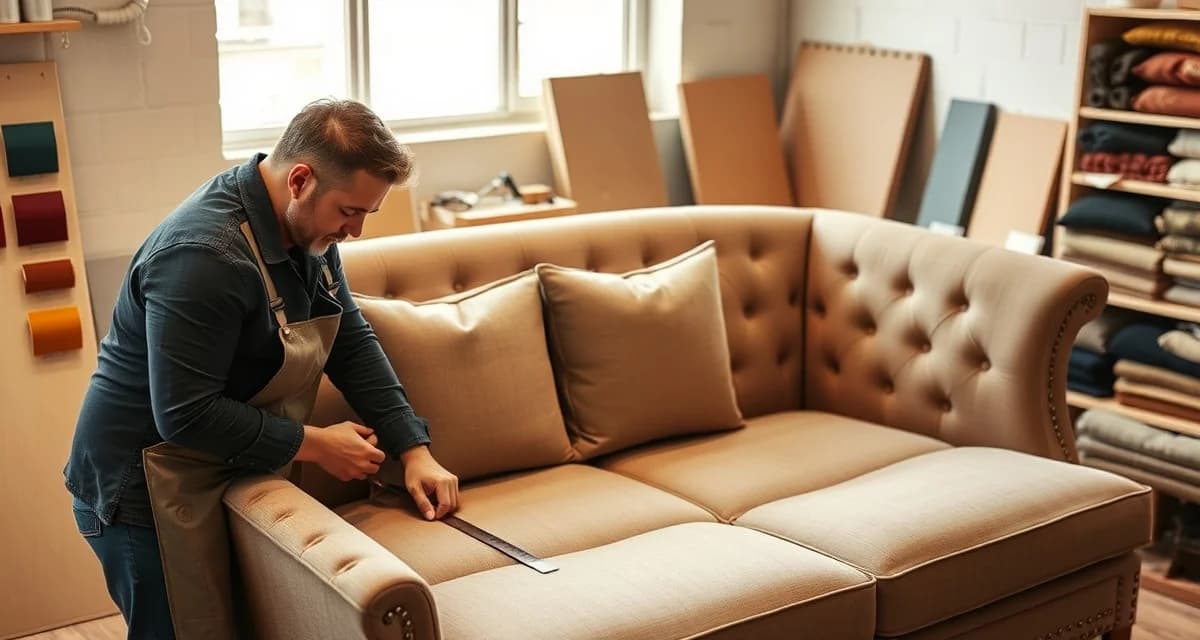
4-Cushion Sofa Fabric Yardage Calculator
A 4-cushion sofa is a longer piece, and it costs more to reupholster than a 3-cushion sofa of any comparable style. That should be obvious. What catches shops off guard is how much more fabric the fourth cushion actually adds, and why a simple "add one cushion worth of fabric" calculation underestimates the real number.
If you're quoting a 4-cushion sofa, here's what you need to know before you order.
TL;DR
- 4 Cushion Sofa yardage depends on fabric width, construction details, pattern repeat, and nap direction.
- Plain 54-inch fabric requires a baseline calculation plus 10-15% waste allowance for a standard 4 cushion sofa job.
- Patterned fabric adds 20-35% to base yardage depending on repeat size and the number of cutting zones that must align.
- Directional fabrics add 15-25% over plain fabric because layout optimization is restricted by nap direction.
- Always verify fabric width before finalizing yardage; COM fabric often comes in non-standard widths.
- Calculating yardage at the quote stage, not mid-job, eliminates reorders and protects your profit margin.
Why You Can't Just Add One Cushion
The intuitive approach is to calculate a 3-cushion sofa and add the fabric for one more cushion. The problem is this ignores the cascading effect on other panels.
A 4-cushion sofa is typically 96 to 108 inches wide. That extra width doesn't just affect the seat cushions. It also affects the inside back, outside back, front border, and deck, all of which span the full width of the sofa. Those panels scale with sofa length, and on a 4-cushion sofa, they're 15 to 20% larger than on a 90-inch 3-cushion piece.
Add the fourth seat cushion, the fourth back cushion (if pillow-back), and the longer back and border panels, and you're looking at 15 to 20% more fabric than a 3-cushion sofa of the same style. That's typically 2 to 3 additional yards, not just the 1 to 1.5 yards most shops budget for an extra cushion.
Yardage Ranges for 4-Cushion Sofas
These figures are for solid 54-inch fabric.
4-cushion tight-back, box seat (96-108 inches): 15 to 18 yards
4-cushion tight-back, T-seat: 16 to 19 yards
4-cushion pillow-back, box seat: 19 to 23 yards
4-cushion pillow-back, T-seat: 20 to 24 yards
At 60-inch fabric, subtract 1.5 to 2.5 yards depending on configuration. The wider fabric makes the most difference on the large back panels where it can eliminate seaming.
The Width Effect: 100-Inch Sofas and Fabric Layout
At 100 to 108 inches, the inside back panel of a 4-cushion sofa is one of the largest single panels you'll cut in residential work. On 54-inch fabric, a 100-inch inside back panel is almost 3 yards of fabric wide, meaning you need to seam it unless you're working with a very narrow sofa depth.
Most shops seam the inside back at a point that falls behind a back cushion, so the seam is hidden. But that seam doesn't disappear from your yardage calculation. You're still cutting two separate panels and placing them side by side, which means you lose at least a seam allowance on each edge.
At 60-inch fabric, some 4-cushion sofas can squeeze an inside back into one width pass if the sofa is on the narrower end of the range. At 118-inch fabric, you get a clean one-pass cut regardless, though you'll pay more per yard for the wider goods.
Panel Breakdown: 4-Cushion Sofa
Structure panels:
- Inside back (full width, may require seaming on narrow fabric)
- Outside back (full width)
- Front border/apron
- Seat deck
Arms (x2):
- Inside arm
- Outside arm
- Arm front
Seat cushions (x4):
- Top face (x4)
- Bottom face (x4)
- Front boxing (x4)
- Side boxing (x8)
- Zipper panel or back boxing (x4)
Back cushions (x4, pillow-back only):
- Front face (x4)
- Back face (x4)
- Boxing strip (x4)
- Zipper panel (x4)
Welt/cording as applicable
With 4 back cushions on a pillow-back style, your back cushion panel count alone is 16 individual pieces. At roughly 0.75 to 1 yard of fabric per back cushion all-in, that's 3 to 4 yards just for the back cushions.
Welt Scaling on a 4-Cushion Sofa
Welt yardage scales with the number of cushions and the width of each panel. On a fully-welted 4-cushion sofa, total welt footage can reach 40 to 50 linear feet.
For 54-inch fabric, a rough calculation: 45 linear feet of welt = 540 inches ÷ 52 usable inches = 10.4 strips × 1.5 inch width = 15.6 inches ÷ 36 = 0.43 yards. Call it half a yard for a fully-welted 4-cushion sofa.
If you're doing double welt, double that estimate. If you're cutting bias welt, factor in additional waste for the diagonal cut.
Pattern Repeat on a Long Sofa
Pattern repeat waste compounds on a longer sofa because you have more panels that require alignment. On a 4-cushion sofa with a 9-inch pattern, you'll be aligning 4 seat cushion faces, 4 back cushion faces (if pillow-back), the inside back, and the front border. That's 9 to 10 major alignment points.
If each alignment point wastes an average of 4.5 inches (half the repeat), that's 45 inches of pattern waste = 1.25 yards. And that's assuming your layout is clean. In practice, pattern waste on a 4-cushion pillow-back sofa with a large repeat can add 2 to 3 yards to your total.
Common Underestimates on 4-Cushion Sofas
Treating it as "a 3-cushion sofa plus one cushion." The additional cushion adds to the total, but the extended back and border panels add just as much. Calculate each element independently.
Forgetting that the arms don't change with cushion count. The arm panels are the same size on a 4-cushion as on a 3-cushion sofa of the same style. Cushion count doesn't affect arm yardage.
Not accounting for inside back seaming. If your inside back needs to be seamed, plan the seam placement before you order. The wrong placement can force you into an additional cut.
Pattern matching at the seam. If the inside back is seamed and you're working with a pattern, both halves of the seam need to be at the same point in the repeat. That adds repeat waste at the seam point in addition to all the other alignment waste.
Using the Sofa Fabric Yardage Calculator
The sofa calculator has a 4-cushion mode that accounts for extended back panels and adds welt yardage scaled to the longer piece. You can compare yardage at different fabric widths to decide whether 60-inch fabric saves enough to justify the cost premium.
For a complete comparison of sofa styles and their yardage implications, see the Sofa Reupholstery Yardage Guide.
How many yards for a 4-cushion sofa?
A 4-cushion sofa in solid 54-inch fabric needs 15 to 24 yards depending on back style, cushion type, and sofa width. Tight-back configurations start around 15 yards. Pillow-back T-seat configurations can reach 24 yards.
How does cushion count affect sofa yardage?
Adding a fourth cushion affects yardage in two ways: the cushion panels themselves (top, bottom, boxing), and the longer back and border panels that span the full sofa width. The back panel scaling is often as substantial as the cushion yardage itself.
What is the typical length of a 4-cushion sofa?
Most 4-cushion sofas measure 96 to 108 inches wide. Some run to 112 inches. If a sofa is under 90 inches, it typically has 3 cushions, not 4, though there are exceptions in custom and vintage pieces.
What is the biggest factor in yardage variation for this piece?
Pattern repeat is the biggest source of yardage variation. On plain fabric, the baseline calculation plus a 10-15% waste buffer is usually sufficient. Add a 13-inch pattern repeat and you may need 15-20% more. Add a 27-inch pattern repeat and the additional yardage can be 25-35% over the plain fabric calculation. Nap direction is the second-largest factor, typically adding 15-25% over plain fabric because layout optimization is restricted.
FAQ
Sources
- National Upholstery Association
- Association of Master Upholsterers and Soft Furnishers (AMUSF)
- Upholstered Furniture Action Council (UFAC)
- Furniture Today (trade publication)
Get Started with StitchDesk
Getting yardage right on yardage 4 cushion sofa jobs is the difference between a profitable quote and an expensive reorder. StitchDesk's fabric calculator accounts for all the variables that cause errors: pattern repeat by zone, nap direction, fabric width, and cushion configuration. Start a free trial and see how accurate yardage calculation affects your bottom line.