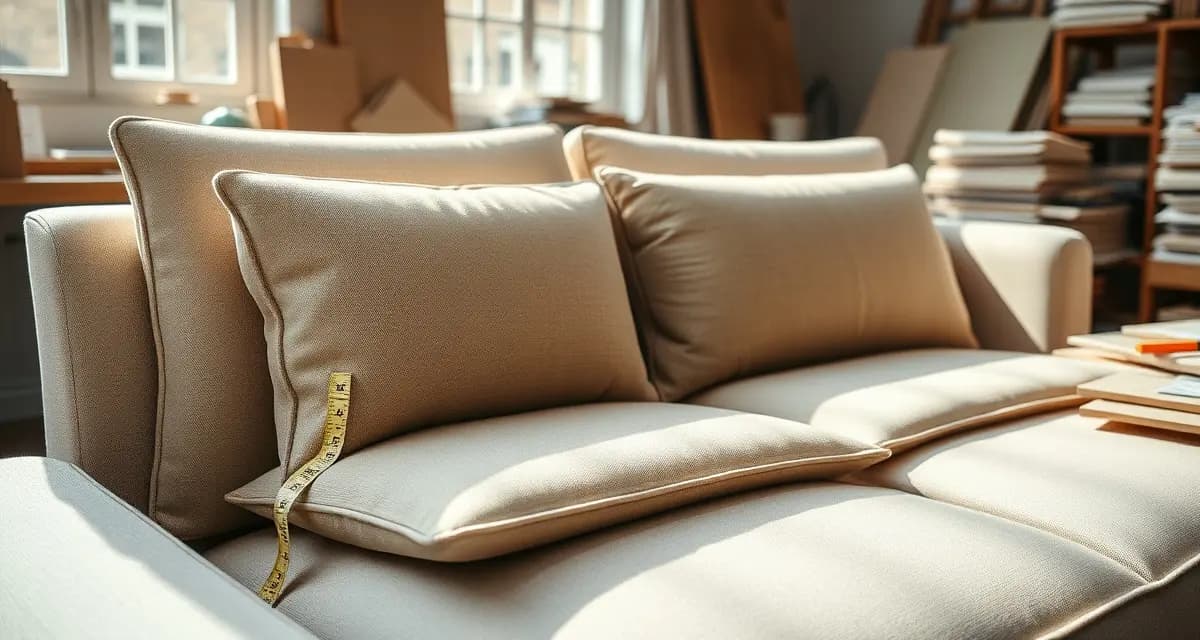
3-Cushion Sofa Fabric Yardage Calculator: T-Seat and Box Seat
The 3-cushion sofa is the most common residential upholstery job in any shop. If you've been in the trade more than a few months, you've quoted dozens of them. And yet it's also one of the most frequently miscalculated pieces, because shops lump all 3-cushion sofas together when the T-seat and box seat configurations have meaningfully different yardage requirements.
Getting this calculation right isn't just about accuracy on one job. It's about having a reliable baseline you can apply quickly when a customer is on the phone asking how much their sofa is going to cost.
TL;DR
- 3 Cushion Sofa yardage depends on fabric width, construction details, pattern repeat, and nap direction.
- Plain 54-inch fabric requires a baseline calculation plus 10-15% waste allowance for a standard 3 cushion sofa job.
- Patterned fabric adds 20-35% to base yardage depending on repeat size and the number of cutting zones that must align.
- Directional fabrics add 15-25% over plain fabric because layout optimization is restricted by nap direction.
- Always verify fabric width before finalizing yardage; COM fabric often comes in non-standard widths.
- Calculating yardage at the quote stage, not mid-job, eliminates reorders and protects your profit margin.
Why the 3-Cushion Sofa Is the Industry Standard Calculation
Most sofas are 3-cushion. It's the dominant configuration for sofas between 80 and 96 inches wide, which covers the majority of residential pieces. When upholstery professionals talk about "standard sofa yardage," they're almost always referring to a 3-cushion piece.
Understanding 3-cushion sofa yardage gives you a reference point for every other sofa configuration. A 2-cushion sofa uses less. A 4-cushion sofa uses more. But the 3-cushion estimate is where most of your work lands, so it deserves a precise calculation rather than a rough estimate.
T-Seat vs Box Seat: What Changes in the Yardage
The difference between a T-seat and a box seat cushion is the shape of the front edge.
A box seat cushion is rectangular. Its cut panels are predictable: top face, bottom face, boxing strip (front, two sides, back), and zipper panel. Everything is a rectangle. Panels nest efficiently on most fabric widths.
A T-seat cushion has a tab on each side of the front that wraps around the arm front. Those tabs create an irregular shape. When you cut a T-seat cushion face, you're cutting a large rectangular piece and leaving two corner cutouts. That waste can't be recovered unless you have small panels that fit in the leftover space.
On a 3-cushion sofa, the difference in seat cushion yardage between box and T-seat configurations is typically 0.75 to 1.5 yards. On a full sofa job, that's a meaningful number. Budget the right amount from the start.
Yardage by Configuration: 3-Cushion Sofa
These ranges assume 54-inch solid fabric with standard seam allowances and 3-inch tuck-in allowances. Pattern repeat or pile direction will increase these numbers.
| Configuration | Yardage Range |
|---|---|
| 3-cushion tight-back, box seat | 13-15 yards |
| 3-cushion tight-back, T-seat | 14-16 yards |
| 3-cushion pillow-back, box seat | 16-19 yards |
| 3-cushion pillow-back, T-seat | 17-20 yards |
If you're using 60-inch fabric, subtract roughly 1 to 1.5 yards from the tight-back estimates and 1.5 to 2 yards from the pillow-back estimates.
Panel-by-Panel Breakdown: 3-Cushion Sofa
Here's every panel you need to account for. Going through this list is the only way to catch the panels that consistently get missed.
Seat cushions (x3):
- Top face (x3)
- Bottom face (x3)
- Boxing strip front (x3)
- Boxing strip sides (x6)
- Boxing strip back or zipper panel (x3)
Back:
- Inside back
- Outside back
Arms:
- Inside arm (x2)
- Outside arm (x2)
- Arm front/arm top (x2): don't skip these
Base and borders:
- Front border or apron
- Deck (under the seat cushions, often cut in decking fabric)
Back cushions if pillow-back:
- Face (x3)
- Back (x3)
- Boxing strip (x3)
- Zipper panel (x3)
Welt/cording: Measure the total linear footage of seam lines that will be welted and divide by usable fabric width to get yardage for welt strips.
How to Measure for a 3-Cushion Sofa
You need actual measurements, not estimates. The calculation is only as good as your input numbers.
Inside back: Height from deck to top rail, plus 4 inches for top tuck-in. Width from inner edge of one arm to inner edge of the other.
Outside back: Same width. Height from floor or bottom rail to top rail (no tuck-in needed here).
Inside arm: Height from top of arm rail to deck, plus 3 inches tuck-in at bottom. Depth from arm front to the back rail.
Outside arm: Same width as inside arm. Height from top of arm to floor or bottom rail.
Seat cushion face (box seat): Width of cushion plus 1 inch each side for seam allowance. Depth of cushion plus 1 inch at front and back.
Seat cushion face (T-seat): Width including tabs, depth including tab depth. Account for the tab cutout waste in your layout.
Boxing strip: Total perimeter of cushion minus zipper panel location, by boxing height plus seam allowance top and bottom.
Adding Pattern Repeat Yardage
Pattern repeat is where 3-cushion sofa yardage gets expensive fast. Every panel that's visible on the front of the sofa needs to start at the same point in the repeat so the pattern aligns. That includes the seat cushion faces, the inside back, and the front border.
For a sofa with a 9-inch repeat, you'll waste up to 8.99 inches at the start of each new panel that doesn't land at a repeat boundary. On a sofa with 8 to 10 major panels requiring pattern alignment, that waste adds up.
A simple way to estimate pattern repeat waste: take your total panel count that requires alignment and multiply by the repeat size, then divide by 36 to get yards. Add that to your base yardage calculation.
For a 3-cushion sofa with 10 aligned panels and a 9-inch repeat: 10 x 9 = 90 inches = 2.5 yards of additional pattern waste. That's a real add.
Welt Yardage for a 3-Cushion Sofa
Welt adds more yardage than most shops budget for. On a fully-welted 3-cushion sofa, the total linear footage of welted seams can reach 30 to 40 feet.
For standard single welt cut from the same fabric, you need strips approximately 1.5 inches wide (for 0.5-inch cording). To calculate yards: measure total welt length in inches, divide by usable fabric width in inches, and multiply by 1.5 inches. Then divide the total inches by 36 for yards.
For a 3-cushion sofa with 36 feet of welt in 54-inch fabric: 432 inches ÷ 52 usable inches = 8.3 strips × 1.5 inches wide = 12.5 inches ÷ 36 = 0.35 yards. Roughly a third of a yard just for welt on a relatively standard job.
Double welt takes twice that. Budget accordingly.
Using the Sofa Fabric Yardage Calculator
If you'd rather not work through the panel calculation manually for every job, the sofa calculator handles it. Select 3-cushion, choose your back style and cushion type, enter your measurements, and it lays out the panels and sums the yardage. You can also toggle between 54-inch and 60-inch fabric to see how width affects your total.
For the full yardage guide covering all sofa styles, the Sofa Reupholstery Yardage Guide walks through how different construction details affect the baseline calculation.
How many yards for a 3-cushion sofa?
A 3-cushion sofa in solid 54-inch fabric typically needs 13 to 19 yards depending on the back style and cushion type. Tight-back box-seat configurations start around 13 yards. Pillow-back T-seat configurations can reach 20 yards. Know your configuration before you estimate.
Does a 3-cushion sofa take more fabric than a 2-cushion?
Yes, usually by 2 to 4 yards. The difference comes from the additional seat cushion and, on pillow-back styles, the additional back cushion. Individual panel sizes on a 3-cushion sofa are slightly smaller than on a 2-cushion, but the total piece count adds up.
What is the standard width of a 3-cushion sofa?
Most 3-cushion sofas measure between 80 and 96 inches wide. The most common size is around 84 to 90 inches. Wider pieces in the 96 to 108-inch range sometimes have 4 cushions instead of 3, so verify cushion count before you estimate yardage.
What is the biggest factor in yardage variation for this piece?
Pattern repeat is the biggest source of yardage variation. On plain fabric, the baseline calculation plus a 10-15% waste buffer is usually sufficient. Add a 13-inch pattern repeat and you may need 15-20% more. Add a 27-inch pattern repeat and the additional yardage can be 25-35% over the plain fabric calculation. Nap direction is the second-largest factor, typically adding 15-25% over plain fabric because layout optimization is restricted.
What should I do if I run short on fabric mid-job?
Stop cutting immediately when you realize you may run short. Calculate exactly how much additional fabric you need before contacting the supplier or client. If reordering from the same dye lot is possible, do so as quickly as possible because dye lots change. If a dye lot match is not available, contact the client before proceeding; visible dye lot differences on the same piece are unacceptable and must be disclosed. Document the situation and response in writing.
FAQ
Sources
- National Upholstery Association
- Association of Master Upholsterers and Soft Furnishers (AMUSF)
- Upholstered Furniture Action Council (UFAC)
- Furniture Today (trade publication)
Get Started with StitchDesk
Getting yardage right on yardage 3 cushion sofa jobs is the difference between a profitable quote and an expensive reorder. StitchDesk's fabric calculator accounts for all the variables that cause errors: pattern repeat by zone, nap direction, fabric width, and cushion configuration. Start a free trial and see how accurate yardage calculation affects your bottom line.