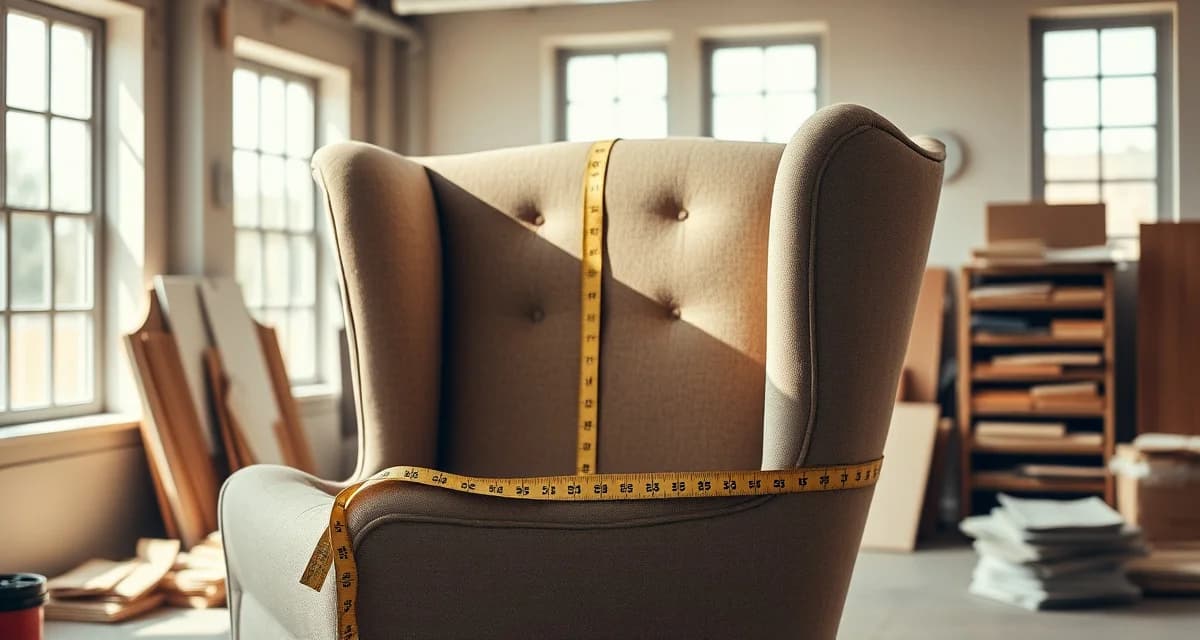
Fabric Yardage Calculator for Wing Chairs: Get the Wings Right
A wing chair uses 6–9 yards of fabric, and roughly 1–2 of those yards go to the wings alone. Shops that calculate a wing chair the same way as a similarly sized club chair are consistently under-ordering, because the wings have shaped panels that don't exist in any other chair style.
Wings are upholstered on both sides, inside wing and outside wing. Both are shaped, meaning they're not simple rectangles. The inside wing typically has a curved or angled profile that follows the shape of the wing frame. The outside wing mirrors it. When you cut those pieces from a rectangular bolt, you lose the corners at every shaped edge. That's waste that a flat-panel calculation completely misses.
TL;DR
- Accurate yardage calculation for wing chair jobs prevents costly fabric shortfalls and over-ordering that erode margin.
- Pattern repeats are the most common source of yardage errors; always calculate each cutting zone separately, not as a flat percentage.
- Nap-direction fabrics (velvet, chenille, mohair) require 15-25% more yardage than the same job in plain fabric.
- Fabric width significantly affects yardage: the difference between 54-inch and 60-inch fabric can be 1-2 yards on the same piece.
- Always add a 10-15% buffer on plain fabric and 15-20% on patterned fabric to account for cutting waste.
- Entering measurements accurately at the quoting stage eliminates the need to reorder mid-job.
Why Wings Change Everything
A typical club chair has these cutting zones: inside back, outside back, inside arm (left and right), outside arm (left and right), seat cushion (front and back if loose), front border, deck. Call it 10–12 pieces depending on cushion style.
A wing chair has all of those plus: inside wing (left and right), outside wing (left and right), sometimes a front wing edge panel if the wing extends forward enough. That's 4–6 additional cutting zones, and all of them involve shaped pieces.
On a standard wing chair with a 9-inch tall wing that extends 5 inches from the back panel:
- Inside wing panel: roughly 14 x 24 inches shaped
- Outside wing panel: roughly 12 x 22 inches shaped
- Each has a curved or angled top edge
Cut from a rectangular bolt, the inside wing panel wastes about 30–40% of the bounding rectangle at its edges. The outside wing is similar. Two wings, left and right, four panel cuts: the wings alone can account for 1–1.5 yards of waste beyond what four rectangular panels would use.
Wing Chair Styles and Their Differences
Traditional wing chair: Full wings that extend significantly from the back, often with a pronounced curve at the top. The most yardage-intensive wing configuration. 7–9 yards.
Modern wing chair / small wing: Less pronounced wings that serve more as design detail than functional headrest. 5.5–7 yards. Smaller shaped panels mean less waste.
High-back wing chair: The back extends taller than usual, sometimes to 48–52 inches. The inside back panel needs extra length, which may require seaming if your fabric width is 54 inches and the panel dimension exceeds that. 7–9 yards.
Skirted wing chair: Add 1–1.5 yards for a full skirt dropping to the floor. Skirts are wide-panel cuts that are relatively material-efficient but add real yardage.
Wing chair with loose seat cushion: Same total yardage but the seat panel is now cut front and back separately rather than as a single tight seat. Adjust upward by 0.5–0.75 yards.
Pattern Repeat on Wing Chairs
A wing chair with a large pattern repeat is one of the most material-intensive pieces in residential upholstery. The wings demand that the pattern be centered or placed intentionally on the shaped panels, which means you're carrying a repeat offset for 4–6 additional zones over a club chair.
On a 27-inch repeat, a wing chair can need 10–12 yards, 3–4 yards over the plain fabric calculation. That's a significant jump. Clients who select a large-scale fabric for a wing chair because "it's just a chair" are often surprised by the yardage requirement. The calculator output breaks down exactly where the pattern waste is occurring, which makes the explanation straightforward.
Centering the pattern on wings: The inside wing face is usually visible from the front of the chair. The motif placement matters. If you're centering a large medallion on the inside back, you also need the wing panels to look intentional. That's a cutting plan decision you make before you order fabric, not after.
Calculating Wing Chair Yardage
- Select "Wing Chair" from the furniture type dropdown.
- Enter overall chair width (at widest point, usually the outer wings).
- Enter seat depth and back height.
- Specify wing dimensions: wing height and wing depth from the back panel.
- Choose arm style: scroll, track, or English arm.
- Select seat type: tight seat or loose cushion.
- Specify skirt: yes/no and skirt drop if yes.
- Input fabric width.
- Enter pattern repeat if applicable.
- Toggle nap direction for velvet or directional fabric.
- Review total yardage and the wing panel zone breakdown specifically.
The wing panel zone shows up as its own line in the breakdown: inside wing L/R, outside wing L/R. You can see exactly what the wings are contributing to the total.
For Antique Wing Chairs
Antique wing chairs often have non-standard proportions. The wings might be unusually large relative to the back, or the arm height might be higher than a modern wing chair. For these pieces, the standard size presets don't apply well, use the custom dimensions input and measure the actual wing height and depth from the chair itself, not from a reference chart.
Old frame integrity matters too. If the wings are showing wear at the tack strip, you may be refastening to soft wood. That's a labor consideration to note in your quote, separate from the yardage.
Related Articles
FAQ
How many yards does a wing chair need?
A standard wing chair needs 6–9 yards of 54-inch plain fabric, depending on chair size and arm style. Small-wing modern interpretations sit at the lower end. Traditional wing chairs with pronounced, tall wings sit at the higher end. Add 30–40% for a large pattern repeat. Add 15–20% for velvet or chenille due to nap direction requirements on all panels including the wings.
How much does a wing chair cost to reupholster?
Wing chair reupholstery typically runs $600–$1,200 in most markets, with fabric costs on top of that. The labor cost reflects the complexity of the shaped wing panels, the junction where wing meets inside back (a technically challenging seam), and the overall piece count. High-end shops in major markets charge $1,000–$1,500 for a quality wing chair reupholstery in a client-supplied fabric. Fabric costs range from $8–$45/yard depending on material, and with 7–9 yards on the high end, total project cost can reach $1,800–$2,500 with a quality fabric.
What fabric looks best on a wing chair?
Wing chairs look best in fabrics that show a pattern well, because the back and wing faces are highly visible. Traditional choices: toile, damask, chintz, large-scale florals. These fabrics reward careful pattern placement on the shaped wing panels. Modern choices: solid velvet, textured boucle, large-scale geometrics. For a wing chair that will see daily use, look for a fabric rated above 25,000 double rubs. The seat and arm areas wear fastest.
Should I add a buffer to calculated yardage?
Yes. A 10-15% buffer is standard on plain fabric to account for cutting waste and minor errors. On patterned fabric, use 15-20% above the pattern-adjusted calculation. For COM fabric that cannot be reordered if you run short, some upholsterers increase the buffer to 20-25%. The cost of a modest buffer is far lower than the cost of sourcing additional fabric after cutting has begun.
Sources
- National Upholstery Association
- Association of Master Upholsterers and Soft Furnishers (AMUSF)
- Upholstered Furniture Action Council (UFAC)
- Furniture Today (trade publication)
Get Started with StitchDesk
Getting yardage right on wing chair jobs is the difference between a profitable quote and an expensive reorder. StitchDesk's fabric calculator accounts for all the variables that cause errors: pattern repeat by zone, nap direction, fabric width, and cushion configuration. Start a free trial and see how accurate yardage calculation affects your bottom line.