Fabric Yardage Calculator for Barrel Chairs: Curved Seams Included
Barrel chair curved backs waste 20–30% more fabric than flat-back chairs of the same size. No spreadsheet template accounts for curved seam geometry. The math requires a different approach, and most shops that estimate barrel chairs by comparison to club chairs of similar size end up consistently short.
The barrel chair is one of those pieces that looks smaller than it is in terms of fabric requirements. It's compact. It often doesn't have loose cushions. Customers sometimes bring in just 4 yards for what seems like a simple accent chair, and then you have to explain why 4 yards isn't enough.
TL;DR
- Accurate yardage calculation for barrel chair jobs prevents costly fabric shortfalls and over-ordering that erode margin.
- Pattern repeats are the most common source of yardage errors; always calculate each cutting zone separately, not as a flat percentage.
- Nap-direction fabrics (velvet, chenille, mohair) require 15-25% more yardage than the same job in plain fabric.
- Fabric width significantly affects yardage: the difference between 54-inch and 60-inch fabric can be 1-2 yards on the same piece.
- Always add a 10-15% buffer on plain fabric and 15-20% on patterned fabric to account for cutting waste.
- Entering measurements accurately at the quoting stage eliminates the need to reorder mid-job.
Why the Curve Costs Fabric
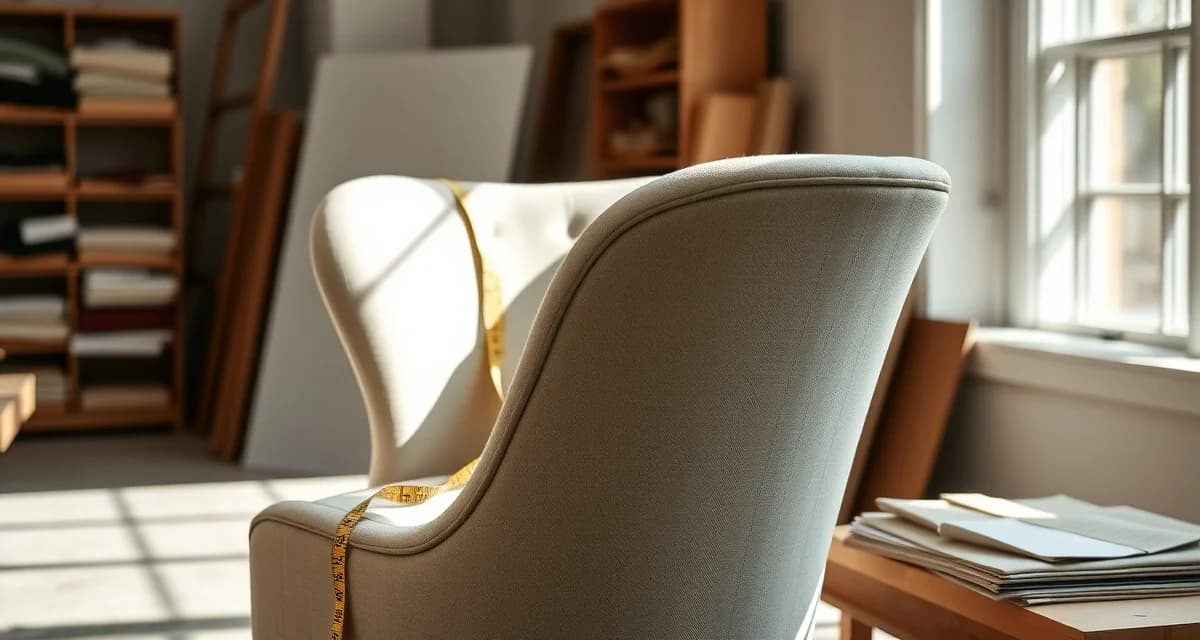
A barrel chair has a continuous curved back, the back and sides of the chair flow in one smooth arc rather than having distinct arm and back sections joined at a seam. That curve is what makes the barrel chair distinctive and also what makes it harder to cut.
On a flat-back chair, the inside back panel is a rectangle. Simple. On a barrel chair, the inside back is a curved panel, it's wider at the bottom than at the top (or vice versa, depending on the chair design), and it has a curve along the sides. When you cut that panel from a rectangular bolt of fabric, the curve means you're losing the triangular corners at the top and bottom of the cut. That's waste that doesn't exist on a flat-back chair.
The outside back mirrors this geometry. The inside and outside arm panels, which on a club chair would be simple rectangles, on a barrel chair are curved pieces that follow the arc of the back rail. Each curved piece wastes fabric at its corners compared to a straight-cut rectangle of the same overall dimensions.
For a medium barrel chair (28 inches wide, 30 inches tall, 28 inches deep), the waste from curved cutting adds up to approximately 1–1.5 yards over a similarly sized flat-back chair. That's not a minor discrepancy.
Barrel Chair Yardage by Size
Small barrel chair (24–26 inch width): 4–5 yards plain fabric. 5–6.5 yards with pattern repeat.
Medium barrel chair (27–30 inch width): 4.5–6 yards plain fabric. 6–8 yards with pattern.
Large barrel chair / barrel chair and a half (31–36 inch width): 5.5–7 yards plain fabric. 7–9 yards with pattern.
These ranges already include the curved seam waste. They're not a "barrel chair is like a club chair" approximation.
Velvet on Barrel Chairs
Barrel chairs are a common choice for velvet and velvet-look fabrics. The rounded shape shows off a directional nap beautifully. But velvet on a barrel chair compounds the cutting challenges.
Nap direction must be consistent across the continuous curved back. Since the inside back and inside arms flow as one piece in many barrel chair designs, you're cutting a large curved panel that needs the pile running one direction throughout. You can't flip the curved pieces for efficiency.
A velvet barrel chair typically needs 15–20% more fabric than the same chair in plain fabric, on top of the curve waste. The combined effect means a medium barrel chair in velvet might need 6.5–7.5 yards compared to 4.5–6 yards in a plain woven fabric.
Fabrics That Work Best for Barrel Chairs
Velvet and velvet-look microfiber: Classic for the barrel silhouette. The curved seams work well with velvet's tendency to hide seam lines.
Leather: Challenging on barrel chairs because of the curved panels, leather doesn't stretch as forgiving as woven fabric. Requires careful pattern cutting. Expect 15–20% hide waste over the flat-back equivalent.
Tight weaves (wool, linen blend): Good. They hold curved shapes well and don't distort at curved seams.
Loosely woven fabrics: More difficult. A loose weave can distort at curved seam allowances, especially on the inside back where the curve is most pronounced.
Heavily textured fabrics (boucle, chenille): Work fine but add to the nap direction constraints. Chenille in particular has a pile direction that affects sheen consistency on the curved back.
How to Use the Barrel Chair Calculator
- Select "Barrel Chair" from the furniture type dropdown.
- Enter seat width, seat depth, and back height.
- Select cushion style: tight seat, loose seat cushion, or no seat cushion (some barrel chairs have a fixed seat).
- Specify back style: continuous curve (standard barrel) or slight barrel with some back/arm distinction.
- Input fabric width.
- Add pattern repeat details.
- Toggle curved-seam geometry mode, this is the key feature that adjusts waste for the curved back.
- Select nap direction if applicable.
- Review total yardage.
The curved-seam geometry mode is what separates this from a generic chair calculator. With it on, the waste factor for the back panel, outside back, and arm panels is calculated based on the curvature radius, not a flat panel estimate.
Related Articles
FAQ
How many yards to reupholster a barrel chair?
A medium barrel chair (28 inches wide) needs 4.5–6 yards of plain 54-inch fabric. A small barrel chair (24 inches) runs 4–5 yards. A large barrel chair or chair-and-a-half can reach 7 yards. Add 30–40% for a pattern repeat on any size, and add 15–20% for velvet or directional nap. The ranges are wider than for flat-back chairs because the curved seam waste is more sensitive to exact dimensions.
Why does a barrel chair use more fabric than a regular chair?
A regular chair (club, wing, or parsons) has flat panels that cut as rectangles. Barrel chairs have curved back and arm panels that cut as curved shapes from a rectangular bolt of fabric. The curves mean you lose the corners of each cut as waste. The back and arm panels of a barrel chair typically waste 20–30% more material per panel than an equivalent flat panel. That adds up across the 4–5 main cutting zones.
What fabrics work best for curved barrel chair backs?
Woven fabrics with some give are ideal, medium-weight velvet, linen-cotton blends, tight-weave wool. These conform to the curved seam allowance without distorting. Avoid loosely woven fabrics that can gap or distort at curved seams. Leather and vinyl are usable but require more careful cutting and marking, and the hide waste is higher. Performance fabrics like Crypton and high-density polyester weaves work well and are practical for a chair that sees daily use.
Should I add a buffer to calculated yardage?
Yes. A 10-15% buffer is standard on plain fabric to account for cutting waste and minor errors. On patterned fabric, use 15-20% above the pattern-adjusted calculation. For COM fabric that cannot be reordered if you run short, some upholsterers increase the buffer to 20-25%. The cost of a modest buffer is far lower than the cost of sourcing additional fabric after cutting has begun.
Sources
- National Upholstery Association
- Association of Master Upholsterers and Soft Furnishers (AMUSF)
- Upholstered Furniture Action Council (UFAC)
- Furniture Today (trade publication)
Get Started with StitchDesk
Getting yardage right on barrel chair jobs is the difference between a profitable quote and an expensive reorder. StitchDesk's fabric calculator accounts for all the variables that cause errors: pattern repeat by zone, nap direction, fabric width, and cushion configuration. Start a free trial and see how accurate yardage calculation affects your bottom line.