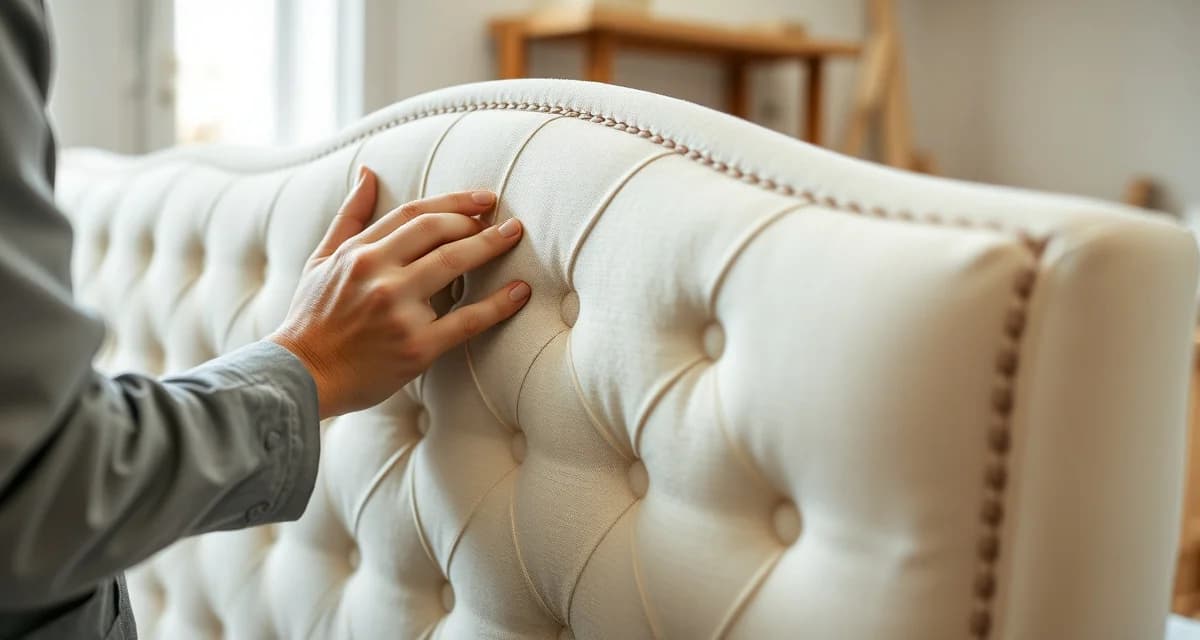
How to Reupholster a Headboard: Flat Tufted and Channel Styles
Tufting sequence matters more than any other technique in headboard reupholstery. Wrong order causes button pull misalignment on 1 in 4 jobs where upholsterers don't follow a center-outward sequence. The reason isn't obvious until it happens to you: when you start at a corner or edge and work toward center, the accumulated fabric tension in one direction pulls the center buttons off-axis. Starting at center and working outward distributes tension evenly in all directions.
This guide covers all three headboard styles with style-specific sequences.
TL;DR
- Successful reupholstery starts with a thorough frame and spring assessment before any fabric is ordered.
- Professional technique follows a consistent panel sequence: strip, repair frame, replace foam, then install fabric panels in the correct order.
- Pattern fabric requires centering and repeat alignment decisions made before cutting; errors discovered after cutting are expensive to correct.
- Professional labor time ranges from 12-20 hours depending on furniture style and fabric complexity.
- Foam selection matters as much as fabric selection; the right density and ILD creates the correct seating profile and longevity.
- Consistent tension on all panels and quality welt cording are the marks of professional finishing.
Flat Headboard Reupholstery
The flat headboard is the simplest style, but several details separate a professional result from an amateur one.
Materials needed:
- New foam (1/2 to 2 inches thick, depending on design intent)
- Dacron polyester batting (1-2 layers for softness)
- New fabric
- Staple gun and staples
- Scissors or rotary cutter
- Mounting hardware (to reattach headboard to bed frame)
Step-by-step process:
- Remove the headboard from the bed frame and set it flat on your worktable.
- Pull all existing fabric, staples, and foam from the headboard base board (typically plywood or MDF).
- Measure the headboard and cut new foam to the front face dimensions. Use spray adhesive to bond foam to the board.
- Cut Dacron batting larger than the board by 4-6 inches on all sides. Wrap Dacron over the foam to the back, pulling taut, and staple at the back of the board.
- Cut fabric: headboard width + 8 inches x headboard height + 8 inches. This gives you 4 inches of wrap on each side.
- Center fabric on the headboard face. Staple center of bottom edge first. Then staple center of top edge, pulling firmly but not so tight the foam compresses visibly.
- Work outward from center on both bottom and top edges, alternating sides to maintain even tension.
- Staple sides from center outward, pulling fabric around the edge to the back.
- At corners: create neat mitered folds on square corners. Fold the corner fabric flat, staple the flap, then fold the adjacent edge over for a clean finish.
- Trim excess fabric at the staple line, leaving 1/2 inch beyond the staple.
- Add a backing fabric (cambric or coordinating fabric) to the back if visible.
- Reattach hardware and mounting.
Diamond-Tufted Headboard
Diamond tufting is the classic button-tufted pattern where buttons form a diamond grid across the headboard. This is more involved than flat work but produces a dramatically different result.
Before you start: Map out your button positions on graph paper or directly on the foam. Standard tufting grids for headboards are 4-6 inches between buttons both horizontally and vertically, offset to create the diamond pattern. Mark every button position with a pin or chalk on the foam before cutting fabric.
Materials additional to flat list:
- Tufting needles (long straight needle, 12-18 inches)
- Button thread (heavy waxed thread or upholstery twine)
- Upholstery buttons covered in matching fabric
- Long straight awl or ice pick
Step-by-step for diamond tufting:
- Complete steps 1-5 from the flat headboard process above. The foam and Dacron layers go on first.
- Transfer button positions to the foam face. Each position needs a small depression to guide the button placement.
- Cut fabric larger than the board by 12 inches on all sides (more than flat work, because tufting takes up fabric).
- Begin tufting at the center button. Push the tufting needle through the fabric, foam, and board from the front. Thread a button onto the needle and pull back through, capturing the fabric in the characteristic tufted fold.
Sequence: always work center-outward. Complete the center button, then work to the adjacent buttons in the row, then the row above and below, then outward in all four diagonal directions. This center-outward expansion distributes fabric tension evenly.
- As you work each button, fold the fabric between buttons into the characteristic tufting pleats. These pleats run toward each button point and form the diamond pattern.
- When all buttons are placed, pull and straighten the pleats so they run cleanly in consistent directions.
- Staple the perimeter of the fabric at the back of the headboard after all tufting is complete.
The most common tufting error: Starting from a corner or edge instead of center. This causes all the fabric tension to accumulate toward the center, which pulls the center buttons off their planned positions.
Channel-Tufted Headboard
Channel tufting creates parallel vertical (or horizontal) channels separated by seam lines. It's a different construction from button tufting, the channels are sewn into the fabric before the fabric goes on the headboard.
The channel headboard requires a different starting point: The channels are created in the fabric itself, sewn as parallel tucks before the fabric is applied to the headboard.
Step-by-step for channel tufting:
- Measure the headboard and plan channel width. Standard channels are 3-5 inches wide. Narrower channels create a more formal look; wider channels are more casual.
- Cut fabric with extra width for channel seaming. Each channel requires the channel width plus two seam allowances (1 inch total). For an 18-inch-wide headboard with 3-inch channels, you need fabric that's 18 + (6 seam allowances x 18/3 channels) = wider than 18 inches.
- Sew channels: stitch parallel rows of seaming to create the channel divisions. Press seams in alternating directions for a flat finish.
- Fill each channel with foam strips or rolled Dacron before applying to the headboard.
- With channels filled, apply the channel-quilted panel to the headboard base, pulling taut and stapling at the back edge.
- Corners on channel headboards need careful handling, align channels with the headboard edge and miter corners so channels appear to continue around the edge cleanly.
For yardage calculation on all three headboard styles, use the headboard fabric yardage calculator. The complete yardage reference by headboard size and style is in the headboard yardage guide.
Frequently Asked Questions
How do I tuft a headboard?
Mark button positions on the foam in a diamond grid pattern, starting from center. Cut fabric extra-large (12 inches larger than headboard on all sides to account for tufting take-up). Starting at the center button, push a tufting needle through fabric, foam, and board, secure a covered button, and pull back. Work center-outward in all four diagonal directions. Between buttons, fold fabric into consistent directional pleats. Staple perimeter after all buttons are placed.
How do I reupholster a flat headboard?
Attach new foam with spray adhesive to the headboard board. Wrap with Dacron batting, stapling at the back. Cut fabric 8 inches larger than the headboard on all sides. Staple center bottom edge first, then center top, pulling firmly but not excessively. Work outward from center in both directions, alternating top and bottom to maintain even tension. Staple sides from center outward. Create clean mitered folds at corners. Trim excess and add backing fabric to the rear.
What tools do I need to reupholster a headboard?
Flat headboard: staple gun, scissors or rotary cutter, spray adhesive, and a tape measure. For tufted headboards: add a 12-18 inch tufting needle, heavy upholstery thread, and fabric-covered buttons. For channel tufting: add a sewing machine for creating channel seams. A chalk line or laser level helps mark even button positions and channel lines. Long straight pins help position and hold fabric during stapling.
What tools are required for professional reupholstery?
Professional reupholstery requires a heavy-duty staple gun (pneumatic or electric), a staple remover and tack puller, quality scissors and a rotary cutter, a sewing machine capable of sewing upholstery-weight fabric, foam cutting tools, and regulator pins for manipulating stuffing. For tufted work, a curved needle and tufting twine are also required. The quality of your tools directly affects the quality of the finished work, particularly at seams and edges.
In what order should upholstery panels be installed?
The correct panel sequence varies by furniture type, but the general principle is inside panels before outside panels, starting from the bottom up. For a sofa: deck first, then inside arms, inside back, seat cushions, back cushions, outside arms, outside back, front arm panels, then dust cover. For a chair: seat platform, inside back, inside arms, outside arms, outside back, then dust cover. Deviating from the correct sequence can make later panels impossible to install cleanly.
How do I handle pattern matching across multiple panels?
Establish the dominant panel first (usually the inside back) and center the pattern motif there. Then cut each subsequent panel so the pattern aligns with the adjacent panel at the seam. Mark the pattern alignment point on each piece before cutting. For complex pieces, some upholsterers make a cutting plan on paper showing where each panel falls in the pattern before cutting any fabric. This investment in planning prevents the most common and costly pattern-matching errors.
Related Articles
- Velvet Tufted Headboard Fabric Yardage: The Hardest Calculation
- How Many Yards of Fabric to Reupholster a Headboard?
Sources
- National Upholstery Association
- Association of Master Upholsterers and Soft Furnishers (AMUSF)
- Upholstered Furniture Action Council (UFAC)
- Furniture Today (trade publication)
Get Started with StitchDesk
Accurate reupholstery quotes require knowing your labor time, material costs, and overhead for each job type. StitchDesk helps upholstery shops build detailed, professional quotes that account for all cost factors, so every job is priced to cover costs and generate profit. Try StitchDesk free and bring accuracy to every estimate you send.