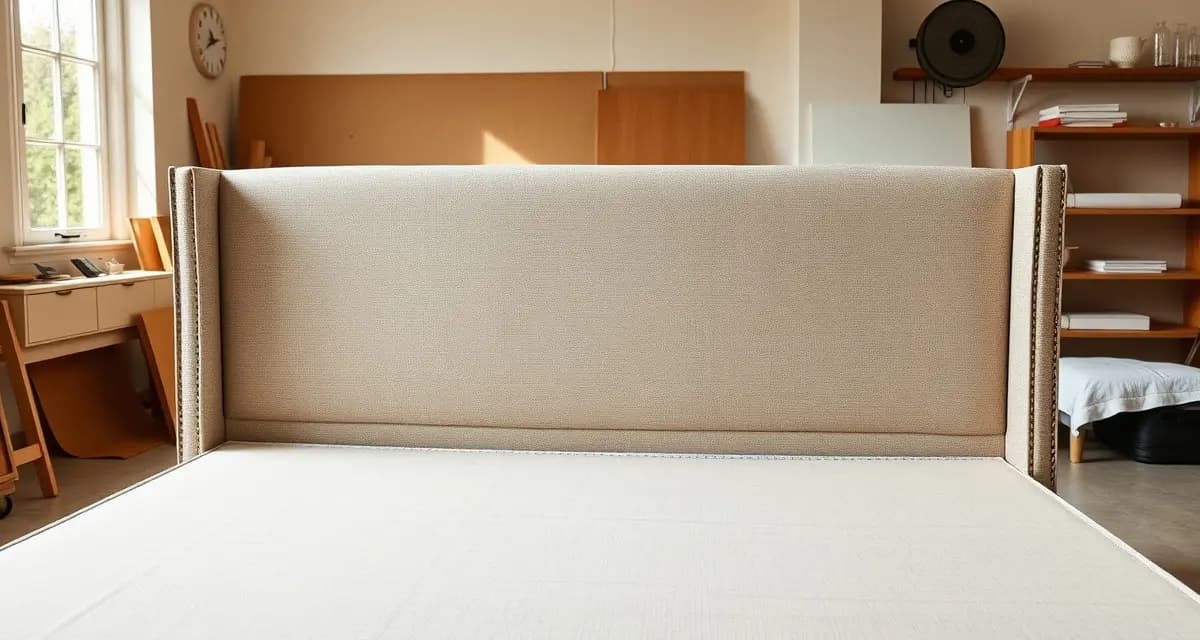
Headboard and Footboard Fabric Yardage: Complete Bed Set Calculation
Headboard and footboard jobs are among the most visually prominent upholstery work a residential shop does. The headboard anchors the bedroom aesthetically, and when the footboard is also upholstered, the full bed frame becomes a design statement.
Getting the yardage right for both pieces together, especially when pattern matching across them, is critical to delivering a finished look that lives up to the investment the client is making.
TL;DR
- Bed Headboard Footboard yardage depends on fabric width, construction details, pattern repeat, and nap direction.
- Plain 54-inch fabric requires a baseline calculation plus 10-15% waste allowance for a standard bed headboard footboard job.
- Patterned fabric adds 20-35% to base yardage depending on repeat size and the number of cutting zones that must align.
- Directional fabrics add 15-25% over plain fabric because layout optimization is restricted by nap direction.
- Always verify fabric width before finalizing yardage; COM fabric often comes in non-standard widths.
- Calculating yardage at the quote stage, not mid-job, eliminates reorders and protects your profit margin.
The Pattern Matching Challenge
When a client wants both headboard and footboard upholstered in the same patterned fabric, pattern alignment becomes a real consideration. The footboard is directly visible at the same time as the headboard, a client standing in the doorway of the bedroom can see both simultaneously.
For a pattern to look intentional rather than random, the major motif elements should align or relate visually between the two pieces. A centered medallion pattern works best when the same medallion is centered on both the headboard and footboard, even if they're different heights.
This alignment requirement adds yardage beyond simply calculating each piece separately. The start position of the pattern on the headboard may leave an unusable gap before the next aligned repeat for the footboard. That gap is waste, but it's necessary waste for a properly matched result.
Shops that calculate headboard and footboard separately miss this pattern matching overlap, it typically adds 0.5 to 1 yard of waste to the combined order.
Headboard Yardage by Size and Style
Twin flat headboard: 1.5 to 2 yards
Full/double flat headboard: 1.75 to 2.25 yards
Queen flat headboard: 2 to 2.5 yards
King flat headboard: 2.5 to 3.5 yards
Add for channel tufting: 40 to 60% more yardage
Add for button/diamond tufting: 50 to 80% more yardage
See the headboard yardage guide for detailed calculations by style.
Footboard Yardage by Size and Style
Footboards are typically shorter than headboards, their height is usually 18 to 28 inches versus 36 to 60 inches for headboards. But the width is the same as the headboard.
Twin flat footboard: 1 to 1.5 yards
Full/double flat footboard: 1 to 1.5 yards
Queen flat footboard: 1.25 to 1.75 yards
King flat footboard: 1.5 to 2.25 yards
Add for tufting: Same percentages as headboard. Button tufting on a footboard adds 50 to 80% to the flat footboard estimate.
Combined Calculation for the Bed Set
Queen flat headboard + flat footboard (no pattern):
- Headboard: 2 to 2.5 yards
- Footboard: 1.25 to 1.75 yards
- Total: 3.25 to 4.25 yards
Queen flat headboard + flat footboard (with 18-inch pattern repeat, aligned):
- Base: 3.25 to 4.25 yards
- Pattern matching waste: 0.75 to 1 yard
- Total: 4 to 5.25 yards
King tufted headboard + tufted footboard (no pattern):
- Tufted headboard: 5 to 7 yards
- Tufted footboard: 3 to 4 yards
- Total: 8 to 11 yards
For the king tufted combination, pattern alignment adds 1 to 1.5 yards to the calculation. An 8 to 11-yard job becomes a 9 to 12.5-yard order for patterned fabric.
Side Rails: A Third Consideration
Some upholstered bed frames include fabric on the visible face of the side rails, the long sections connecting headboard to footboard. If the client wants side rail upholstery:
Side rails per bed (both rails):
- Queen: approximately 1 to 1.5 yards (two runs along the long sides)
- King: approximately 1.25 to 1.75 yards
If side rails are included, pattern matching across headboard, footboard, and rails becomes more complex. The most common approach is to run the pattern consistently in one direction across all elements rather than centering individually on each.
Using the Combined Calculator
The StitchDesk headboard yardage calculator allows you to calculate headboard and footboard as a coordinated pair. Input both pieces with their dimensions and tufting style, and the calculator handles the pattern matching overlap calculation automatically. This gives you one combined yardage number to order from, and it's a more accurate number than two separate calculations added together.
Frequently Asked Questions
How much fabric for a headboard and footboard?
A queen flat headboard and flat footboard together in solid fabric need approximately 3.25 to 4.25 yards. With button tufting on both pieces, the combined estimate rises to 6 to 10 yards depending on button density. King tufted headboard and footboard can run 8 to 12 yards or more. If the fabric has a pattern that you're aligning across both pieces, add 0.75 to 1.5 yards for pattern matching waste.
Can I match patterns across headboard and footboard?
Yes, and for a high-quality finished look you should. The most common approach is centering the dominant pattern element on both pieces. This requires starting each piece at the same point in the pattern repeat, which means the cut between pieces has unused fabric between them, that's the pattern matching waste. Calculate this waste before ordering to ensure you order enough.
What fabric is best for a bed frame?
For headboards that will see contact (people lean back against them while reading or watching TV), performance or tight-weave fabric with at least 30,000 Wyzenbeek rubs is appropriate. Velvet is one of the most popular choices for luxury headboards, beautiful but requires nap direction planning. Bouclé and textured fabrics are popular for modern designs but require gentle handling during tufting. For footboards, durability is less critical since they see less direct contact.
What is the biggest factor in yardage variation for this piece?
Pattern repeat is the biggest source of yardage variation. On plain fabric, the baseline calculation plus a 10-15% waste buffer is usually sufficient. Add a 13-inch pattern repeat and you may need 15-20% more. Add a 27-inch pattern repeat and the additional yardage can be 25-35% over the plain fabric calculation. Nap direction is the second-largest factor, typically adding 15-25% over plain fabric because layout optimization is restricted.
Sources
- National Upholstery Association
- Association of Master Upholsterers and Soft Furnishers (AMUSF)
- Upholstered Furniture Action Council (UFAC)
- Furniture Today (trade publication)
Get Started with StitchDesk
Getting yardage right on yardage bed headboard footboard jobs is the difference between a profitable quote and an expensive reorder. StitchDesk's fabric calculator accounts for all the variables that cause errors: pattern repeat by zone, nap direction, fabric width, and cushion configuration. Start a free trial and see how accurate yardage calculation affects your bottom line.