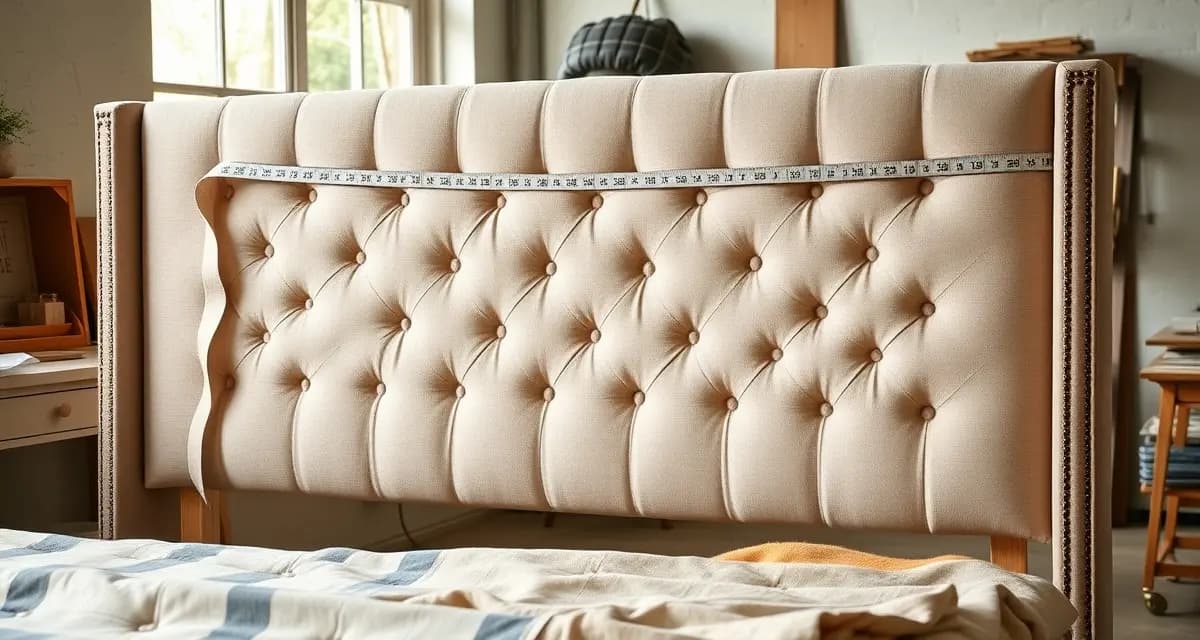
King Headboard Fabric Yardage Calculator: Tufted and Flat Styles
King headboards span the widest range of fabric requirements of any single piece type in bedroom upholstery. A flat king headboard might need 2 to 3 yards. A diamond-tufted king headboard can need 5 to 7 yards. Apply a single generic estimate and you'll either run out of fabric or overbuy by enough to cover a second piece.
King is the largest standard bed size. That matters because the width affects every panel calculation, and tufting on a king-size surface means more buttons, more pull, and more fabric consumed in the gathering.
TL;DR
- Accurate yardage calculation for king headboard jobs prevents costly fabric shortfalls and over-ordering that erode margin.
- Pattern repeats are the most common source of yardage errors; always calculate each cutting zone separately, not as a flat percentage.
- Nap-direction fabrics (velvet, chenille, mohair) require 15-25% more yardage than the same job in plain fabric.
- Fabric width significantly affects yardage: the difference between 54-inch and 60-inch fabric can be 1-2 yards on the same piece.
- Always add a 10-15% buffer on plain fabric and 15-20% on patterned fabric to account for cutting waste.
- Entering measurements accurately at the quoting stage eliminates the need to reorder mid-job.
King Headboard Dimensions
Most king headboards are 76 to 82 inches wide (matching the mattress width). The height varies considerably by style:
Low profile: 30 to 40 inches tall
Standard height: 40 to 55 inches tall
Statement/oversized: 55 to 72 inches tall or more
Height is a bigger variable than width in headboard yardage. A standard 80-inch wide king headboard at 50 inches tall uses noticeably more fabric than the same width at 36 inches tall. When you're calculating, always measure the actual headboard height rather than assuming a standard.
Yardage by Headboard Style
All figures assume 54-inch fabric. Add 1.5 to 2 yards if covering the back in main fabric.
Flat King Headboard
A flat king headboard is covered on the front face, with fabric wrapping around to staple on the back. No structural complexity. Your panel is essentially one rectangle per width pass of fabric.
Yardage range: 2.5 to 4 yards (depending on height)
A 50-inch tall king headboard at 80 inches wide needs one width pass of about 55 to 58 inches of fabric (80" headboard width + wrap allowances), repeated across 2 to 3 passes of fabric width if you're on 54-inch fabric. The front face is the main material cost; add a half yard for corner wraps and side panel finishing.
Channel-Tufted King Headboard
Channel tufting runs vertical rows of stitching through the headboard, creating channels between each row. The channels compress the fabric horizontally but not vertically, so the main yardage addition is horizontal, you need extra width to account for the fabric taken into each channel.
Yardage range: 3.5 to 5 yards
Channels typically require 10 to 15% additional fabric width per panel pass. On a king headboard with 8 to 10 channels, that's a real addition. The additional yardage also depends on channel depth, shallow 0.5-inch channels add less than deep 1.5-inch channels.
Diamond-Tufted King Headboard
Diamond tufting compresses fabric in both directions (horizontal and vertical) at every button point. The fabric gather pulls from all directions toward each button. On a king headboard, which might have 4 to 6 rows of buttons and 6 to 8 columns, that's 24 to 48 button points each pulling fabric.
Yardage range: 4.5 to 6.5 yards (not including back panel)
A king diamond-tufted headboard needs 4.5 to 6 yards versus 1.5 to 2 yards for a twin flat headboard. That's a 3x to 4x multiple driven by two factors: the king headboard is roughly 2.5x the surface area of a twin, and the diamond tufting adds 25 to 35% to the panel yardage over flat.
Calculating Tufting Waste on a King Headboard
For diamond tufting specifically:
Step 1: Determine button grid (rows × columns). A typical king headboard might be 5 rows × 7 columns = 35 buttons.
Step 2: Estimate average pull waste factor. For standard 0.75 to 1-inch pull depth, use 20 to 25% additional yardage on tufted panels.
Step 3: Calculate the front face yardage flat, then multiply by 1.22 (using 22% as mid-range).
Step 4: Add back panel, welt if applicable, and side wraps.
Example: King headboard 80" wide × 52" tall, diamond tufted (5×7 grid):
- Front face flat: approximately 2.8 yards (at 54-inch fabric)
- Tufting multiplier × 1.22: 3.4 yards
- Back panel in main fabric: 2.5 yards (same dimensions, flat)
- Welt perimeter: 0.3 yards
- Side and edge wraps: 0.25 yards
- Total: approximately 6.5 yards
Does Headboard Height or Width Drive More Yardage?
Height is the bigger driver for most king headboards. Here's why:
Width (80 inches) determines how many fabric width passes you need. At 54-inch fabric, an 80-inch headboard needs 2 passes width-wise. At 60-inch fabric, you might still need 2 passes but with less overlap waste. The efficiency gain from wider fabric is modest.
Height drives yardage more directly. A 60-inch tall headboard needs 40% more fabric than a 40-inch tall headboard of the same width. Statement headboards that reach to or near the ceiling are in a completely different yardage category than standard-height pieces.
Adding the Back Panel
Whether you cover the back of a king headboard in the main fabric is a design and budget decision. On headboards where the back is never seen (mounted directly to a wall), some shops use a dust cover fabric for the back. On freestanding headboards or four-poster beds where the back is partially visible, the main fabric is the right choice.
Back in main fabric: Add 2 to 3 yards for a king headboard. The back is flat regardless of front style, so no tufting multiplier applies.
Back in cambric or dust cover: Add to your supplies order rather than your main fabric order.
Fabric Recommendations for King Headboards
Performance velvet is one of the most popular choices for king headboards. The large surface area shows the fabric at scale, and performance velvet handles the behind-the-scenes friction of use (pillows, headrests) better than standard velvet.
Linen and linen-look fabrics work well on flat headboards where the weave texture is the visual statement. For tufted headboards, linen can be harder to pull tight at button points.
Boucle is increasingly popular for flat and channel-tufted headboards. The looped texture adds visual weight and warmth. For diamond tufting, boucle requires careful handling at the button points to avoid distortion.
Leather makes a dramatic king headboard. Remember to calculate by hide count rather than yardage: see the general leather upholstery guide for the conversion methodology.
Fabric Width Consideration
On a king headboard, 60-inch fabric can save approximately 0.5 to 1 yard over 54-inch fabric. The main savings come from reduced panel seaming on the front face, at 60 inches, many king headboards can get more coverage from each width pass. For statement headboards over 70 inches tall, the savings are less pronounced because height is the dominant variable.
Using the Headboard Fabric Yardage Calculator
The headboard calculator has separate modes for flat, channel-tufted, and diamond-tufted styles at king dimensions. Enter your actual headboard height and width for the most accurate result, don't rely on bed size alone. The Headboard Yardage Guide covers all headboard styles and sizes with comparison data.
How much fabric for a king headboard?
A flat king headboard needs 2.5 to 4 yards. A channel-tufted version needs 3.5 to 5 yards. A diamond-tufted king headboard needs 4.5 to 6.5 yards, or up to 8 yards for a very tall statement piece. All figures assume solid 54-inch fabric for the front face; add 2 to 3 yards for the back if covering in main fabric.
Does king headboard tufting require a lot of extra fabric?
Yes. Diamond tufting adds 20 to 25% to the front panel yardage over a flat cut. On a king headboard where the flat front panel is already 2.5 to 3 yards, that's 0.5 to 0.75 extra yards just from tufting. Combined with the large surface area of a king headboard, tufted versions can cost twice the material of a flat version.
What fabric is best for a king headboard?
Performance velvet is a leading choice for its durability and appearance. Boucle and textured weaves work well for flat or channel-tufted styles. Linen-look fabrics are popular in transitional and minimalist bedrooms. For the most dramatic look, top-grain leather requires the most maintenance but ages well.
Should I add a buffer to calculated yardage?
Yes. A 10-15% buffer is standard on plain fabric to account for cutting waste and minor errors. On patterned fabric, use 15-20% above the pattern-adjusted calculation. For COM fabric that cannot be reordered if you run short, some upholsterers increase the buffer to 20-25%. The cost of a modest buffer is far lower than the cost of sourcing additional fabric after cutting has begun.
FAQ
Sources
- National Upholstery Association
- Association of Master Upholsterers and Soft Furnishers (AMUSF)
- Upholstered Furniture Action Council (UFAC)
- Furniture Today (trade publication)
Get Started with StitchDesk
Getting yardage right on king headboard jobs is the difference between a profitable quote and an expensive reorder. StitchDesk's fabric calculator accounts for all the variables that cause errors: pattern repeat by zone, nap direction, fabric width, and cushion configuration. Start a free trial and see how accurate yardage calculation affects your bottom line.