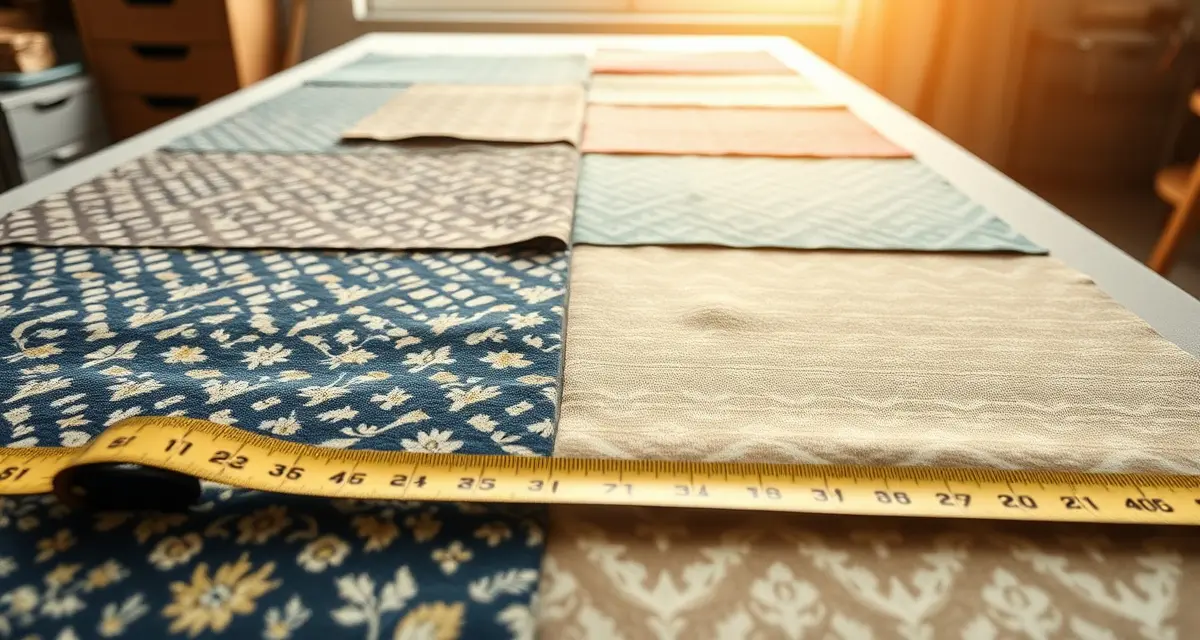
Pattern Repeat Calculator for Upholstery: Stop Losing Money on Mismatched Fabric
Pattern repeat errors are the leading cause of fabric shortfalls in upholstery shops. Not measuring wrong. Not cutting wrong. Calculating the yardage without accounting for the repeat, then running out 3 yards into a sofa that needs 4 more yards to finish.
The math isn't complicated once you understand what's actually happening. But doing it right for every zone on a complex piece, on every job, without a dedicated tool, that's where errors creep in.
TL;DR
- Pattern repeat is the most common source of fabric waste and yardage underestimation in upholstery shops.
- Each cutting zone on a piece must start at the same point in the repeat, meaning waste accumulates across every panel.
- A 27-inch vertical repeat on a 3-cushion sofa can add 4-6 yards of fabric over the same sofa in plain fabric.
- Horizontal and vertical repeats must both be planned; a plaid or geometric with both adds more waste than a single-axis repeat.
- Pattern centering decisions (where the motif falls on the seat face) should be made at the quoting stage, not after cutting begins.
- Always quote pattern repeat work with a zone-by-zone calculation, not a flat percentage buffer.
What a Pattern Repeat Actually Is
A pattern repeat is the distance along the fabric before the design starts over. A fabric with a 13.5-inch vertical repeat has a motif that repeats every 13.5 inches up the bolt. When you cut a panel from that fabric, the cut must start at a specific point in the repeat so the pattern looks intentional on the finished piece.
Vertical repeat (warp): The repeat measured along the length of the fabric, up the bolt. This is the most common and most impactful type for upholstery. Affects every panel cut along the bolt length.
Horizontal repeat (weft): The repeat measured across the fabric width. Affects panels that sit side by side horizontally, seat cushion front and back, left and right arms. A horizontal stripe with a 6-inch repeat needs to align at vertical seams.
Half-drop repeat: A pattern where alternating columns of the design are offset by half the vertical repeat. More common in residential decorative fabrics. Wastes more fabric than a straight vertical repeat because the offset columns require even more careful cutting to maintain alignment.
Set repeat: Both horizontal and vertical. Plaids, checks, large medallions with clear grid placement. The most complex to cut, you're matching in two directions simultaneously.
The Zone-by-Zone Problem
Here's why pattern repeat waste is so often underestimated.
Say you have a sofa with 12 cutting zones and a 13.5-inch vertical repeat. Each zone has to start at the correct point in the repeat. The first zone, let's say the inside back, is 24 inches tall. That's 1 full repeat (13.5 inches) plus 10.5 inches. The inside back cuts at the top of a repeat and ends 10.5 inches into the next repeat. That 10.5 inches of repeat is still in the bolt.
Now the second zone, the seat cushion face, also needs to start at the top of a repeat. But you're currently sitting 10.5 inches into a repeat. So you skip ahead 3 inches (to complete the 13.5-inch repeat) before you start your next cut. Those 3 inches are waste.
Do this for 12 zones. Each zone introduces waste equal to the partial repeat left over from the previous zone. On some zones the waste is 1–2 inches. On others it's 10–12 inches. Across 12 zones on a large patterned sofa, the total waste can be 40–60 inches, 1.25–1.75 yards, purely from repeat carryover.
This is the math that a generic yardage estimate misses. It adds 1.75 yards to the order on a single sofa, and if you're doing 20 sofas a month with pattern fabrics, that's an enormous accumulated error.
Horizontal Pattern Waste
Horizontal repeats matter when panels sit next to each other vertically, meaning the front panel of a seat cushion and the back panel, or the left arm and right arm, need to align at their horizontal seam.
A horizontal stripe with a 6-inch repeat on a seat cushion that's 24 inches wide: the center of the seat should have the stripe centered, not landing on a random stripe position. That centering might require starting the cut 3 inches into the repeat, wasting 3 inches across the full fabric width. Across multiple cushions in a set, this horizontal waste adds up.
The calculator handles horizontal repeat separately from vertical. You input both repeat dimensions, and the waste is calculated for both axes independently, then combined.
The Half-Drop Repeat (The Complicated One)
Half-drop repeats are common in large-scale botanical and contemporary prints. Every other column of the pattern is offset by half the vertical repeat.
The cutting challenge: if you place two panels side by side (seat cushion front panel and back panel, for example), the pattern doesn't repeat on a straight horizontal line. One side of the seam has the motif at height X, but the adjacent piece's matching motif is at height X plus half the repeat. You have to either cut very carefully to align the motifs across each seam, or accept a visible mismatch.
Most shops charge a pattern-matching premium for half-drop repeats because the cutting time and waste are both significantly higher. The calculator identifies half-drop as a separate repeat type and applies the appropriate waste factor.
How the Calculator Works
- Select the furniture type.
- Enter dimensions.
- In the pattern section: choose repeat type (straight vertical, horizontal, half-drop, or set/plaid).
- Enter repeat dimensions in inches.
- Specify motif centering preferences for key panels (optional, the calculator will assume centering by default).
- Review output: plain fabric yardage vs. patterned yardage side by side, with pattern waste called out as a separate line.
The side-by-side comparison is useful for conversations with clients. When they see "Plain fabric: 16 yards | Your pattern fabric: 20.5 yards | Pattern waste: 4.5 yards," it's immediately clear why they need to order more than they expected.
Common Repeat Waste by Furniture Piece
| Furniture | Repeat Size | Additional Yardage |
|---|---|---|
| Dining chair (6-set) | 13.5" | 1–1.5 yards |
| Club chair | 13.5" | 1.5–2 yards |
| Wing chair | 27" | 3–4 yards |
| Standard sofa | 13.5" | 2–3 yards |
| Standard sofa | 27" | 4–6 yards |
| 5-piece sectional | 27" | 8–12 yards |
These are approximate. The exact number depends on cushion count, panel dimensions, and motif centering choices. The calculator gives you the specific number for your specific job.
Related Articles
- Fabric Waste Calculator for Upholstery: Find Your Waste Percentage
- Fabric Yardage Calculator Guide for Upholstery
FAQ
What is pattern repeat in upholstery?
Pattern repeat is the distance along a fabric bolt before the design restarts. A 13.5-inch vertical repeat means every panel cut must start at a point that's a multiple of 13.5 inches from a fixed starting point, so that the pattern reads consistently across the finished piece. When multiple panels on the same piece need to align, seat cushion matching the inside back, arms matching each other, each panel's cut starting point is constrained by the repeat, and the gaps between those starting points become waste.
How do I calculate pattern repeat waste for a sofa?
For each cutting zone on the sofa, calculate the panel height and determine how many full repeats it contains plus a remainder. If the remainder is more than zero inches, the next zone must skip forward by (repeat size minus remainder) inches before starting its cut. Add up all of those skip amounts across all zones. That's your pattern waste in linear inches, divide by 36 to get yards. Add this to your plain-fabric yardage.
How much extra fabric should I order for a pattern repeat?
A general rule: add 1 full repeat per cutting zone for a straight vertical repeat, then multiply by total zone count divided by 4 (since not every zone transition wastes a full repeat). For a 27-inch repeat on a sofa with 12 zones, that's 3 full repeats of waste, about 2.25 yards. For a 13.5-inch repeat, about 1–1.5 yards. Add an additional 0.5–1 yard as a buffer for cutting errors, especially on COM fabric where you can't reorder.
How do I calculate yardage for a large pattern repeat?
Calculate each cutting zone separately. For each zone, round up to the next full repeat. Sum the adjusted zones and add a 15-20% buffer. For a 27-inch repeat, a seat cushion panel that measures 22 inches still requires a full 27-inch repeat allocation, wasting 5 inches. Multiply this across 8-12 zones on a sofa and the waste adds up to 4-6 yards over the plain-fabric calculation. Zone-by-zone calculation is the only reliable method.
Should I charge extra for pattern repeat work?
Yes. Pattern repeat work adds material cost (extra yardage) and labor cost (planning time, careful alignment during cutting and installation). Both should be reflected in the quote. For clients providing COM fabric with a pattern repeat, calculate and communicate the additional yardage requirement before accepting the fabric. For shop-supplied fabric, build the pattern repeat waste into your material cost and add a pattern complexity labor charge.
Sources
- National Upholstery Association
- Association of Master Upholsterers and Soft Furnishers (AMUSF)
- Upholstered Furniture Action Council (UFAC)
- Furniture Today (trade publication)
Get Started with StitchDesk
Pattern repeat work is where fabric errors are most common and most costly. StitchDesk's yardage calculator handles pattern repeats zone by zone, not as a flat buffer, so your quotes for patterned fabric are accurate before the first cut. Start a free trial and eliminate the most expensive source of fabric waste in your shop.