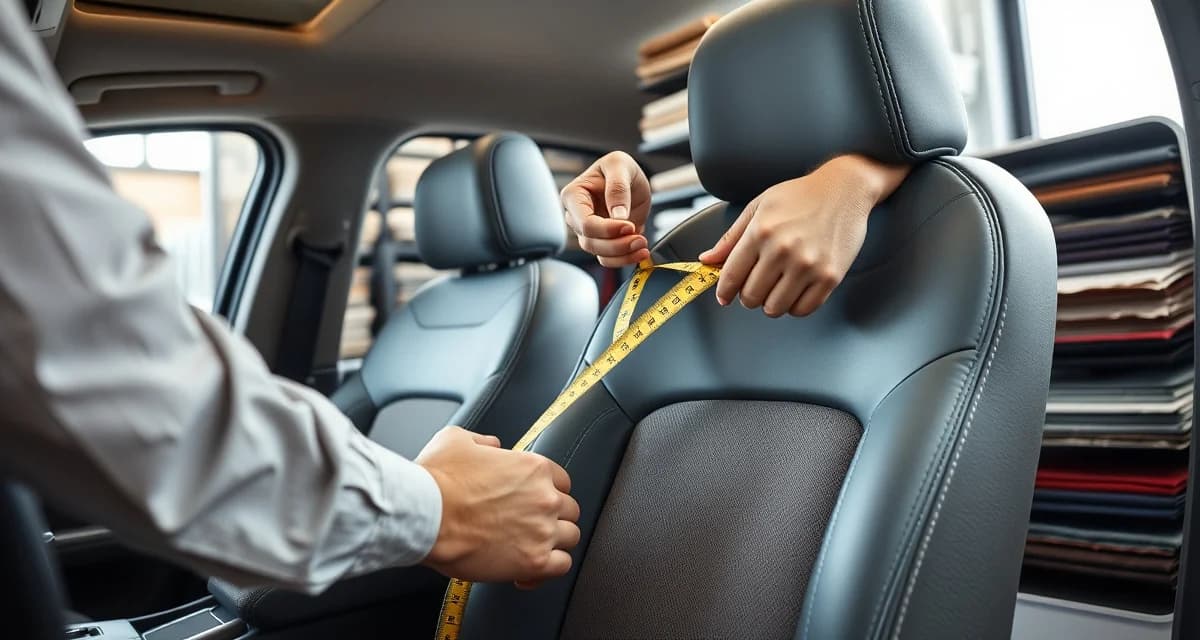
Fabric Yardage Calculator for Auto Upholstery: Seat and Panel Coverage
Automotive upholstery has the tightest yardage tolerances of any category. An error of 0.5 yards causes job failure, not a seam that looks slightly different, but a panel that can't be completed. The precision required in auto upholstery is higher than residential furniture, and generic upholstery tools don't account for automotive panel geometry and grain direction requirements.
The fabric yardage calculator for auto upholstery covers car seat and door panel reupholstery in leather, vinyl, and suede with stretch and grain direction built in.
TL;DR
- Automotive upholstery fabric must meet FMVSS 302 flammability standards that standard furniture fabric does not need to meet.
- Automotive vinyl, automotive leather, and woven fabric each have distinct durability and pricing profiles suited to different applications.
- Genuine automotive leather interiors run $800-2,500 in material costs alone for a typical vehicle, before labor.
- Automotive leather is tanned for temperature cycling and UV exposure; furniture leather will crack and fade in a vehicle interior.
- Full interior recovering starts at $1,500 and can exceed $10,000 on premium vehicles with custom work.
- Fabric selection for heated seats must account for heat transfer, as thick materials reduce heating effectiveness.
Why Auto Upholstery Is Different
Automotive upholstery panels are shaped to fit specific vehicle geometries that vary considerably between makes and models. A Ford F-150 seat has different panel shapes, bolster profiles, and headrest configurations than a BMW 3-Series seat. A generic "seat cushion" template is useless for automotive work.
The vehicle seat template library in a proper auto upholstery calculator selects the car make and model for pre-measured seat dimension profiles. This eliminates the need to measure every vehicle from scratch (though verification is always good practice) and ensures the panel geometry is correct for the specific vehicle.
Automotive Fabric Types and Their Calculation Differences
Automotive Leather
Auto-grade leather differs from furniture leather. It's treated differently, cut differently, and hides are typically smaller (average 40-45 sq ft vs 50-55 sq ft for furniture leather).
The biggest challenge: automotive seats have complex 3D geometry with deep bolsters, contoured seat backs, and multi-radius curves. Leather panels must be cut to follow these curves, which creates considerably more shaped waste than flat furniture panels.
For a full car interior in leather (2 front seats, back seat, door panels):
- Typical hide requirement: 8-12 full hides
- Average square footage needed: 350-500 sq ft
- Average waste from complex geometry: 20-28%
Vinyl for Auto Upholstery
Automotive vinyl is available in vehicle-specific grades that differ from commercial upholstery vinyl. Auto vinyl typically has a fabric backing (for breathability and shape retention) and comes in 54-inch widths most commonly.
Grain direction on auto vinyl must be consistent across all panels of the same surface (all door panels, all seat backs, etc.). Inconsistent grain shows as color variation under the car's interior lighting.
For a full car interior in vinyl (front seats + back seat):
- Typical yardage: 8-12 yards at 54-inch width
- Grain direction waste: 10-15% additional
Alcantara and Suede for Auto Upholstery
Alcantara and suede microfiber for automotive use are premium materials that require careful attention to pile and grain direction. Alcantara specifically is engineered for automotive use and its handling requirements are well-documented.
For suede/Alcantara:
- Add 15-20% over base yardage for directional cutting requirements
- The visible pile direction must be consistent: typically running downward on vertical panels, forward on horizontal panels
- Alcantara on a full interior (seats + dash accents + door panels): 10-15 yards
Panel-by-Panel Auto Seat Calculation
For a front bucket seat (without headrest):
Seat bottom section:
- Main seat panel (visible center)
- Side bolsters (2): shaped to fit the seat contour
- Front edge facing panel
Seat back section:
- Main seat back panel
- Upper bolsters (2): for high-sided sport seats
- Lower bolsters (2)
- Shoulder area panel (if separate)
- Back panel (rear of seat back)
Headrest:
- Front panel
- Back panel
- Side gussets (2)
A typical full-replacement front bucket seat in vinyl or leather: 3-4 yards at 54 inches. Times 2 front seats: 6-8 yards. Add rear seat (bench or bucket configuration): 3-5 yards. Total seats: 9-13 yards.
Door panels, dash, and center console add further yardage depending on coverage requirements.
Grain Direction in Automotive Work
Every visible automotive panel must have consistent grain direction. The standard for most automotive interiors:
- Seat faces and backs: Grain runs horizontally (left to right across the seat)
- Door panels: Grain runs vertically (top to bottom)
- Headrests: Grain runs to match the seat back
Any deviation from this standard, even on a single panel, shows as a mismatched surface under the vehicle's interior light. Automotive clients notice this instantly.
When calculating yardage, the grain direction requirement means you can't rotate panels to fit more efficiently on the bolt. All panels of a given orientation must be cut with the grain running the same way, which limits nesting options.
The fabric yardage calculator in auto mode should enforce grain direction per panel group and calculate waste accordingly.
Related Articles
FAQ
How much leather for a full car interior reupholstery?
A full car interior in leather (two front bucket seats, rear bench or bucket seats, and door panels) typically requires 8-12 full hides, or approximately 350-500 square feet of total leather. Auto leather hides are typically 40-45 square feet each, with 20-28% waste from the shaped panel geometry. Always order 2 hides more than your calculation suggests, matching a hide from a different batch after the job has started is very difficult.
What type of fabric is used for car seat upholstery?
The most common materials for car seat reupholstery are: automotive-grade leather (full-grain or top-grain, specifically tanned for automotive use), PVC vinyl with fabric backing, Alcantara or suede microfiber (premium), and cloth automotive fabric (in original or aftermarket OEM-style). Residential or commercial upholstery fabrics are not appropriate for automotive use: they lack the backing structure, UV resistance, and abrasion ratings required for vehicle interiors.
How do I calculate yardage for automotive door panels?
Measure each door panel individually: door panel shapes vary considerably by vehicle model. Note the total height and width of the panel, plus any raised sections, pocket areas, or speaker grille coverings that are fabric-wrapped separately. For most sedans, a full door panel (two doors) in vinyl or leather requires 1.5-2 yards per door at 54-inch fabric width. Four-door vehicles need 5-8 yards for all door panels. Add grain direction waste of 10-15% to the base measurement.
What is the difference between automotive leather and furniture leather?
Automotive leather is tanned and finished specifically for temperature cycling, UV exposure, and the repeated flexing that vehicle interiors experience. It typically has more UV-resistant topcoats and greater flexibility than furniture leather. Furniture leather is finished for appearance rather than durability under automotive conditions and will crack, fade, and delaminate much faster in a vehicle. The two are not interchangeable for quality automotive work.
How should I price an automotive interior job?
Auto upholstery pricing depends on scope: individual panel replacement, seat recovering, headliner replacement, or full interior work. Per-panel work typically runs $150-400 depending on complexity. Full seat recovering runs $300-800 per seat. Full interior work starts at $1,500 and can exceed $10,000 on premium vehicles with custom specifications. Material costs for automotive leather and vinyl are higher than standard furniture fabric and must be factored into every quote.
Sources
- Automotive Trim, Restyling and Accessory Connection (ATRAX)
- Specialty Equipment Market Association (SEMA)
- National Upholstery Association
- Upholstered Furniture Action Council (UFAC)
Get Started with StitchDesk
Auto upholstery shops deal with diverse job types, material specifications, and pricing variables that generic shop tools were not designed for. StitchDesk's quoting and job tracking tools help auto upholstery shops document scope, track materials, and deliver professional quotes. Try StitchDesk free and see how it handles your specific workflow.