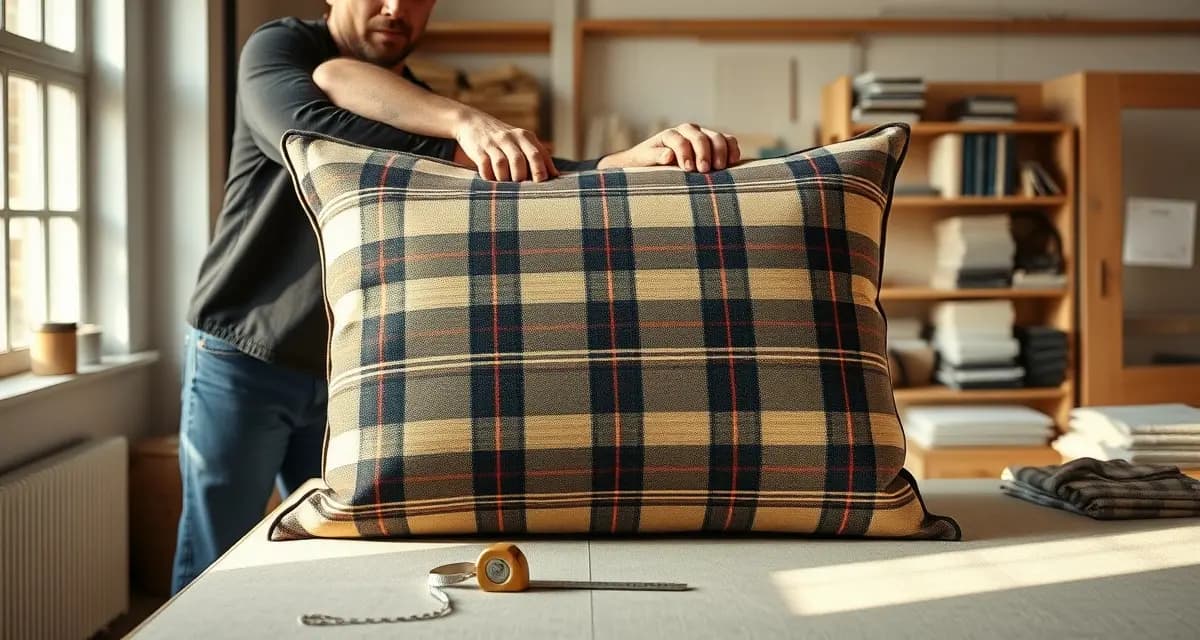
Plaids in Upholstery: Matching Centering and Yardage Guide
Large-scale tartan centered on all cushion faces requires 30-40% more yardage than the same fabric mismatched. That's not the cost of perfection, that's the cost of doing the job correctly. A mismatched tartan on a sofa cushion is not a close call. It reads as an error from across the room.
Plaid fabric has some of the highest yardage complexity in residential upholstery because it creates a two-directional matching requirement: the horizontal color bars must match at vertical seams, and the vertical bars must align at horizontal seams. When the plaid is asymmetric, different bar widths in different directions, as most tartans are, this becomes a planning challenge that rewards careful layout.
TL;DR
- Pattern repeat is the most common source of fabric waste and yardage underestimation in upholstery shops.
- Each cutting zone on a piece must start at the same point in the repeat, meaning waste accumulates across every panel.
- A 27-inch vertical repeat on a 3-cushion sofa can add 4-6 yards of fabric over the same sofa in plain fabric.
- Horizontal and vertical repeats must both be planned; a plaid or geometric with both adds more waste than a single-axis repeat.
- Pattern centering decisions (where the motif falls on the seat face) should be made at the quoting stage, not after cutting begins.
- Always quote pattern repeat work with a zone-by-zone calculation, not a flat percentage buffer.
Plaid Types and Their Matching Complexity
Small Windowpane
Windowpane plaid uses a fine grid pattern, typically a contrasting color creating small rectangles over a solid ground. The repeat is usually under 3 inches in both directions.
Matching is visible only at very close inspection. The small repeat means the visual difference between a matched and a slightly off seam is minimal.
Centering approach: Center the repeat horizontally on the major panels. Vertical seam matching is appreciated but not essential for small windowpane.
Yardage premium: 10-15% over solid fabric.
Medium Plaid (Traditional Tweed or Block Plaid)
Medium plaid repeats range from 3-8 inches. The color bars are wide enough to be clearly visible from conversational distance, and misalignment at seams is visible from 5-6 feet.
Centering approach: Center the dominant color bar horizontally on the outside back panel. Match the horizontal bars at every vertical seam. For cushion faces, maintain vertical bar alignment across adjacent cushions.
Yardage premium: 15-25% depending on the specific repeat.
Large Tartan and Plaid (Repeat Over 8 Inches)
Large-scale tartan, the classic Scottish clan pattern with multiple overlapping color bars, has a repeat that is both large and typically asymmetric. Different bars have different widths, and the repeat must be tracked in both directions simultaneously.
Misalignment on large tartan is visible from across the room. The centering decision, which bar sits at panel center, is a design decision with a visible impact on the overall aesthetic of the finished piece.
Centering approach: Before cutting anything, present the centering options to the client or designer. Show them where the dominant color bar falls on the panel center. The decision changes the visual character of the finished piece and cannot be made after cutting begins.
Yardage premium: 25-40%. Large tartan is the highest-waste pattern type in upholstery because the large repeat size means significant fabric is consumed between matching cut points.
Houndstooth
Houndstooth is a two-color woven pattern with a distinctive broken-check motif. It appears in three scale ranges:
- Micro houndstooth (under ½ inch): Reads as texture from a distance; matching at seams is not typically required
- Standard houndstooth (½ to 2 inches): Visible at medium distance; center the repeat horizontally and match at seams
- Large houndstooth (over 2 inches): Same approach as large plaid, centering required, matched at all seams
The Two-Direction Matching Challenge
Plaid fabric is the only common upholstery pattern that requires matching in both directions simultaneously. At any seam:
- The horizontal bars (weft direction) must continue across the seam at the same position
- The vertical bars (warp direction) must align at horizontal seams
This means that once you establish the position of the horizontal bars on one panel, every adjacent panel's position is determined. You can't move one panel left or right without creating a horizontal mismatch, even if doing so would improve the vertical alignment.
Work out the centering and position for all panels on paper before cutting anything. The sequence:
- Determine the center of the horizontal repeat for the dominant panel (outside back)
- Calculate the horizontal repeat offset for each vertical seam
- Calculate the vertical position for each horizontal seam
- Verify that these positions work together before beginning cuts
Centering on a Sofa
The outside back is the first panel to center. For a symmetric plaid (same bar arrangement in both directions), centering means the dominant color bar (usually the widest bar) lands at the center of the panel width.
For an asymmetric plaid or tartan, you have a centering choice: which element feels most balanced. This is a judgment call that should involve the client or designer for any large-scale pattern.
Once the outside back position is established, every other panel is determined by the repeat offset from that position.
Yardage Planning for Plaid
Plan your yardage by mapping every panel and calculating where in the repeat each panel begins. The waste between matching cut points is unavoidable, it's the cost of the pattern matching.
For large tartans, the waste between panels can be as significant as the fabric used in the panels themselves. A panel that needs to begin at a specific point in a 12-inch repeat, coming after another panel that ended at a different point, may waste 8-10 inches of fabric between cuts.
Use the plaid matching upholstery yardage calculator with your repeat dimensions for accurate per-job estimates. See the pattern repeat guide for upholstery for the full method across all pattern types.
Charging for Plaid Work
Plaid upholstery requires:
- Additional planning time for mapping panels and centering decisions
- More careful cutting with two-direction matching checks
- More yardage (bill actual yardage used, not minimum coverage)
- More careful inspection before sewing
A plaid surcharge of 20-25% on labor, plus billing actual yardage rather than minimum coverage, is appropriate. This should be explained to clients during quoting, not after the job is complete.
Related Articles
FAQ
How do I match a plaid fabric across sofa cushions?
Start by establishing the outside back panel position with the plaid centered horizontally. Calculate the vertical and horizontal offsets from the back panel to each cushion face position. Each cushion face must begin at the point in the repeat that continues the plaid naturally from the back panel above it. Cushion faces that sit side by side must also align with each other horizontally. Arrange all cut pieces in their installed positions on the floor and check alignment in both directions before sewing. This inspection step is where miscuts are caught, before they're sewn into the piece.
Should I center plaid on a sofa back?
Yes, for any plaid with a repeat over 3 inches. Centering means placing the dominant element of the plaid at the center of the panel width so the pattern is visually balanced from the front. For symmetric plaids, this is straightforward. For asymmetric plaids or large tartans, there may be multiple centering options, and the choice affects the overall visual character. For large-scale tartan, confirm the centering approach with the client before cutting, this is a design decision that's visible and irreversible once the fabric is cut.
How much extra yardage does tartan plaid need?
Large-scale tartan with a repeat over 8 inches typically requires 25-40% more yardage than the same job in a solid fabric. The extra yardage is consumed by two-direction matching waste between panels. Each panel must begin at a specific point in both the horizontal and vertical repeat, and the fabric between the end of one panel's cut and the beginning of the next matching point is unavoidable waste. Medium plaid (repeat 3-8 inches) requires 15-25% extra. Small windowpane plaid (under 3 inches) requires 10-15% extra. Use a calculator that accepts your specific repeat dimensions for an accurate per-job estimate.
How do I calculate yardage for a large pattern repeat?
Calculate each cutting zone separately. For each zone, round up to the next full repeat. Sum the adjusted zones and add a 15-20% buffer. For a 27-inch repeat, a seat cushion panel that measures 22 inches still requires a full 27-inch repeat allocation, wasting 5 inches. Multiply this across 8-12 zones on a sofa and the waste adds up to 4-6 yards over the plain-fabric calculation. Zone-by-zone calculation is the only reliable method.
Should I charge extra for pattern repeat work?
Yes. Pattern repeat work adds material cost (extra yardage) and labor cost (planning time, careful alignment during cutting and installation). Both should be reflected in the quote. For clients providing COM fabric with a pattern repeat, calculate and communicate the additional yardage requirement before accepting the fabric. For shop-supplied fabric, build the pattern repeat waste into your material cost and add a pattern complexity labor charge.
Sources
- National Upholstery Association
- Association of Master Upholsterers and Soft Furnishers (AMUSF)
- Upholstered Furniture Action Council (UFAC)
- Furniture Today (trade publication)
Get Started with StitchDesk
Pattern repeat work is where fabric errors are most common and most costly. StitchDesk's yardage calculator handles pattern repeats zone by zone, not as a flat buffer, so your quotes for patterned fabric are accurate before the first cut. Start a free trial and eliminate the most expensive source of fabric waste in your shop.