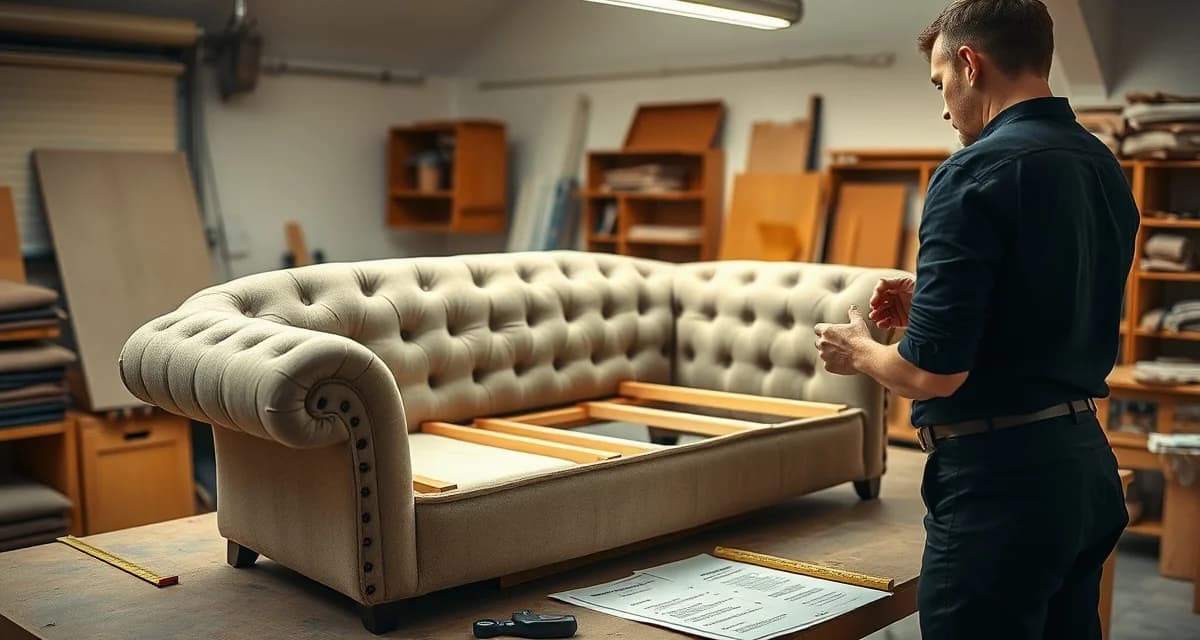
Upholstery Pricing by Sofa Style: Why Style Matters More Than Size
Pricing a Chesterfield at Lawson rates loses $300-500 in labor on an already-priced job. That's the most expensive pricing error in sofa reupholstery, and it happens because many shops measure a sofa's footprint and price by size without accounting for the radically different labor requirements of different styles.
A 90-inch Chesterfield and a 90-inch Lawson sofa are the same size. They are completely different jobs.
TL;DR
- Accurate pricing requires knowing your actual labor rate (overhead + target wage + profit margin), not a rough estimate.
- Most shops undercharge by failing to account for pattern repeat waste, frame repair time, and non-billable admin overhead.
- A documented pricing structure with itemized line items builds client trust and reduces negotiation friction.
- Fabric markup of 20-40% over cost is standard practice in residential upholstery shops.
- Premium work (leather, tufting, custom trim) warrants a premium labor rate, which should be explicit in your quote structure.
- Consistent pricing with clear line items also makes it easier to analyze profitability by job type over time.
The Labor Time Reality by Style
Lawson Sofa: 12-15 Hours
The Lawson is the simplest production sofa style: straight arms, straight back, T-cushion or standard seat cushions, no decorative buttons or complex seaming.
What makes it efficient:
- Arms are straight and wrap in a single panel without complex shaping
- Back cushions (if present) are simple loose cushions
- Minimal curved seaming
- Fabric requirement is predictable
Price this as your baseline. Every other style is adjusted up from the Lawson.
Track Arm Sofa: 10-13 Hours
The track arm (sometimes called English arm or apartment arm) is even simpler than the Lawson, low, horizontal arms with minimal fabric. If you have a Lawson baseline, track arm sofas should price slightly below it.
Camelback Sofa: 14-18 Hours
The camelback's defining feature, the arched back with multiple camels (humps), creates significant complexity. The fabric on the back must follow the curves of the arched rail, which requires:
- Pattern matching across the arch (if patterned fabric is used)
- Curved seaming along the back rail
- Multiple fabric panels rather than the single outside back panel of a Lawson
- More time for precise tension management on curved surfaces
Add 2-6 hours over a Lawson, depending on the number of humps and the depth of the curves.
Rolled Arm Sofa (Traditional): 13-16 Hours
The rolled arm requires fabric to wrap around a tube-like arm form and meet cleanly at the front face of the arm. Achieving a smooth rolled arm without puckers or uneven tension at the crown of the roll requires technique and time.
The inside arm to outside arm transition at the arm top needs careful attention to ensure the fabric rolls evenly. This is where most pricing underestimations occur on rolled-arm sofas, the arm work looks simple but takes longer than it appears.
Chesterfield: 20-28 Hours
The Chesterfield is the most labor-intensive standard sofa style. It combines:
- Tufting across the back, arms, and sometimes the seat back
- The diamond-cut precision required for consistent button spacing
- Multiple fabric panels assembled with visible welting at every seam
- Rolled arms with a high inside arm that follows the tufted back line
- A formal finishing standard that requires consistent seam and welt quality throughout
A Chesterfield that takes 20 hours is produced by an experienced professional working efficiently. A first-time Chesterfield on a complex piece can take significantly longer.
Price Chesterfields at a multiplier of 1.5-2x your Lawson base rate, not at your standard sofa rate. The difference is not excessive, it's what the job actually costs.
Sectional Sofa: Multiple Calculations
Sectionals are not a "style" for pricing purposes, they're a configuration. Price each section as the appropriate style (each piece as a Lawson arm unit, corner unit, or chaise) and add:
- A sectional configuration premium (typically 15-20%) for the connection points, shared corner work, and coordinating all pieces
- Any pattern matching premium if the client wants the pattern to continue across the sectional
Fabric Factor Adjustments on Top of Style
The style price covers labor. Add fabric-specific labor premiums on top:
- Velvet: +25% labor
- Leather: +30% labor
- Large pattern matching (over 12-inch repeat): +20% labor
- Performance fabric: +10% labor (slightly more careful handling)
See the how to price reupholstery jobs guide for how these factors combine into a complete quote.
Communicating Style Pricing to Clients
When a client provides a Chesterfield and expects Lawson pricing, the conversation requires a brief explanation:
"The Chesterfield is a significantly more labor-intensive sofa than a standard Lawson or track-arm style. The tufting alone takes 4-6 hours for the back and arms. The total labor time for a Chesterfield is about twice a comparably sized Lawson. That's why the price is higher, it's not the size, it's the work that goes into it."
Most clients who chose a Chesterfield already understand it's a more formal, higher-craft piece. The explanation is consistent with their expectation of the piece's character.
FAQ
How do I price a Chesterfield vs a Lawson sofa?
A Chesterfield takes 20-28 labor hours compared to 12-15 hours for a Lawson of similar size. Price the Chesterfield at 1.5-2x your Lawson base rate for labor. The labor premium reflects the tufting (4-6 hours for back and arms), the rolled arm construction, the formal welt seaming at every seam junction, and the higher standard of precision required throughout. If you price a Chesterfield at your standard sofa rate, you absorb $300-500 in labor cost on every job. Clients who choose Chesterfields expect a premium, the price should reflect the craft.
Why does a Chesterfield cost more to reupholster?
Three factors: tufting, formal seam construction, and arm complexity. Tufting requires marking precise button positions, drilling through multiple foam and fabric layers, and pulling every button to a consistent depth, 4-6 hours of skilled technique on a standard Chesterfield back and arms. The formal seaming at every panel join requires precise welt application throughout. The rolled arms, which follow the tufted back line at the top, require careful tension management that straight or track arms don't. These elements together roughly double the labor time compared to a simple sofa style of equivalent size.
How do I price sofa reupholstery by style?
Start with your base labor rate and a baseline style (Lawson or track arm as the simplest production sofas). Adjust upward for complexity: rolled arm adds 10-25% over Lawson, Camelback adds 15-30%, Chesterfield adds 50-100%. Then layer fabric-specific labor premiums on top: velvet adds 25%, leather 30%, large pattern matching 20%. Calculate the fabric cost separately based on actual yardage required (including repeat waste for patterned fabric). Add your markup on fabric and materials. The total is your quoted price. Never use a single rate for all sofa styles, the labor time variation between styles is too significant to average out profitably.
How do I set an hourly labor rate for my upholstery shop?
Start with your actual cost per hour: divide total monthly overhead (rent, utilities, insurance, supplies, equipment) by your billable hours per month, then add your target wage per hour. Apply a profit margin of 20-35% on top of that base. Most residential upholstery shops in 2025 bill $65-120/hour depending on location and specialization. Urban markets and shops specializing in antiques or premium leather command the higher end of that range.
How do I handle clients who want to negotiate the price?
The most effective response to price negotiation is to explain what the price covers, not to simply lower it. Walk the client through the labor time, fabric cost, and any structural work required. If the client needs a lower price, offer to adjust the scope (simpler fabric, no welt cording, tight seat instead of loose cushion) rather than discounting the same work. Discounting without scope changes devalues your labor and creates an expectation of discounting on future jobs.
Sources
- National Upholstery Association
- Association of Master Upholsterers and Soft Furnishers (AMUSF)
- Upholstered Furniture Action Council (UFAC)
- Furniture Today (trade publication)
Get Started with StitchDesk
Pricing confidence comes from knowing your actual costs and communicating them clearly in every quote. StitchDesk helps upholstery shops build detailed quotes, track job costs against estimates, and develop pricing that protects margins across every job type. Try StitchDesk free and bring precision to your pricing.