Sofa Reupholstery Guide: Every Style Covered Professionally
Professional sofa reupholstery takes 12 to 20 hours depending on style. Shops that estimate by size not style lose margin on every Chesterfield and every camelback they quote at the same rate as a Lawson sofa. A Lawson in solid fabric at 12 hours is a very different job from a Chesterfield with 60-button tufting at 20-22 hours. Both might be described as a "3-cushion sofa" by a client on the phone.
This guide covers the professional approach to 6 distinct sofa styles, with the technique decisions unique to each.
TL;DR
- Successful reupholstery starts with a thorough frame and spring assessment before any fabric is ordered.
- Professional technique follows a consistent panel sequence: strip, repair frame, replace foam, then install fabric panels in the correct order.
- Pattern fabric requires centering and repeat alignment decisions made before cutting; errors discovered after cutting are expensive to correct.
- Professional labor time ranges from 20-22 hours depending on furniture style and fabric complexity.
- Foam selection matters as much as fabric selection; the right density and ILD creates the correct seating profile and longevity.
- Consistent tension on all panels and quality welt cording are the marks of professional finishing.
Style 1: Lawson Sofa
The Lawson sofa has square or slightly tapered arms with a back that's higher than the arms. It's the most common contemporary residential style and the baseline for standard sofa technique.
Defining characteristics: T-cushion or square cushions, rolled or track arms at approximately arm height, back cushions or tight back.
Panel sequence: Deck, inside arms, inside back, seat cushions (assemble separately), back cushions (assemble separately), outside arms, outside back, front arm panels, dust cover.
Technique focus: The arm-to-back junction. On a Lawson, the inside arm typically tucks behind the inside back at the side. Pull the inside back firmly into the arm junction without creating a visible dimple or gap. The welt cord at the outside arm front edge should be consistent in pull and tension.
Time estimate: 12-14 hours for an experienced upholsterer.
Style 2: Chesterfield Sofa
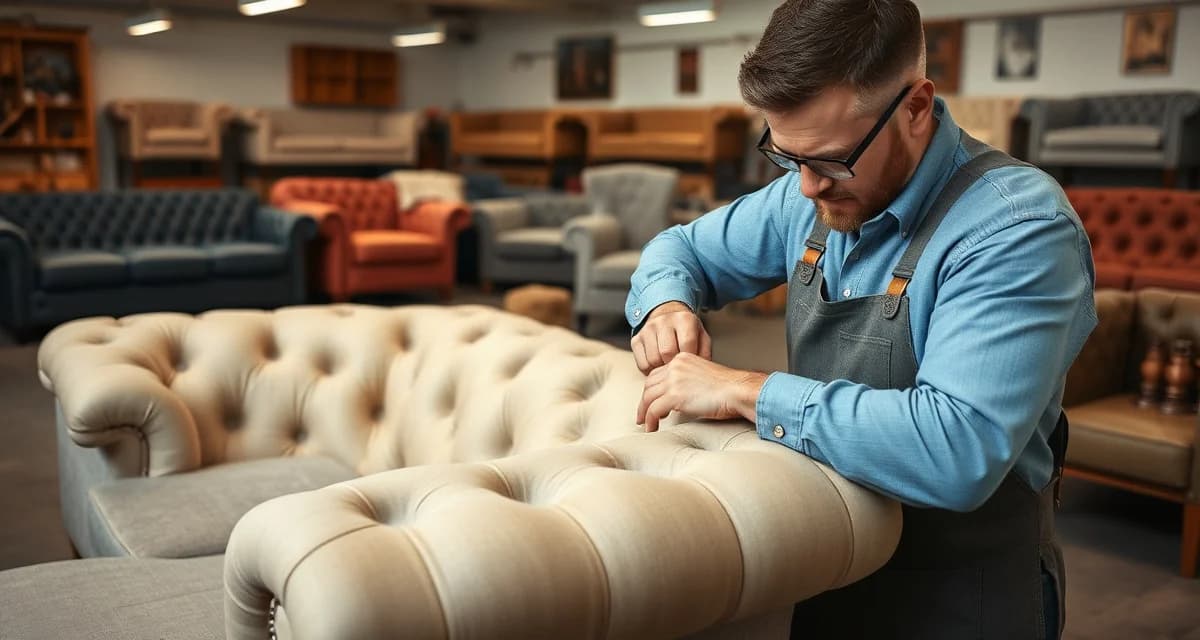
The Chesterfield has fully tufted back and seat, rolled arms at back height, and the entire sofa (including arms) is often tufted.
Defining characteristics: Button tufting throughout, rolled arms that are the same height as the back, tight-seat and tight-back (no loose cushions in traditional Chesterfield design).
Panel sequence: This diverges from standard sequence because tufting is done during panel installation, not after.
- Seat platform: mark button positions before applying fabric. Begin tufting from center outward as fabric is attached.
- Inside arms: mark and tuft during installation.
- Inside back: most button-intensive panel. Mark all button positions on foam. Begin tufting from center outward.
- Outside arms (no tufting, close panel)
- Outside back (no tufting)
- Dust cover
Tufting on curved Chesterfield arms: The rolled arm and back continuous curve means tufting extends around the arm crest. Manage the tufted fabric around the roll using the same notching principle as barrel chairs, relief cuts at the top edge allow the tufted fabric to follow the roll without distortion.
Time estimate: 18-22 hours due to button work.
Style 3: Camelback Sofa
The camelback sofa has a curved back rail with a characteristic single or double hump at the center-top of the back.
Defining characteristics: Curved (camelback) top back rail, often rolled arms, typically traditional style.
Panel sequence: Same as Lawson sofa sequence.
Technique focus: The inside back top edge must follow the camelback curve without puckering. Use the same notching technique as barrel chairs: relief cuts spaced every 1/2-3/4 inch along the top back edge before stapling. The number of notches and their depth depend on the steepness of the camelback profile.
Pattern note: Pattern placement on the inside back of a camelback sofa is complicated by the curved top rail. A symmetrical pattern (centered horizontally and vertically) will appear to curve at the top edge because the top rail curves. Plan pattern placement with the curve in mind, or use solid fabric to avoid the issue.
Time estimate: 13-16 hours (add 1-2 hours over Lawson for camelback notching and inside back complexity).
Style 4: Pillow-Back Sofa
A pillow-back sofa has loose back cushions that rest against an upholstered back panel. The seat may be T-cushion or standard cushion.
Defining characteristics: Multiple loose back cushions (3 or more), upholstered back panel, modern or transitional style.
Panel sequence: Deck with rear tuck allowance, inside arms, inside back (frame panel, not cushion), seat cushions (assemble separately), back cushions (assemble separately), outside arms, outside back, front arm panels, dust cover.
Technique focus: The deck tuck. The back cushions rest against the inside back and sit on the deck. Leave a 3-4 inch fabric tuck at the rear of the deck (as described in the loveseat guide) so back cushions sit flat against the inside back without a visible ridge at the deck-to-back junction.
Back cushion variation: Some pillow-back sofas have back cushions that are taller than the back frame. These "over-sized" back cushions lean slightly forward when placed. This is typical and expected, the back cushion size is intentionally relaxed.
Time estimate: 14-17 hours (back cushion construction adds time).
Style 5: Tight-Back Sofa
A tight-back sofa has no loose back cushions. The back is upholstered directly to the frame.
Defining characteristics: No loose back cushions, back fabric pulled flat to the frame, often contemporary or minimal style.
Panel sequence: Standard sequence but no back cushion construction.
Technique focus: Inside back tension. With no cushion to soften the visual, any tension inconsistency in the inside back is immediately visible. Pull the inside back fabric from the center outward in all four directions, maintaining consistent tension across the full panel. Use a long straight ruler or straightedge to check that the fabric lies perfectly flat with no diagonal pulls.
Time estimate: 11-13 hours (saves 1-2 hours vs pillow-back because no back cushion construction).
Style 6: Rolled-Arm Traditional Sofa
A fully rolled-arm traditional sofa has rolled arms (English roll or standard roll), typically spring construction, and traditional-style details.
Defining characteristics: Rolled arms, often spring construction, traditional fabric choices, may have trim, fringe, or nail head.
Panel sequence: Same as standard but with additional arm considerations.
Rolled arm technique: The arm boxing (the strip that follows the roll profile) is installed before the inside and outside arm panels. The boxing creates the curved form that the arm panels attach to. Cut the boxing strip slightly curved (not straight) to follow the arc of the roll.
Trim application: Traditional sofas often have applied trim (gimp braid, nail head, fringe). Apply all trim as the last step before delivery, not during installation. Nail head is applied after all fabric panels are stapled and checked.
Time estimate: 16-20 hours depending on spring condition and trim complexity.
For yardage by sofa style, use the sofa fabric yardage calculator. The step-by-step tear-down and technique guide for a standard sofa is at how to reupholster a sofa guide.
Frequently Asked Questions
How long does sofa reupholstery take?
It depends heavily on style: Lawson or tight-back contemporary: 11-14 hours. Pillow-back with multiple cushions: 14-17 hours. Camelback or rolled-arm traditional: 14-18 hours. Chesterfield with full tufting: 18-22 hours. These are professional upholsterer hours (not elapsed calendar days). Most shops schedule 3-7 calendar days for a sofa depending on production load and sofa complexity.
What is the hardest sofa style to reupholster?
The Chesterfield is the most time-intensive due to button tufting throughout. Diamond-tufted backs and seats with 50-80 buttons each require precise layout, center-outward installation, and careful pleat management. The tufted rolled arms add another layer of complexity because the tufting must follow the arm's curved profile. A Chesterfield takes 50-75% more time than a same-size Lawson sofa, which is fully justified in the price difference.
How do I reupholster a Chesterfield sofa?
Mark all button positions on the foam before applying any fabric. Begin every panel from the center button outward, never from a corner or edge. On the inside back (the most button-dense panel), set the center button first, then the row at center-height, then center-width, filling in quadrants from center outward. Between buttons, fold fabric into consistent directional pleats pointing toward each button. For the tufted rolled arms, use relief notching at the arm crest to allow the tufted fabric to follow the roll without distortion.
What tools are required for professional reupholstery?
Professional reupholstery requires a heavy-duty staple gun (pneumatic or electric), a staple remover and tack puller, quality scissors and a rotary cutter, a sewing machine capable of sewing upholstery-weight fabric, foam cutting tools, and regulator pins for manipulating stuffing. For tufted work, a curved needle and tufting twine are also required. The quality of your tools directly affects the quality of the finished work, particularly at seams and edges.
How do I handle pattern matching across multiple panels?
Establish the dominant panel first (usually the inside back) and center the pattern motif there. Then cut each subsequent panel so the pattern aligns with the adjacent panel at the seam. Mark the pattern alignment point on each piece before cutting. For complex pieces, some upholsterers make a cutting plan on paper showing where each panel falls in the pattern before cutting any fabric. This investment in planning prevents the most common and costly pattern-matching errors.
Related Articles
Sources
- National Upholstery Association
- Association of Master Upholsterers and Soft Furnishers (AMUSF)
- Upholstered Furniture Action Council (UFAC)
- Furniture Today (trade publication)
Get Started with StitchDesk
Accurate reupholstery quotes require knowing your labor time, material costs, and overhead for each job type. StitchDesk helps upholstery shops build detailed, professional quotes that account for all cost factors, so every job is priced to cover costs and generate profit. Try StitchDesk free and bring accuracy to every estimate you send.