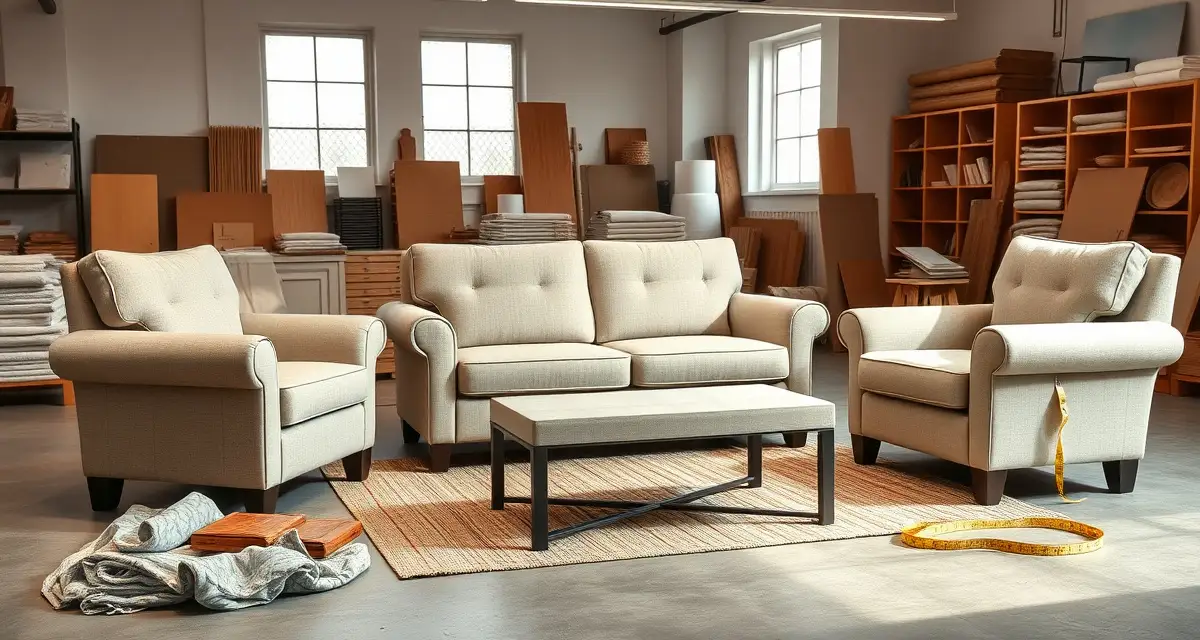
Sofa Set Fabric Yardage: Sofa Loveseat and Chair in One Order
A living room sofa set, sofa, loveseat, and accent chair, is the largest residential fabric order a client will place in most cases. When all three pieces are done at the same time in the same fabric, the calculation needs to account for all three together, not just each piece independently.
The key reason: ordering fabric for a sofa set separately versus together wastes 1 to 2 yards in dye-lot splitting across three orders. Order all three at once from a single dye lot, and you simplify the matching question entirely.
TL;DR
- Upholstery For Sofa Set yardage depends on fabric width, construction details, pattern repeat, and nap direction.
- Plain 54-inch fabric requires a baseline calculation plus 10-15% waste allowance for a standard upholstery for sofa set job.
- Patterned fabric adds 20-35% to base yardage depending on repeat size and the number of cutting zones that must align.
- Directional fabrics add 15-25% over plain fabric because layout optimization is restricted by nap direction.
- Always verify fabric width before finalizing yardage; COM fabric often comes in non-standard widths.
- Calculating yardage at the quote stage, not mid-job, eliminates reorders and protects your profit margin.
Per-Piece Yardage for a Standard Set
These figures are for solid fabric in 54-inch width, standard arm style (English arm), pillow-back configuration:
3-cushion sofa (84 inches): 13 to 16 yards
2-cushion loveseat (60 inches): 9 to 11 yards
Standard arm chair: 4 to 5 yards
Total set (solid fabric): 26 to 32 yards
This is a notable fabric order. At $30/yard trade pricing, that's $780 to $960 in fabric cost for the set, before any pattern repeat, directional pile, or other complexity factors.
Why Order All Three Together
Dye lot consistency: When you order all three pieces from a single dye lot, the fabric is color-consistent across the entire set. Order each piece separately and you risk dye lot variation between orders, subtle on solid fabrics, more visible on textured or rich-color fabrics.
Pattern alignment: For patterned fabric, ordering for all three pieces at once lets you plan the pattern layout across the set. If the sofa has a centered motif, the loveseat and chair should also have centered or related placement. Planning this with a single fabric order (and enough total yardage) prevents the scramble of trying to achieve alignment from two or three separate cuts.
Cost efficiency: Single larger orders may qualify for better pricing at some suppliers. Shipping one order instead of three saves shipping fees if your supplier charges by order.
Pattern Matching Across a Sofa Set
For a set with patterned fabric, the matching question becomes: how consistent should the pattern placement be across all three pieces?
Option 1: Independent centering on each piece. Each piece has the pattern centered on its seat cushions and major panels independently. The pattern looks intentional on each piece but doesn't try to align across the three pieces as a group. This is the most common approach and requires the least additional yardage beyond normal pattern repeat waste.
Option 2: Coordinated placement across the set. The pattern elements on the sofa, loveseat, and chair relate to each other visually: for example, all centered on the same part of the repeat so that when the pieces are arranged in a room, the pattern reads as a continuous family. This requires more careful cutting layout planning and potentially more yardage.
For most residential clients, Option 1 is appropriate and looks excellent. Option 2 is worth discussing for designer clients who are deeply invested in the visual outcome and where the three pieces will be very visible together in an open-plan space.
Using the Set Planner Calculator
StitchDesk's sofa set planner lets you input sofa, loveseat, and chair dimensions simultaneously. The calculator builds all three yardage calculations at the same time and sums them into a single order with pattern matching requirements automatically included for patterned fabric.
This gives you one number to order to rather than three separate numbers to manually add. It also flags if the three-piece total qualifies for any minimum-order pricing thresholds at common suppliers.
Tight-Back vs. Pillow-Back Impact on Set Yardage
If the set is tight-back rather than pillow-back, the total yardage for the set reduces considerably because loose back cushions are the largest single fabric consumer on each piece:
Tight-back 3-piece set (same dimensions):
- Sofa: 11 to 13 yards
- Loveseat: 7 to 9 yards
- Chair: 3 to 4 yards
- Total: 21 to 26 yards (versus 26 to 32 yards for pillow-back)
If a client hasn't specified back style and it's ambiguous from the piece, confirm before calculating. The difference between tight-back and pillow-back yardage for a full set can be 5 to 6 yards, at $30/yard, that's $150 to $180 that matters.
Frequently Asked Questions
How much fabric for a sofa set?
A standard 3-piece sofa set (3-cushion sofa, 2-cushion loveseat, arm chair) in solid fabric requires approximately 26 to 32 yards total in pillow-back configuration, or 21 to 26 yards in tight-back. Patterned fabric adds 4 to 8 yards depending on repeat size. Order all three pieces from a single dye lot.
Can I order one fabric for sofa loveseat and chair?
Yes, and it's the recommended approach. Ordering all three pieces together ensures color consistency, allows pattern alignment planning, and may save on shipping costs. Calculate yardage for all three pieces simultaneously, sum the total, add your buffer, and place one order.
How do I match patterns across a sofa set?
The most common approach is to center the pattern independently on each piece, seat cushions centered on the major motif, inside back panel centered. This looks intentional and coordinated on each piece individually without requiring the more complex cross-piece alignment that would consume additional yardage. For high-end designer work where the pieces will be prominently visible together, cross-piece alignment can be planned with enough additional yardage to execute.
What is the biggest factor in yardage variation for this piece?
Pattern repeat is the biggest source of yardage variation. On plain fabric, the baseline calculation plus a 10-15% waste buffer is usually sufficient. Add a 13-inch pattern repeat and you may need 15-20% more. Add a 27-inch pattern repeat and the additional yardage can be 25-35% over the plain fabric calculation. Nap direction is the second-largest factor, typically adding 15-25% over plain fabric because layout optimization is restricted.
How do I verify I have enough fabric before starting?
Calculate the yardage zone by zone before making any cuts. Lay out all required cuts on paper or digitally to confirm they fit in the available fabric. If you are working with COM fabric at or near the minimum yardage, verify the width and inspect for any defects that would require cutting around them. It is far easier to order more fabric before cutting begins than to source a match mid-job.
Sources
- National Upholstery Association
- Association of Master Upholsterers and Soft Furnishers (AMUSF)
- Upholstered Furniture Action Council (UFAC)
- Furniture Today (trade publication)
Get Started with StitchDesk
Getting yardage right on upholstery for sofa set jobs is the difference between a profitable quote and an expensive reorder. StitchDesk's fabric calculator accounts for all the variables that cause errors: pattern repeat by zone, nap direction, fabric width, and cushion configuration. Start a free trial and see how accurate yardage calculation affects your bottom line.