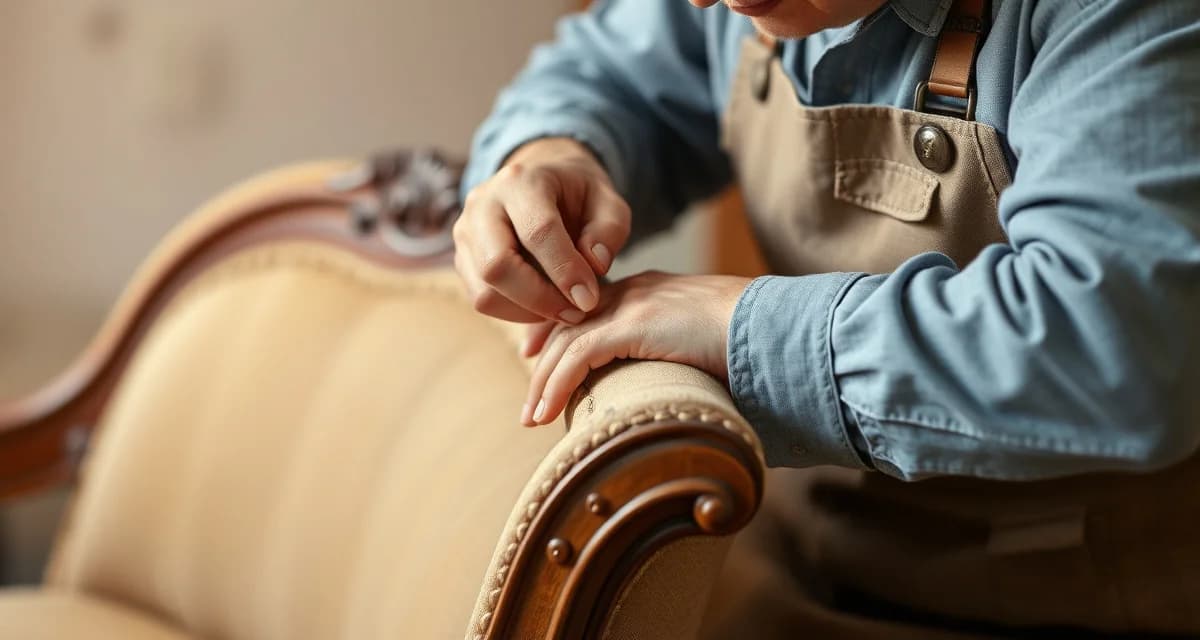
Antique Furniture Reupholstery: Preserve Value While Updating Fabric
Using staples on antique frames can reduce resale value by 20 to 40 percent. Collectors and antique dealers can identify staple gun marks in wood. The distinctive rectangular puncture pattern of modern staple guns is an immediate signal that the piece has been worked on with modern tools in ways that are inconsistent with the original manufacture. For clients with valuable antique furniture, this matters.
This guide covers value-impact assessment, period-appropriate techniques, and fabric selection for antique furniture reupholstery.
TL;DR
- Successful reupholstery starts with a thorough frame and spring assessment before any fabric is ordered.
- Professional technique follows a consistent panel sequence: strip, repair frame, replace foam, then install fabric panels in the correct order.
- Pattern fabric requires centering and repeat alignment decisions made before cutting; errors discovered after cutting are expensive to correct.
- Professional labor time ranges from 12-20 hours depending on furniture style and fabric complexity.
- Foam selection matters as much as fabric selection; the right density and ILD creates the correct seating profile and longevity.
- Consistent tension on all panels and quality welt cording are the marks of professional finishing.
When Antique Value Is a Factor
Not all old furniture is a collectible antique. The distinction matters for how you approach the job.
Assess value potential before starting. A Victorian parlor chair from the 1880s with original horsehair stuffing and a hand-carved walnut frame is a different project from a reproduction Victorian chair made in the 1960s. Both might look similar, but the original is worth preserving carefully and the reproduction can be treated with modern technique.
Signs that a piece may have collectible value:
- Hand-carved or hand-detailed woodwork (not router-cut reproduction details)
- Original stuffing materials (horsehair, cotton batting, coil springs tied by hand)
- Dovetail or mortise-and-tenon frame construction visible at joints
- Paper labels, stamps, or maker's marks on the underside
- Provenance documentation from the client
- Consistent wear patterns that indicate genuine age vs artificially distressed reproduction
When in doubt, ask the client. Many clients don't know the value or history of a piece. If you have a piece that might be notable, recommend they consult an antiques appraiser before proceeding. This protects both them and you.
Value-Impact Assessment: Methods That Preserve vs Methods That Diminish
| Technique | Value Impact | Notes |
|---|---|---|
| Hand tacking | Neutral/positive | Period-appropriate, reversible |
| Staple gun | Reduces by 20-40% | Visible puncture pattern in wood |
| Hand stitching closing seams | Neutral | Period-appropriate |
| Hot glue at seams | Reduces value | Modern adhesive is non-reversible |
| Horsehair or cotton stuffing | Preserves/improves value | Period-appropriate materials |
| Modern foam replacement | Reduces value for collectors | Not period-appropriate |
| Original spring restoration | Preserves value | Maintains original suspension |
| Spring replacement with sinuous | Reduces value | Changes the piece's character |
The guiding principle is reversibility. Period-appropriate techniques can be undone by a future restorer without damaging the frame. Modern shortcuts are often irreversible.
Period-Appropriate Techniques
Tack Application
Use cut tacks (also called upholstery tacks), not a staple gun. Cut tacks come in standard sizes for upholstery (#3, #5, #6, #7) and are driven with a tack hammer. The small round head of a cut tack leaves a much smaller mark than a staple and is consistent with how the original piece was made.
Tacking is slower than stapling but not dramatically so once you've developed the rhythm. For a wing chair with period technique, budget 20-25% more labor time than for a modern stapled version.
Stuffing Materials
Victorian and earlier furniture was originally stuffed with:
- Curled horsehair (the highest grade)
- Processed cotton batting
- Tow fiber and cotton combinations
- Coir fiber (coconut fiber) as a base layer
Horsehair is still available from specialty upholstery suppliers and from antique dealers who sell salvage materials. It's more expensive than foam but appropriate for pieces where value preservation matters.
For less valuable pieces or for clients who want the period look without full period materials, high-quality cotton batting over firm foam can approximate the character of original stuffing.
Coil Spring Restoration
Traditional antique furniture uses 8-way hand-tied coil springs. If the original springs are intact but have loose twine, retying them is the correct approach, not replacing them.
Retie using appropriate spring twine (not modern nylon cord, which isn't period-appropriate). The 8-way hand tie pattern ties each spring to its neighbors in 8 directions, creating the characteristic feel of traditional spring construction.
Completely failed springs can be replaced with matching size coil springs (not sinuous springs, which are a modern substitute). The replacement spring should be identical in coil count and height to the original.
Fabric Selection for Antique Furniture
Period-appropriate fabric choices for Victorian and earlier pieces:
1880s-1910s (Victorian and Edwardian): Damask, brocade, velvet, needlepoint, tufted materials. Rich jewel tones (burgundy, forest green, sapphire blue) or neutral tones (cream, ivory). Pattern scale matched to the piece, ornate pieces can carry large patterns; simpler forms suit smaller patterns.
1820s-1870s (Empire and Rococo Revival): Silk damask and horsehair fabric (woven from actual horsehair, available from specialty suppliers). Striped and medallion patterns. Bold contrast borders.
1700s and early 1800s (Georgian, Federal): Fine wool fabrics, silk, and linen. Toile de Jouy prints. Embroidered panels. Simpler patterns appropriate to the Federal aesthetic.
When clients insist on modern performance fabric: This is their piece and their decision. If they want performance fabric on a Victorian chair for practical reasons, discuss the value implications but honor their choice. Modern performance fabrics can be selected in traditional colorways and patterns that are visually period-appropriate even if the material itself isn't.
The Client Conversation
The most important part of antique furniture reupholstery is the conversation before you start. Cover:
- Does the client know the piece's provenance and potential value?
- Do they want value-preserving technique or are they focused on appearance only?
- What is their budget flexibility for period-appropriate materials?
- Are they keeping the piece as a family heirloom or might it eventually be sold?
Clients who understand the value implications make better decisions. Clients who later discover their $800 antique chair lost half its value because of staple holes are unhappy clients.
The upholstery fabric for antiques guide covers period-appropriate fabric selection in more detail. For yardage calculation on antique chairs and sofas, use the antique chair yardage calculator.
Frequently Asked Questions
How do I reupholster an antique chair without losing value?
Use hand tacking instead of a staple gun, hand-stitch closing seams instead of using hot glue or stapled blind tacks, and use period-appropriate stuffing materials (horsehair or quality cotton batting) rather than foam. Restore original coil springs rather than replacing them with modern sinuous springs. Confirm the client is aware that modern technique (especially stapling) can reduce the piece's value by 20-40% to antique collectors before beginning work.
What fabric is appropriate for Victorian antique furniture?
Victorian furniture (approximately 1840-1900) is most period-appropriate with damask, brocade, velvet, or needlepoint fabric. Rich jewel tones (burgundy, forest green, sapphire, gold) are historically accurate. Reproduction Victorian fabrics are available from specialty fabric suppliers in patterns and weights consistent with the originals. Avoid polyester performance fabrics and bold contemporary patterns, which read as anachronistic on Victorian pieces even when the colors are appropriate.
Should I restore or replace foam in antique furniture?
For antique furniture with collectible value, restore rather than replace whenever possible. Original horsehair or cotton stuffing that has compressed can be supplemented with additional batting rather than entirely replaced. If stuffing must be replaced due to hygiene issues or total compression failure, use horsehair or quality cotton batting rather than foam, which wasn't used in original Victorian or earlier construction. Clients who want foam comfort in an antique frame can have it with the understanding that it changes the character of the piece.
What tools are required for professional reupholstery?
Professional reupholstery requires a heavy-duty staple gun (pneumatic or electric), a staple remover and tack puller, quality scissors and a rotary cutter, a sewing machine capable of sewing upholstery-weight fabric, foam cutting tools, and regulator pins for manipulating stuffing. For tufted work, a curved needle and tufting twine are also required. The quality of your tools directly affects the quality of the finished work, particularly at seams and edges.
How do I handle pattern matching across multiple panels?
Establish the dominant panel first (usually the inside back) and center the pattern motif there. Then cut each subsequent panel so the pattern aligns with the adjacent panel at the seam. Mark the pattern alignment point on each piece before cutting. For complex pieces, some upholsterers make a cutting plan on paper showing where each panel falls in the pattern before cutting any fabric. This investment in planning prevents the most common and costly pattern-matching errors.
Related Articles
Sources
- National Upholstery Association
- Association of Master Upholsterers and Soft Furnishers (AMUSF)
- Upholstered Furniture Action Council (UFAC)
- Furniture Today (trade publication)
Get Started with StitchDesk
Accurate reupholstery quotes require knowing your labor time, material costs, and overhead for each job type. StitchDesk helps upholstery shops build detailed, professional quotes that account for all cost factors, so every job is priced to cover costs and generate profit. Try StitchDesk free and bring accuracy to every estimate you send.