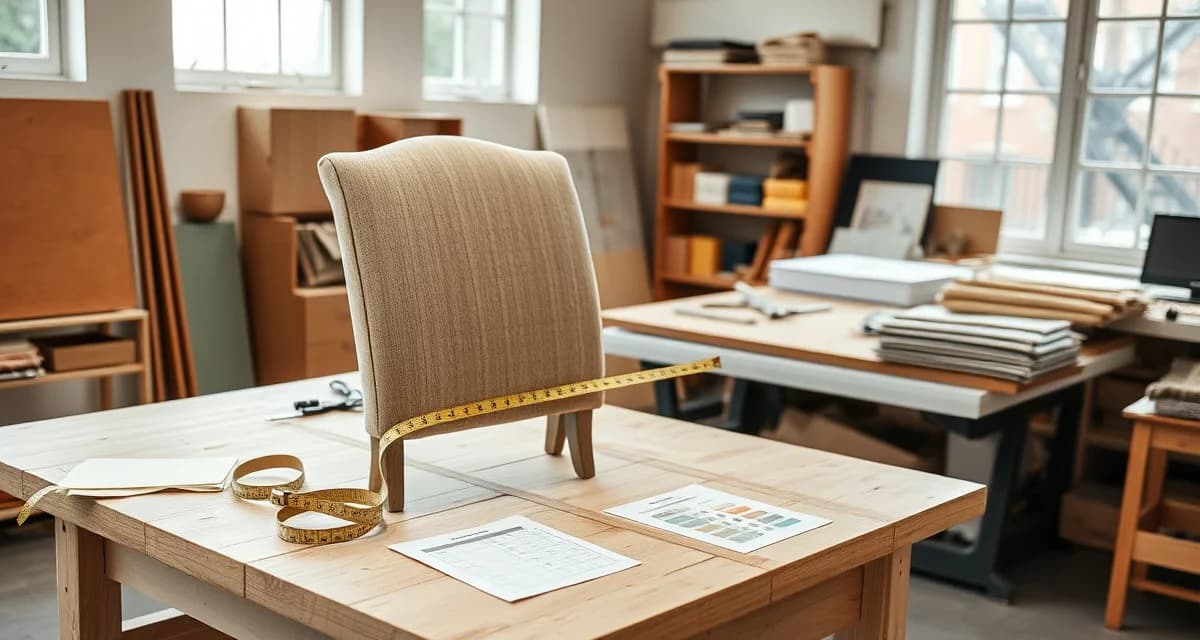
How to Calculate Fabric for Dining Chair Seats Only: Quick Method
Recovering dining chair seats is the fastest, most common 1-day job in residential upholstery. A client calls, says they want the seat pads on their dining chairs freshened up, wants a price. If you can give them a number in 2 minutes, you get the job. If you say you'll need to see the chairs first, you probably lose it.
The calculation is genuinely simple once you have the right process.
TL;DR
- Calculate Dining Chair Seat Only yardage depends on fabric width, construction details, pattern repeat, and nap direction.
- Plain 54-inch fabric requires a baseline calculation plus 10-15% waste allowance for a standard calculate dining chair seat only job.
- Patterned fabric adds 20-35% to base yardage depending on repeat size and the number of cutting zones that must align.
- Directional fabrics add 15-25% over plain fabric because layout optimization is restricted by nap direction.
- Always verify fabric width before finalizing yardage; COM fabric often comes in non-standard widths.
- Calculating yardage at the quote stage, not mid-job, eliminates reorders and protects your profit margin.
What You Need to Know Over the Phone
For a seat-only dining chair job, the two pieces of information that determine yardage are:
- How many chairs?
- What are the approximate seat dimensions? (Standard dining chair seats are typically 16 to 20 inches wide and 15 to 18 inches deep)
If the client doesn't know exact measurements, you can estimate based on typical dining chair proportions. Most standard dining chairs fall within a narrow range, and your phone estimate can reflect that.
The Per-Seat Yardage Calculation
A dining chair seat pad has just two components if it's a simple pad style:
- Top face
- Underside (often cambric or secondary fabric, but if face fabric wraps under, account for it)
For a standard rectangular seat, 18 x 17 inches, in 54-inch fabric:
- You can typically fit 3 seat cuts per row of fabric at 18-inch width (54 ÷ 18 = 3 chairs per row)
- Depth of each cut: 18 inches (17-inch seat + seam allowance and wrap)
- One row of fabric at 18-inch depth = 0.5 yards
- 3 seats per 0.5-yard row = approximately 0.17 yards per seat
For a set of 6 standard dining chair seats in solid fabric: approximately 1 to 1.25 yards total.
That's a quick phone number. "For solid fabric on 6 standard dining chair seats, you're looking at about 1 to 1.5 yards."
Seat-Only vs. Full Chair Calculation
Seat-only jobs are a fraction of full chair reupholstery:
- Seat-only, 6 chairs, solid fabric: 1 to 1.5 yards
- Full chair (seat + back panel + any cushioned sections), 6 chairs: 4.5 to 6 yards
Clients asking about seat-only recovery often aren't sure whether they should do just the seats or the whole chair. Having these numbers ready lets you explain the difference clearly: "To do just the seats, you're looking at about 1.5 yards of fabric. To do the whole chair including the back panel, it's closer to 5 yards. The price difference in fabric is roughly X, want me to put together numbers for both?"
That's a useful upsell conversation that serves the client.
Pattern Matching for a Set
The main complication for seat-only chair sets is pattern matching, having the same part of the pattern centered and aligned on each seat across the set.
For a 6-chair dining set in a 9-inch pattern repeat fabric:
Without pattern matching: seats can be cut anywhere in the repeat sequence. This is most efficient but looks inconsistent if the pattern is obvious and customers are sitting around the table together.
With pattern matching: each seat must start at the same point in the pattern repeat. This wastes the fabric between each aligned cut. On a 9-inch repeat with a 17-inch seat, every other cut can be aligned and every other cut is wasted. Roughly doubles the pattern waste.
For a 6-chair set with matching: add 1.5 to 2 yards over the solid fabric estimate.
Clients choosing a patterned fabric for dining chairs are often specifically thinking about how it will look at the table, bring up the matching question proactively: "With this pattern, do you want the design centered the same way on each seat? If so, I'll need a bit more fabric for matching."
The Quick-Turn Workflow
Dining chair seat jobs run fastest when the client drops off all their chairs, you recover all the seats at once, and they pick them up same day or next day.
For 6 standard seats recovered while the client waits: 1 to 2 hours depending on whether you're pulling old fabric and replacing foam.
This is the upholstery version of an oil change, fast, predictable, profitable if priced correctly. Price it too low and you're doing expensive quick-turn work for nothing. Price it right (typically $30 to 60 per seat for labor plus materials) and it's a reliable revenue stream.
The dining chair reupholstery yardage guide has the full calculation breakdown for complete dining chair jobs when clients want to go beyond seat-only.
Frequently Asked Questions
How much fabric for dining chair seats only?
For a standard set of 6 dining chairs with seat pads only (16 to 18 inches wide), plan on 1 to 1.5 yards of solid 54-inch fabric. For 4 chairs: 0.75 to 1 yard. For 8 chairs: 1.5 to 2 yards. Pattern fabric with matching adds 1.5 to 2 yards across the set depending on pattern repeat size.
Can I recover just the seat of a dining chair?
Yes, and it's one of the most common residential upholstery jobs. Dining chair seats are typically a drop-in pad style, the pad is held on by a few screws through the frame and lifts out easily. Recovering just the seat takes 10 to 20 minutes per chair and can extend the life of chairs where the frame and back are in good condition.
How do I calculate yardage for 6 dining chair seat pads?
Measure one seat width and depth. Determine how many seats fit per row of your fabric width (54 ÷ seat width, rounded down). Calculate the depth in yards of each row (seat depth + seam allowance and wrap, divided by 36). Multiply rows needed by depth per row. For a typical 18-inch wide seat in 54-inch fabric: 3 seats per 0.5-yard row means 6 seats need 2 rows = 1 yard total, plus a small buffer.
What is the biggest factor in yardage variation for this piece?
Pattern repeat is the biggest source of yardage variation. On plain fabric, the baseline calculation plus a 10-15% waste buffer is usually sufficient. Add a 13-inch pattern repeat and you may need 15-20% more. Add a 27-inch pattern repeat and the additional yardage can be 25-35% over the plain fabric calculation. Nap direction is the second-largest factor, typically adding 15-25% over plain fabric because layout optimization is restricted.
Related Articles
Sources
- National Upholstery Association
- Association of Master Upholsterers and Soft Furnishers (AMUSF)
- Upholstered Furniture Action Council (UFAC)
- Furniture Today (trade publication)
Get Started with StitchDesk
Getting yardage right on calculate dining chair seat only jobs is the difference between a profitable quote and an expensive reorder. StitchDesk's fabric calculator accounts for all the variables that cause errors: pattern repeat by zone, nap direction, fabric width, and cushion configuration. Start a free trial and see how accurate yardage calculation affects your bottom line.