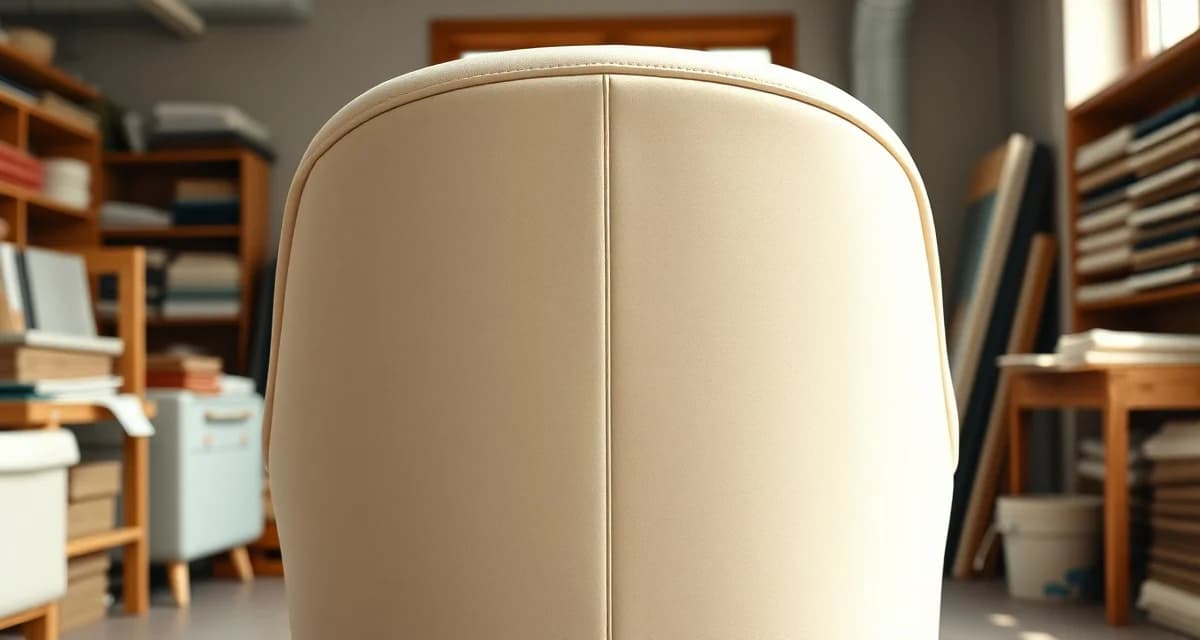
Tub Chair Fabric Yardage Calculator: Continuous Back and Seat Curve
The tub chair looks simple. Round, compact, friendly proportions. And for most of the chair, the calculation is straightforward. The challenge is the continuous back-to-seat curve, the inside back panel and seat panel aren't two separate rectangles. They're one continuous curved surface.
Cut them as separate pieces and you run short by 0.5 to 0.75 yards every time. That's the math problem this guide solves.
TL;DR
- Tub Chair yardage depends on fabric width, construction details, pattern repeat, and nap direction.
- Plain 54-inch fabric requires a baseline calculation plus 10-15% waste allowance for a standard tub chair job.
- Patterned fabric adds 20-35% to base yardage depending on repeat size and the number of cutting zones that must align.
- Directional fabrics add 15-25% over plain fabric because layout optimization is restricted by nap direction.
- Always verify fabric width before finalizing yardage; COM fabric often comes in non-standard widths.
- Calculating yardage at the quote stage, not mid-job, eliminates reorders and protects your profit margin.
What Is a Tub Chair and Why Does It Calculate Differently?
A tub chair (also called a tub armchair or round barrel chair) has a rounded, continuous back that curves around the sitter. The back doesn't meet the seat at a right angle, it curves down and forward, transitioning from vertical at the top to roughly 45 degrees at the seat. In some tub chair designs, the inside back panel flows continuously from the top of the back all the way to the front edge of the seat in one unbroken curve.
This continuous curve is the defining construction challenge. On a standard sofa or arm chair, inside back and seat are separate panels with a seam at the deck. On a tub chair, if you're following the traditional construction, those surfaces may be cut from a single continuous piece that wraps the interior of the "tub."
The problem with cutting as two separate pieces: you need extra seam allowance at the junction, and more importantly, you need to accommodate the curve of the transition. A flat rectangle cut to the combined height of back + seat will be too short for the actual surface area of the curved path from back top to seat front. The curved surface is always longer than the straight-line measurement between its endpoints.
Tub chairs cut as two separate pieces consistently run short by 0.5 to 0.75 yards due to curve seam requirements.
Calculating the Continuous Curve Length
The inside surface of a tub chair's back-to-seat transition follows an arc. To calculate the actual fabric length needed for this surface:
Option A: Template method (most accurate)
Pull the existing cover off the chair or create a pattern directly from the foam/batting. Trace the actual inside surface from the top of the back to the front edge of the seat on paper. Measure the traced length. This is your panel height. Add seam allowances.
Option B: Arc calculation
If you know the back height (vertical), seat depth (horizontal), and the radius of the back-to-seat curve:
The arc length formula is: L = r × θ (where r is the radius and θ is the angle in radians)
For a quarter-circle transition (90 degrees, π/2 radians): L = r × 1.57
If the curve radius at the back-to-seat transition is 4 inches, the arc adds 6.3 inches of fabric length over a straight-corner cut. For a 6-inch radius, it adds 9.4 inches. Over the full width of the inside back panel, that's notable.
Option C: Measurement estimate
Add 8 to 12 inches to the sum of inside back height and seat depth. This accounts for the transition arc without requiring precise radius measurement. Use 8 inches for gentle curves, 12 inches for pronounced curves.
Tub Chair Yardage Reference
These figures assume the continuous inside back-to-seat panel is calculated correctly.
Small tub chair (26-30 inch width): 4 to 5.5 yards
Standard tub chair (30-36 inch width): 5 to 6.5 yards
Large tub chair or oversized barrel: 6 to 8 yards
The outside of the tub chair is typically covered in two or three sections: outside back, outside arms (which on a tub chair are often a continuous outside panel wrapping from arm to arm across the back), and outside base/front.
Panel Breakdown for a Tub Chair
Interior surfaces:
- Inside back-to-seat continuous panel (or inside back + seat with generous seam allowance and curve accommodation)
- Arm cap panels (the curved top of each arm)
- Arm front panels (where the arm meets the front face)
Exterior surfaces:
- Outside back panel (the rear exterior of the tub)
- Outside arm panels (x2) or continuous outside wrap
- Front base panel (below the seat, between the two arm fronts)
Cushion (if loose seat cushion):
- Top face
- Bottom face
- Boxing strip and zipper panel
Welt: Measure perimeter welt at any seam lines on the exterior and at the arm top.
Velvet and Pile Fabrics on Tub Chairs
Velvet tub chairs are popular in contemporary and glam interiors. The pile direction requirement, all panels cut so pile runs the same direction, is a particular challenge on the tub chair because of the variety of panel orientations.
The continuous inside back panel runs vertically at the top but transitions toward horizontal at the seat. If the pile direction is vertical (pile faces down), the top of the panel is correct but the horizontal seat portion has pile running across rather than down. Most upholsterers prioritize the back pile direction and accept the seat pile direction as a consequence.
For velvet tub chairs, add 10 to 15% to your yardage estimate for pile direction waste. The curved outside panels also require careful nap direction management.
Outside Panel Construction: Continuous Wrap vs Separate Panels
On some tub chairs, the outside of the chair is one continuous panel that wraps from one arm front, across the outside back, to the other arm front. This is a wide, curved panel that needs to be cut with careful consideration of fabric width.
If your tub chair has this continuous outside wrap:
- Measure the total width across the outside at its widest point
- For chairs over 54 inches at the outside wrap, you'll need to seam the wrap panel
- Place the seam at the center back where it's least visible, or where a decorative detail (contrast welt, button) can cover it
For chairs where the outside is three separate panels (two outside arms plus outside back), cutting is more straightforward but you have three seam lines to manage.
Common Mistakes on Tub Chairs
Measuring the inside back height and seat depth separately without adding curve accommodation. The curve eats those extra inches. Always add 8 to 12 inches to your combined measurement.
Calculating the outside as a single panel without checking width. Some tub chairs are wider at the back than 54 inches. Measure the outside before assuming you can cut it in one pass.
Forgetting the arm cap. The curved top surface of each arm is a distinct panel. It's small but it needs to be there.
Ignoring pile direction on velvet. On a tub chair, the pile direction decision needs to be made before you cut. Once you've committed to a pile direction, all panels have to follow it.
Using the Chair Fabric Yardage Calculator
The chair calculator includes a tub chair mode with continuous curve adjustment for the inside back-to-seat panel. Select "tub chair" and enter your inside back height and seat depth separately, the calculator adds the curve accommodation automatically.
For the barrel chair variant, which shares some of the tub chair's curved construction, the Barrel Chair Yardage Guide covers that style's specific calculation.
How much fabric for a tub chair?
A standard tub chair (30 to 36 inch width) typically needs 5 to 6.5 yards of 54-inch solid fabric. Smaller chairs use 4 to 5.5 yards; larger oversized versions can reach 8 yards. Velvet or pile fabrics add 10 to 15% for nap direction waste.
Why does a tub chair need more fabric than it appears?
The continuous back-to-seat curve means the actual surface length from top of back to front of seat is longer than it looks when you measure it with a straight tape. The curved path adds 8 to 12 inches of fabric length over a straight-corner measurement, and that difference turns into 0.5 to 0.75 yards of shortfall if you don't account for it.
What fabric is best for a tub chair?
Performance velvet, boucle, and heavy wovens all work well on tub chairs. The tub chair's rounded shape shows off rich textures well. For high-traffic living rooms, a performance fabric at 50,000+ rubs is the practical recommendation. For decorative use in lower-traffic spaces, velvet gives the most dramatic result.
What is the biggest factor in yardage variation for this piece?
Pattern repeat is the biggest source of yardage variation. On plain fabric, the baseline calculation plus a 10-15% waste buffer is usually sufficient. Add a 13-inch pattern repeat and you may need 15-20% more. Add a 27-inch pattern repeat and the additional yardage can be 25-35% over the plain fabric calculation. Nap direction is the second-largest factor, typically adding 15-25% over plain fabric because layout optimization is restricted.
What should I do if I run short on fabric mid-job?
Stop cutting immediately when you realize you may run short. Calculate exactly how much additional fabric you need before contacting the supplier or client. If reordering from the same dye lot is possible, do so as quickly as possible because dye lots change. If a dye lot match is not available, contact the client before proceeding; visible dye lot differences on the same piece are unacceptable and must be disclosed. Document the situation and response in writing.
FAQ
Sources
- National Upholstery Association
- Association of Master Upholsterers and Soft Furnishers (AMUSF)
- Upholstered Furniture Action Council (UFAC)
- Furniture Today (trade publication)
Get Started with StitchDesk
Getting yardage right on yardage tub chair jobs is the difference between a profitable quote and an expensive reorder. StitchDesk's fabric calculator accounts for all the variables that cause errors: pattern repeat by zone, nap direction, fabric width, and cushion configuration. Start a free trial and see how accurate yardage calculation affects your bottom line.