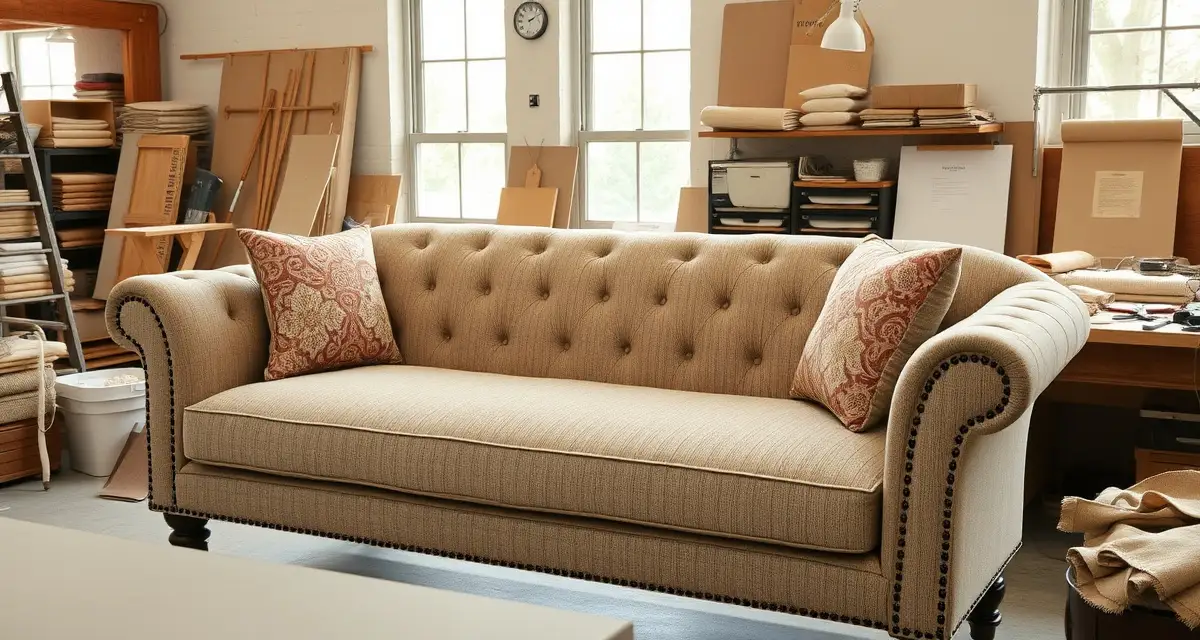
Daybed Reupholstery Guide: Mattress Bolsters and Arms Together
Daybeds have 4 to 6 distinct upholstery zones, shops that work sequentially without a plan finish 40 percent slower than shops that plan the zone sequence before starting. The sequential-without-plan approach produces frequent backtracking: you finish the mattress surface, then realize the bolster installation requires access behind the arm panel you just closed. Planning the zone sequence before starting prevents all of this.
TL;DR
- Successful reupholstery starts with a thorough frame and spring assessment before any fabric is ordered.
- Professional technique follows a consistent panel sequence: strip, repair frame, replace foam, then install fabric panels in the correct order.
- Pattern fabric requires centering and repeat alignment decisions made before cutting; errors discovered after cutting are expensive to correct.
- Professional labor time ranges from 12-20 hours depending on furniture style and fabric complexity.
- Foam selection matters as much as fabric selection; the right density and ILD creates the correct seating profile and longevity.
- Consistent tension on all panels and quality welt cording are the marks of professional finishing.
Identifying the Daybed Zones
Before planning your work sequence, identify every zone on the specific daybed in front of you. Common zone configurations:
Standard daybed (sofa-style):
- Mattress top surface
- Mattress boxing (sides)
- Inside back (the sofa-style back panel)
- Outside back
- Arms (typically 2: one at each end)
- Bolsters (1-3: cylindrical cushions at each end and sometimes center)
Platform daybed (no arms, low profile):
- Mattress top surface
- Side boxing strips (all four sides)
- Optional back cushions or bolsters
Trundle daybed:
- All zones of the platform daybed
- Trundle drawer face (often not upholstered, but some styles include it)
The Zone Map and Sequence
For a standard daybed, the correct installation sequence prevents backtracking:
1. Mattress deck and mattress boxing. The mattress (main sleeping/sitting surface) should be treated as a large cushion: top panel, side boxing strips on all four sides, zipper or sewn closure on one short end. This is assembled separately as a cushion unit.
2. Inside back. The inside back panel is installed first among the frame-attached panels. It needs to be accessible from all sides, which is easier before the arms are installed.
3. Arms (both). With the inside back in place, install arm panels. Each arm has inside arm and outside arm faces, plus a top cap and front face. The arm panels are installed in standard chair-arm sequence (inside arm first, outside arm closes last).
4. Bolsters. Bolsters are cylindrical cushions. Each bolster has:
- A main body panel (the tube: circumference x length)
- Two end caps (circular)
- Optional zipper for foam insertion
Bolsters are constructed as separate cushions and placed in position after all frame-attached panels are complete.
5. Outside back. Close the outside back last among the frame-attached panels.
6. Dust cover. Final step.
Bolster Construction in Detail
Bolsters are cylindrical cushions that provide the back support on daybeds. They require specific construction.
Measuring bolsters:
- Bolster diameter: typically 6-10 inches for daybed bolsters
- Bolster length: typically 18-24 inches, to span from arm to near-center of the daybed
Cutting the main body panel:
- Height: circumference of the bolster (pi x diameter = 3.14 x 8 inches = 25.1 inches for an 8-inch bolster)
- Width: bolster length plus 1 inch seam allowance at each end = 26 inches for a 24-inch bolster
- Single panel, sewn along the length seam to create a tube
Cutting end caps:
- Diameter: bolster diameter plus 1 inch total for seam allowance
- Two circles per bolster
Assembly sequence:
- Sew the long seam of the body panel to create a tube
- Pin one end cap to one end of the tube, distributing fullness evenly around the circle
- Sew the end cap seam
- Insert foam (cut as a cylinder to exact bolster interior dimensions)
- Sew or zipper-close the second end cap
Foam for bolsters: 1.8-2.0 density foam, 30-35 ILD, cut as a cylinder (use a foam saw or sharp-tipped foam knife). The foam should fit snugly inside the bolster, not so tight it distorts the cylinder shape, not so loose the bolster goes limp.
Pattern Coordination Across Daybed Zones
If the daybed uses patterned fabric, the pattern must coordinate across the mattress, back panel, and bolsters.
The most visible alignment: The inside back panel pattern should appear to flow naturally into the mattress top when the bolster is removed. This means the inside back pattern and the mattress pattern need to be cut with coordinated positioning.
Bolster pattern: On a cylindrical bolster, pattern alignment is practically impossible to maintain around the cylinder. Use the bolster as a contrast element rather than a pattern-continuation element, or use a solid fabric for bolsters to avoid the pattern alignment problem entirely.
For daybed fabric yardage including bolster yardage, use the daybed fabric yardage calculator. Additional guidance on settee reupholstery (similar in scale and zone count) is in the daybed reupholstery guide.
Frequently Asked Questions
How do I reupholster a daybed?
Plan your zone sequence before starting: mattress cushion assembly (treated as a large cushion), inside back, both arms (inside arm then outside arm), bolsters (as separately constructed cylindrical cushions), outside back, and dust cover. Assemble all cushion units separately before beginning any frame-attached panel work. The inside back must go in before the arms so it's accessible from all sides during installation.
What order do I work on daybed sections?
Install frame-attached panels in this order: inside back first, then both arms, then outside back, then dust cover. Construct all cushion units (mattress, bolsters) separately and install them after the frame panels are complete. Never install a closing panel (outside arm, outside back) before the corresponding inside panel is complete and properly tensioned.
How do I make daybed bolsters?
Cut a main body panel (circumference x length + seam allowances), sew the long seam to create a tube, sew one circular end cap, insert the foam cylinder, then close the second end cap (with a zipper for easier foam changes). Bolster foam should be 1.8-2.0 density at 30-35 ILD, cut as a cylinder to the exact interior dimensions. The foam fits snugly, neither so tight it distorts the bolster shape nor so loose the bolster loses its round profile.
What tools are required for professional reupholstery?
Professional reupholstery requires a heavy-duty staple gun (pneumatic or electric), a staple remover and tack puller, quality scissors and a rotary cutter, a sewing machine capable of sewing upholstery-weight fabric, foam cutting tools, and regulator pins for manipulating stuffing. For tufted work, a curved needle and tufting twine are also required. The quality of your tools directly affects the quality of the finished work, particularly at seams and edges.
How do I handle pattern matching across multiple panels?
Establish the dominant panel first (usually the inside back) and center the pattern motif there. Then cut each subsequent panel so the pattern aligns with the adjacent panel at the seam. Mark the pattern alignment point on each piece before cutting. For complex pieces, some upholsterers make a cutting plan on paper showing where each panel falls in the pattern before cutting any fabric. This investment in planning prevents the most common and costly pattern-matching errors.
Related Articles
Sources
- National Upholstery Association
- Association of Master Upholsterers and Soft Furnishers (AMUSF)
- Upholstered Furniture Action Council (UFAC)
- Furniture Today (trade publication)
Get Started with StitchDesk
Accurate reupholstery quotes require knowing your labor time, material costs, and overhead for each job type. StitchDesk helps upholstery shops build detailed, professional quotes that account for all cost factors, so every job is priced to cover costs and generate profit. Try StitchDesk free and bring accuracy to every estimate you send.