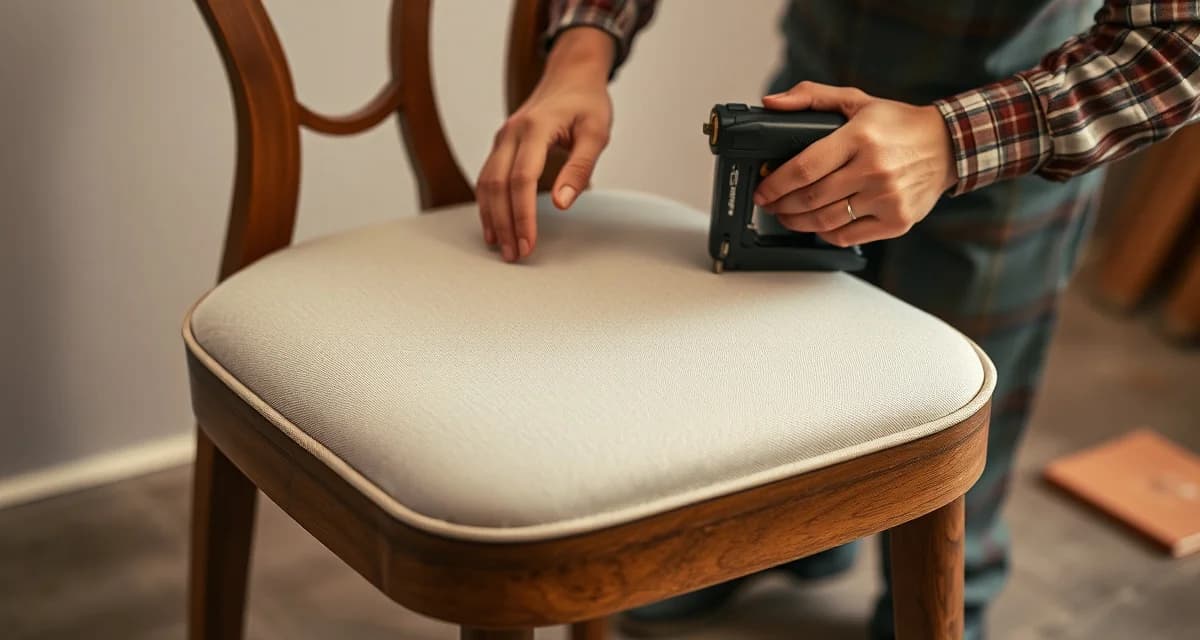
How to Reupholster Dining Chairs: Seat and Back Full Guide
Seat-only dining chair recovery is a 15-minute job when done correctly. Shops that take 45 minutes lose margin on every dining chair set they touch. The process is genuinely fast when you've built a consistent workflow, and the workflow is worth building because dining chair sets are among the highest-volume work for residential upholstery shops.
This guide covers seat-only recovery and the more involved seat-and-back process, with production tips for working through full sets efficiently.
TL;DR
- Successful reupholstery starts with a thorough frame and spring assessment before any fabric is ordered.
- Professional technique follows a consistent panel sequence: strip, repair frame, replace foam, then install fabric panels in the correct order.
- Pattern fabric requires centering and repeat alignment decisions made before cutting; errors discovered after cutting are expensive to correct.
- Professional labor time ranges from 12-20 hours depending on furniture style and fabric complexity.
- Foam selection matters as much as fabric selection; the right density and ILD creates the correct seating profile and longevity.
- Consistent tension on all panels and quality welt cording are the marks of professional finishing.
Seat-Only Dining Chair Recovery
The vast majority of dining chair jobs coming into most residential shops are seat-only. The seat pad comes off the chair (typically 4 screws from underneath), gets new foam and new fabric, and goes back on.
The 15-minute process:
- Remove the seat (4 screws, 2-3 minutes)
- Remove old fabric by pulling staples or tacks (2-3 minutes)
- Assess old foam, replace if compressed more than 50% from original thickness, or if it's stained or degraded
- Cut new fabric to size: seat pad width + 6 inches x seat pad depth + 6 inches (3 inches wrap each side)
- Center fabric on pad, pull taut and staple front edge (middle first, then working toward corners)
- Pull and staple back edge opposite
- Staple both sides, keeping tension even
- Fold corners: on square corners, create a flat fold; on rounded corners, pleat evenly
- Trim excess fabric 1/2 inch from staple line
- Reattach seat to chair (4 screws, 2-3 minutes)
With practice, this entire process runs 15-18 minutes per chair. On a set of 6 dining chairs with pre-cut fabric, it's a 90-minute job after setup.
Seat-Only Production Tips for Sets
When you're doing a set of 4, 6, or 8 chairs, don't do one chair at a time start to finish. Work in stages across the full set.
Stage production method:
- Remove all seats first (the whole set)
- Pull all old fabric from all seats
- Cut all new fabric panels at once
- Apply foam if needed to all seats
- Upholster all seats
- Reattach all seats
This method is faster than one-at-a-time because you're not context-switching between removing, cutting, and upholstering. Each task uses the same tool setup and the same body position. Switching between tasks for every chair adds friction.
The stage method runs about 30-35% faster per chair than one-at-a-time.
Seat-and-Back Dining Chair Reupholstery
When the chair back is upholstered (fully or partially), the job is more complex. There are three common configurations:
Slip seat with upholstered back panel: The seat is removable as described above. The back has a separate upholstered panel, typically stapled or tacked to the back frame. The back panel is usually approached from the rear.
Fixed seat with upholstered back: The seat is attached to the frame and must be upholstered in place. The back panel is usually attached at the back frame.
Fully upholstered dining chair: Every panel, inside back, outside back, seat, and sometimes arms, is upholstered. This is more of a full chair job than a dining chair job.
Seat-and-Back Sequence
For the most common configuration (slip seat + attached back panel):
For the back panel:
- Remove old fabric from the back (usually tacks or staples on the back face of the chair frame)
- Remove old padding from the back panel if present
- Cut new fabric: back panel width + 4 inches x panel height + 4 inches
- Position fabric on the panel, pulling from center outward
- Staple from the inside face of the back frame (staples not visible in the finished piece)
- At the back face, use a blind tack strip along the top and sides for a clean finish
- Hand stitch the bottom edge if needed for chairs where the staple line would be visible
For the seat:
Follow the seat-only process above.
Do the back before the seat. If you reinstall the seat first, you have less working room for the back panel.
Corner Techniques for Dining Chairs
Corners are where dining chair quality shows most clearly. Three corner types appear on different chair styles:
Square corners: The simplest to execute cleanly. Fold the fabric edge in from one side, creating a 45-degree mitered fold. Staple the fold flat. From the finished side, this should look like a flat corner fold with no bulk.
Rounded corners: More forgiving than square corners. Make a series of small pleats around the curve (5-7 pleats is typical for a standard rounded corner). Space them evenly, pull each pleat taut, and staple. The goal is a smooth curve with no bunching or visible staple crowns.
Front leg post corners: When the leg post comes through the seat pad area (as on many traditional dining chairs), cut a relief slit in the fabric at each post location. Make the slit from the edge of the fabric toward the post, stopping 1/4 inch from the post. This allows fabric to fold around the post without pulling.
Pattern Matching for Dining Sets
When you're reupholstering a dining chair set in patterned fabric, the pattern position on each seat should be consistent. If the pattern is centered on one chair, it should be centered on all chairs. If a motif falls at the front edge of one chair, it should fall consistently on all chairs.
Achieving this requires:
- Marking the center of each seat pad with chalk
- Aligning the fabric pattern to the mark on each pad before stapling
- Measuring and confirming pattern position is consistent before cutting all panels
This adds 5-10 minutes per set but is essential for professional results on patterned sets. Inconsistent pattern placement on a matched set is immediately visible when chairs are pushed back from the table.
For yardage on dining chair sets with pattern matching, use the dining chair fabric yardage calculator. The dining chair reupholstery guide covers additional techniques for full-frame dining chairs and carved-back styles.
Frequently Asked Questions
How do I reupholster a dining chair seat?
Remove the seat pad from the chair frame (typically 4 screws from beneath). Pull all existing staples or tacks. Assess foam and replace if needed. Cut new fabric at seat width + 6 inches by seat depth + 6 inches. Center fabric on pad, pull taut, and staple: front center first, then back center opposite, then sides, working from center outward on each side. Fold corners cleanly (mitered for square corners, pleated for rounded). Trim excess fabric and reattach the seat to the chair frame.
How do I reupholster a dining chair with a full back?
For a chair with a back panel in addition to the seat, do the back panel first. Access the back panel by tipping the chair, the back panel fabric is typically stapled at the back face of the frame. Remove old fabric, apply new foam or padding if needed, then staple new fabric from the back, using a blind tack strip for a clean finish at the top and sides. Hand stitch or fold-tack the bottom edge. Then complete the seat following the standard seat-only process.
How long should dining chair reupholstery take?
An experienced upholsterer should complete a dining chair seat-only recovery in 15-20 minutes per chair, including removing and reattaching the seat. A seat-and-back job on a standard dining chair runs 35-45 minutes per chair. For a full-frame dining chair with all panels upholstered, budget 60-90 minutes. Using batch production for sets (all teardown first, then all cutting, then all upholstery) reduces per-chair time by 30-35% compared to completing each chair individually.
What tools are required for professional reupholstery?
Professional reupholstery requires a heavy-duty staple gun (pneumatic or electric), a staple remover and tack puller, quality scissors and a rotary cutter, a sewing machine capable of sewing upholstery-weight fabric, foam cutting tools, and regulator pins for manipulating stuffing. For tufted work, a curved needle and tufting twine are also required. The quality of your tools directly affects the quality of the finished work, particularly at seams and edges.
How do I handle pattern matching across multiple panels?
Establish the dominant panel first (usually the inside back) and center the pattern motif there. Then cut each subsequent panel so the pattern aligns with the adjacent panel at the seam. Mark the pattern alignment point on each piece before cutting. For complex pieces, some upholsterers make a cutting plan on paper showing where each panel falls in the pattern before cutting any fabric. This investment in planning prevents the most common and costly pattern-matching errors.
Related Articles
- Camelback Sofa Fabric Yardage: Hump Back Calculation Guide
- Can I Reupholster a Sofa Myself? Honest Assessment Guide
Sources
- National Upholstery Association
- Association of Master Upholsterers and Soft Furnishers (AMUSF)
- Upholstered Furniture Action Council (UFAC)
- Furniture Today (trade publication)
Get Started with StitchDesk
Accurate reupholstery quotes require knowing your labor time, material costs, and overhead for each job type. StitchDesk helps upholstery shops build detailed, professional quotes that account for all cost factors, so every job is priced to cover costs and generate profit. Try StitchDesk free and bring accuracy to every estimate you send.