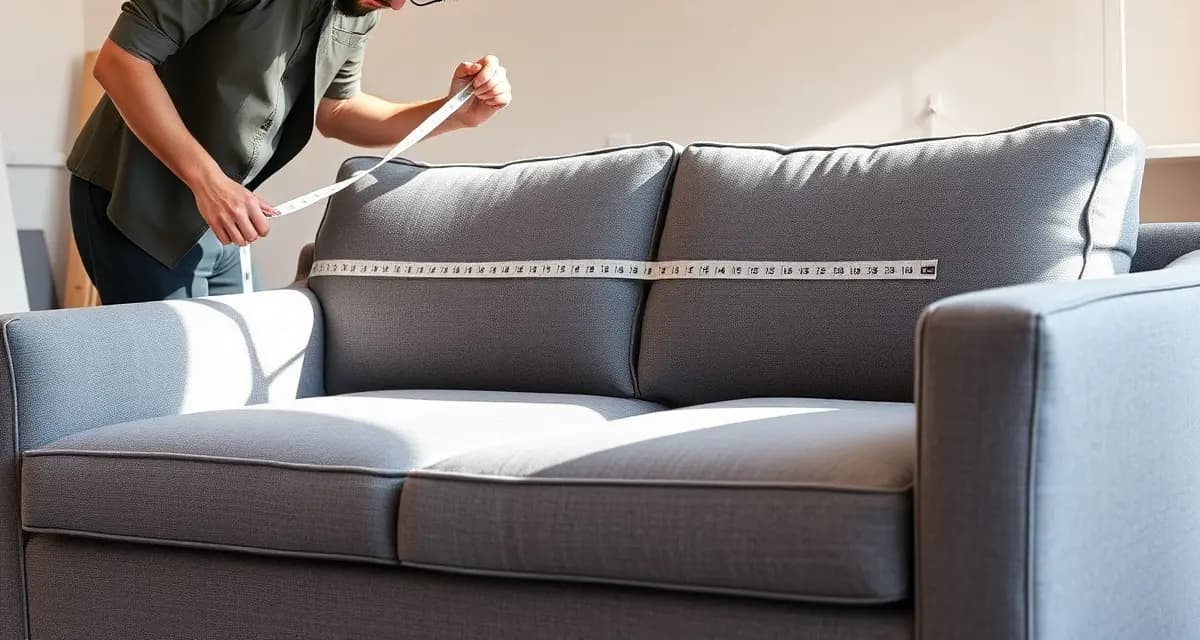
How to Measure a Sofa for Reupholstery
Measuring wrong is the first place yardage estimates go wrong. It's not the math, it's that someone measured the overall sofa width and called that the inside back width. Or they measured the cushion finished size instead of the cut size. Small errors compound through a full sofa calculation.
Here's the measuring protocol I use for every sofa intake. It takes about 8 minutes. It produces numbers I can trust.
TL;DR
- Successful reupholstery starts with a thorough frame and spring assessment before any fabric is ordered.
- Professional technique follows a consistent panel sequence: strip, repair frame, replace foam, then install fabric panels in the correct order.
- Pattern fabric requires centering and repeat alignment decisions made before cutting; errors discovered after cutting are expensive to correct.
- Professional labor time ranges from 12-20 hours depending on furniture style and fabric complexity.
- Foam selection matters as much as fabric selection; the right density and ILD creates the correct seating profile and longevity.
- Consistent tension on all panels and quality welt cording are the marks of professional finishing.
What You Need
- Soft measuring tape (not a rigid tape measure, you need to follow curves)
- A notepad or StitchDesk intake form on your phone
- The sofa off any slipcovers and with cushions removed
Step 1: Overall Dimensions (Orientation Reference)
These aren't used directly in panel calculations, but they give you a sanity check.
- Overall width: Measure from outside arm to outside arm at the widest point.
- Overall depth: Seat depth (front of seat rail to back of sofa, not including cushions).
- Overall height: Floor to top of back (or measure just the back height above the seat for yardage purposes).
Write these down first. When your zone-by-zone measurements are done, they should all reconcile with these overall numbers. If your inside back width is wider than your overall width minus arm widths, something is wrong.
Step 2: Back Measurements
Inside back width: Measure across the inside of the sofa back, from where the fabric begins on the left inside arm to where it begins on the right inside arm. This is the finished width of the inside back panel, not the sofa's overall width.
Inside back height: Measure from the seat deck surface up to the top of the back rail. If the sofa has a button-tufted back, measure to the highest point of the tufted area.
Outside back width: Measure across the outside back, from the outside edge of one arm to the outside edge of the other. Often similar to inside back width but may differ if the arms have different profiles.
Outside back height: Floor to top of back rail on the outside.
Note: If the sofa has cushioned backs (loose back cushions rather than a tight upholstered back), measure the individual back cushions separately, not the back area.
Step 3: Arm Measurements
Inside arm width: Measure from the front face of the arm to the back of the arm (arm depth, front to back).
Inside arm height: From the seat deck up to the top of the arm.
Outside arm width: Usually slightly larger than inside arm width (the outside includes the arm frame thickness). Measure from front of arm to back of arm on the outside.
Outside arm height: Floor to top of arm on the outside.
Measure both left and right arms separately. On antique sofas, they're often not symmetric. On modern sofas, they usually are, but document both in case.
Arm style note: The arm style affects how you cut, not just what you measure. Note the arm style: scroll arm, track arm (straight and vertical), panel arm, slope arm, English arm (curves down toward the front). This affects how panels wrap and seam.
Step 4: Seat Measurements
Seat deck width: Measure the full seat deck from one inside arm face to the other. This is where the cushions rest.
Seat deck depth: From the front edge of the seat rail to the back of the deck (where it meets the inside back or back rail).
Seat cushion dimensions: Measure each cushion individually.
- For standard cushions: width, depth, and boxing height (thickness of the cushion).
- For T-cushions: measure the T-shape, the full width at the back and the notch at the front for the arms. T-cushions require a different cutting layout.
- For box-edge cushions: measure the top face, the boxing strip width.
- For knife-edge cushions: just the top face, the knife edge has no boxing.
Cushion count: Note how many seat cushions and whether they're all the same size or different.
Step 5: Front Measurements
Front border width: Measure across the full front of the sofa, from outside arm to outside arm.
Front border height: From the bottom of the seat rail to the floor (or to the bottom of a skirt if applicable). This is the panel below the seat cushions, facing the room.
Step 6: Skirt (If Applicable)
Skirt perimeter: Measure around all four sides of the sofa at floor level.
Skirt drop: From the bottom of the sofa frame to the floor. Skirts are typically 5–7 inches.
Skirt style: Box pleat, kick pleat, straight panel. This affects cutting.
Step 7: Back Cushions (If Loose)
If the sofa has loose back cushions (not a tight back):
Each back cushion: Width, height, boxing depth. Note if they're standard rectangles or shaped (angled tops, curved bottoms).
Back cushion count: Standard sofas have 2–3 back cushions. Sectionals may have more.
Step 8: Welt Cording Estimate
You don't measure welt directly, you estimate the total linear inches of welt on the finished piece:
- Count the seam lines that will get welting: typically top of seat front, arm/back junctions, seat cushion borders.
- Rough estimate for a standard sofa: 18–25 linear yards of welt.
- Note whether the client wants welt on all seams or selected seams (some modern styles have minimal welt).
Recording Your Measurements
Record measurements in a table by zone. Resist the urge to add notes and qualifications in the measurement column, just numbers. Keep interpretation separate.
In StitchDesk's intake form, you enter measurements zone by zone and the system formats them correctly for the yardage calculator. There's no re-entering at the calculation stage.
Common Measuring Mistakes
Measuring outside dimensions for cutting zones. The outside back width includes the arm thickness. The inside back width does not. These are different numbers.
Not measuring both arms. On antique pieces, they're often asymmetric.
Forgetting cushion boxing. A 4-inch boxing strip on 3 cushions adds significant fabric. It's easy to note "cushions: 24 x 24 x 4" and then forget to calculate the boxing.
Using the cushion finished size for fabric. A finished cushion that's 24 x 24 x 4 requires fabric cut larger to account for seam allowances and boxing strips. Calculate from the finished size, not the cut size, let the yardage calculator add seam allowances.
Related Articles
- Sleeper Sofa Reupholstery Guide
- Sleeper Sofa Reupholstery Yardage: Mechanism Clearance Explained
- How Much Does It Cost to Reupholster a Sofa? 2025 Guide
- Sofa Reupholstery Guide: Every Style Covered Professionally
FAQ
What measurements do I need to calculate sofa reupholstery yardage?
You need: inside back width and height, outside back width and height, inside arm width and height (both sides), outside arm width and height (both sides), seat deck width and depth, front border width and height, and individual cushion dimensions (width, depth, boxing height) for each cushion. Also note arm style, back type (tight or loose cushions), and whether there's a skirt.
How long does it take to measure a sofa for reupholstery?
With practice, a full sofa takes 6–10 minutes to measure thoroughly. New upholsterers should allow 15 minutes and double-check their numbers against the overall dimensions as a sanity check. Rushing the measurement phase to save a few minutes costs more time later when you're recalculating because something doesn't add up.
Should I measure the sofa before or after removing the old fabric?
Measuring with the old fabric on is fine for yardage calculation. The existing fabric panels are already the right size, the measurements you take of the assembled sofa are what you need. If you're going to do structural repairs (replacing foam, rebuilding a spring unit, adding padding), those don't change the fabric panel dimensions. Measure the assembled sofa and note any structural repairs in the job ticket separately.
How do I handle pattern matching across multiple panels?
Establish the dominant panel first (usually the inside back) and center the pattern motif there. Then cut each subsequent panel so the pattern aligns with the adjacent panel at the seam. Mark the pattern alignment point on each piece before cutting. For complex pieces, some upholsterers make a cutting plan on paper showing where each panel falls in the pattern before cutting any fabric. This investment in planning prevents the most common and costly pattern-matching errors.
Sources
- National Upholstery Association
- Association of Master Upholsterers and Soft Furnishers (AMUSF)
- Upholstered Furniture Action Council (UFAC)
- Furniture Today (trade publication)
Get Started with StitchDesk
Accurate reupholstery quotes require knowing your labor time, material costs, and overhead for each job type. StitchDesk helps upholstery shops build detailed, professional quotes that account for all cost factors, so every job is priced to cover costs and generate profit. Try StitchDesk free and bring accuracy to every estimate you send.