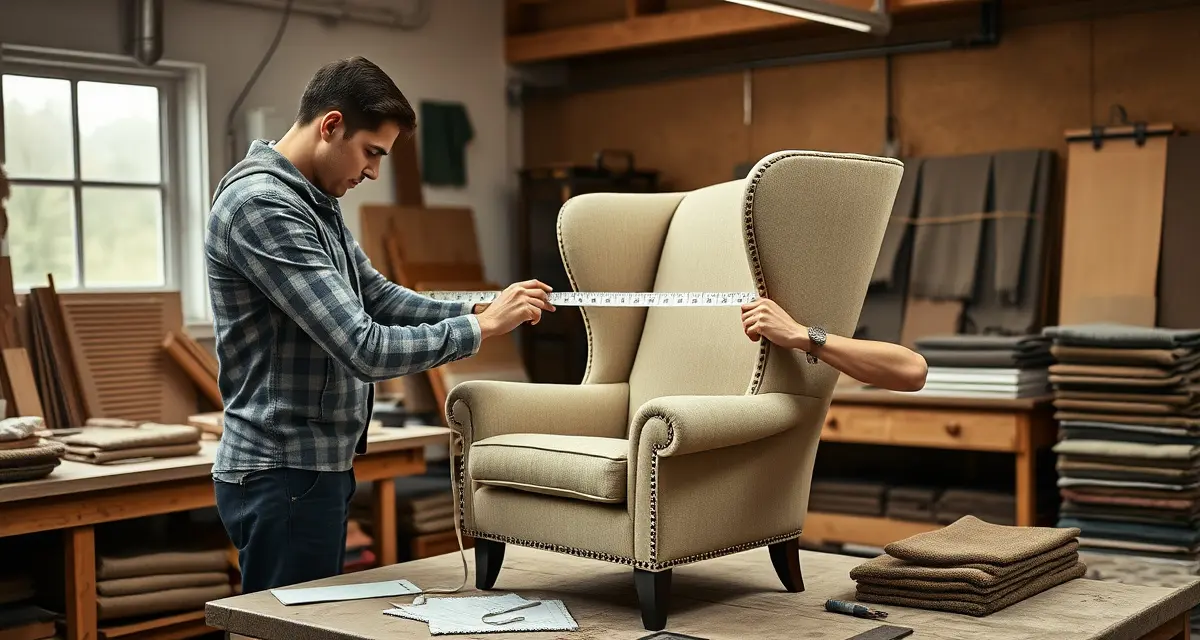
How to Measure a Chair for Reupholstery
The difference between a good yardage estimate and a short order usually comes down to how the chair was measured. Not how well the math was done, how accurately the zones were identified and measured before the math started.
Chairs have more style variation than any other piece. A wing chair and a parsons chair are both "chairs." Their measurement protocols are completely different. Here's how to approach each major style.
TL;DR
- Successful reupholstery starts with a thorough frame and spring assessment before any fabric is ordered.
- Professional technique follows a consistent panel sequence: strip, repair frame, replace foam, then install fabric panels in the correct order.
- Pattern fabric requires centering and repeat alignment decisions made before cutting; errors discovered after cutting are expensive to correct.
- Professional labor time ranges from 12-20 hours depending on furniture style and fabric complexity.
- Foam selection matters as much as fabric selection; the right density and ILD creates the correct seating profile and longevity.
- Consistent tension on all panels and quality welt cording are the marks of professional finishing.
General Principles Before Measuring
Remove cushions first. You're measuring the chair structure, not the cushion package. Cushions get measured separately.
Measure finished dimensions. You're measuring what you see on the assembled chair, not adding seam allowances. The yardage calculator adds seam allowances. Your job is to give it accurate finished zone dimensions.
Note the arm style before measuring. Arm style affects how the inside arm measurement is taken (and whether there's an inside arm at all):
- Track arm (straight, vertical): Inside arm is a flat rectangle.
- Scroll arm: Inside arm has a curved profile at the front.
- English arm: Slopes down toward the front.
- Open arm (no upholstered arm): No inside arm or outside arm fabric zones.
Measuring a Club Chair
Inside back: Width (from inside arm to inside arm) × height (from seat deck to top of back).
Outside back: Width (outside arm to outside arm) × height (floor to back top rail, outside).
Inside arm (left): Depth (front of arm to back, measured horizontally along the arm) × height (seat deck to top of arm rail).
Inside arm (right): Same as left. Measure both.
Outside arm (left): Same depth measurement as inside arm × height (floor to arm top rail on outside).
Outside arm (right): Same as left.
Seat: For a loose cushion, measure the cushion face. For a tight seat, measure the seat deck width and depth.
Front border: Full front width × height from seat rail to floor (or to bottom of skirt).
Deck: Width (inside arm to inside arm) × depth (front seat rail to back rail). Often done in utility fabric.
Welt cording estimate: Count welt seam lines. Standard club chair has approximately 8–10 linear yards of welt.
Measuring a Wing Chair
All club chair measurements above, plus:
Inside wing (left): Measure the height of the wing (from where it meets the back rail to the wing tip at top), and the depth of the wing (how far it extends from the back panel). The inside wing is a shaped panel, measure the bounding rectangle (height × depth) and note that it's shaped.
Inside wing (right): Same as left.
Outside wing (left): Height and depth, typically slightly smaller than inside wing. Measure bounding rectangle.
Outside wing (right): Same as left.
Wing junction: Note whether the wing meets the back in a straight seam or a curved seam. Curved seams add waste in cutting.
Total wing panel bounding area: Height × depth × 4 panels. This will be larger than the actual fabric needed due to shape waste, the calculator accounts for this, which is why you see more yardage on a wing chair than expected.
Measuring a Barrel Chair
The barrel chair has a continuous curved back that requires a different measurement approach.
Inside back/arm (continuous curved panel): Instead of measuring the inside back and inside arms separately, measure the arc. Lay your soft tape along the inside curved surface from the front edge of one arm across the inside back to the front edge of the other arm. That arc length is the width of your inside panel. Height: from seat deck to top of back at the peak.
Outside back/arm (continuous or segmented): Same arc measurement along the outside of the back and arms combined.
Seat: Width and depth of seat face (for cushion) or seat deck.
Front border/front face: Width at the front across the two arm fronts × height.
Note the curvature: Shallow barrel (slight curve) vs. deep barrel (pronounced horseshoe curve). More curve = more corner waste when cutting. Note this in your job ticket.
Measuring a Dining Chair
Slip seat (seat only): Width and depth of seat face. Add 4 inches to each dimension for pull-under wrap. Record as finished seat dimensions and let the calculator add the pull-under allowance.
Side chair (seat + back): As above for seat, plus:
- Inside back width and height
- Outside back width and height (often narrower than inside back, the frame is visible at the sides)
Armed dining/host chair: Full measurements as for club chair but smaller scale.
Set count: Record the number of chairs in the set. For pattern matching, the calculator needs this to compute total set yardage with repeat waste.
Measuring a Parsons Chair
Parsons chairs are fully upholstered, including legs (on some designs).
- Inside back width and height
- Outside back (solid panel)
- Inside arm, outside arm (narrower than a club chair, parsons arms are often 3–4 inches wide)
- Seat face
- Front face of seat rail
- Leg panels (4 legs, each approximately 3 inches wide × leg height), don't forget these. They're small but together they add 0.5 yards.
Measuring an Antique Chair
Old chairs don't follow modern standards. Measure everything from scratch.
- Check for asymmetry. Measure left and right arms separately. Measure inside back at top and bottom separately, old frames sometimes rack slightly.
- Check whether the frame is sound enough to hold new tack strips before measuring for fabric. If it's not, note the repair work in your intake before generating a quote.
- Note unusual construction: double-stuffed backs, coil springs in the seat, horsehair padding over springs. These affect cushion depth and therefore fabric panel sizes.
Recording Your Measurements
Create a measurement sheet per chair. Zone name, width, height. If you're using StitchDesk, the intake form captures this and feeds directly to the calculator, no re-entering at the calculation stage.
For a set of chairs, create one measurement sheet per chair type (not per chair, unless they vary). Note the set count separately.
Related Articles
- Chair Reupholstery Guide
- Club Chair Reupholstery Guide: T-Cushion and Tight Seat Options
- Dining Chair Reupholstery Guide: Full Set Production Tips
FAQ
In what order should I measure a chair for reupholstery?
Start with overall dimensions (overall width, depth, back height) as a sanity check. Then work zone by zone: inside back, outside back, inside arms, outside arms, seat, front panels, any special zones (wings, skirt). Write everything down before calculating. Finish by estimating welt cording linear footage and noting any special construction details that affect cutting.
What is the inside arm measurement on a chair?
The inside arm measurement is the depth of the arm (front of arm to back of arm, measured horizontally) and the height of the arm (from the seat surface to the top of the arm rail). The inside arm is the face of the arm visible when sitting in the chair. It's distinct from the outside arm (the exterior face of the arm visible from outside the chair), which is usually measured separately and may have slightly different dimensions due to arm rail thickness.
Do I need to measure a chair before the client brings it in?
No, you measure when the chair arrives at your shop. For initial quoting, most shops use the chair style and size category to generate a preliminary estimate, then confirm with actual measurements during intake. The StitchDesk quote flow supports a two-stage process: a quick visual quote at consultation based on style and approximate size, then a confirmed quote after measurement at intake. If the exact dimensions matter for a specific fabric or a COM job with limited yardage, measure before the client commits.
How do I handle pattern matching across multiple panels?
Establish the dominant panel first (usually the inside back) and center the pattern motif there. Then cut each subsequent panel so the pattern aligns with the adjacent panel at the seam. Mark the pattern alignment point on each piece before cutting. For complex pieces, some upholsterers make a cutting plan on paper showing where each panel falls in the pattern before cutting any fabric. This investment in planning prevents the most common and costly pattern-matching errors.
Sources
- National Upholstery Association
- Association of Master Upholsterers and Soft Furnishers (AMUSF)
- Upholstered Furniture Action Council (UFAC)
- Furniture Today (trade publication)
Get Started with StitchDesk
Accurate reupholstery quotes require knowing your labor time, material costs, and overhead for each job type. StitchDesk helps upholstery shops build detailed, professional quotes that account for all cost factors, so every job is priced to cover costs and generate profit. Try StitchDesk free and bring accuracy to every estimate you send.