Settee Reupholstery Guide: Small Sofa Big Technique
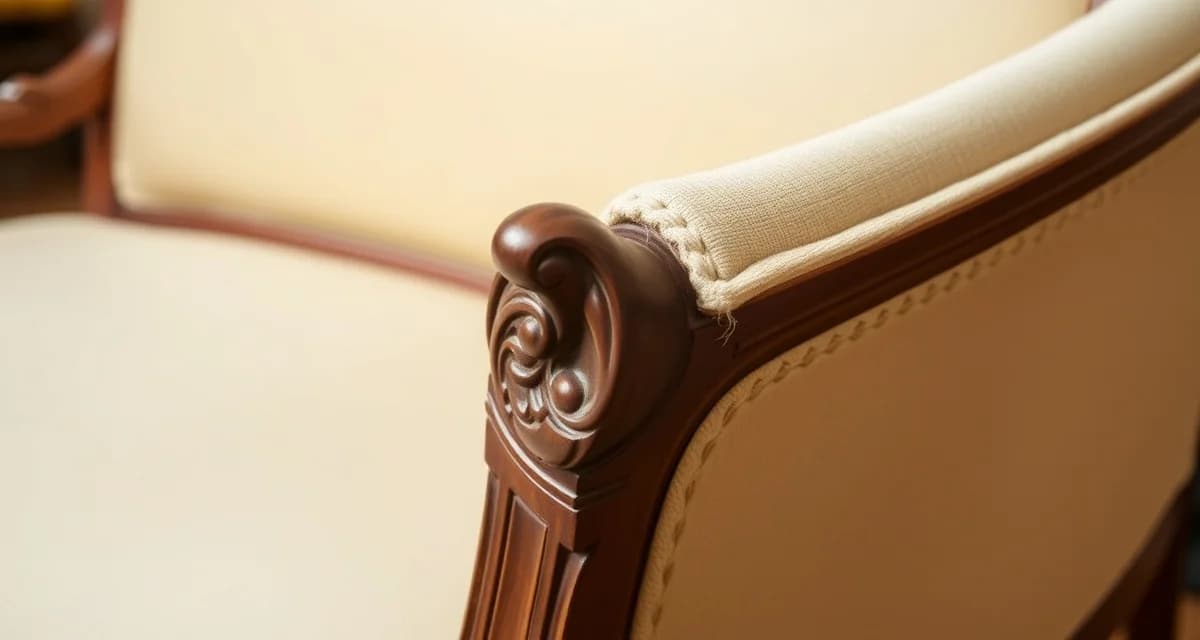
Victorian settees with carved show-wood frames require hand-stitching to avoid staple-gun marks on the wood. This isn't optional or stylistic, it's the technical reality of working on a piece where the frame is part of the visual design. Every panel edge that meets carved wood on a Victorian settee needs to be finished without the staple gun touching the show wood. Knowing when to set the stapler aside and pick up the needle separates appropriate technique from inappropriate for this piece type.
TL;DR
- Successful reupholstery starts with a thorough frame and spring assessment before any fabric is ordered.
- Professional technique follows a consistent panel sequence: strip, repair frame, replace foam, then install fabric panels in the correct order.
- Pattern fabric requires centering and repeat alignment decisions made before cutting; errors discovered after cutting are expensive to correct.
- Professional labor time ranges from 12-20 hours depending on furniture style and fabric complexity.
- Foam selection matters as much as fabric selection; the right density and ILD creates the correct seating profile and longevity.
- Consistent tension on all panels and quality welt cording are the marks of professional finishing.
Victorian vs Modern Settee: Key Differences
Victorian settee (1840-1910):
- Taller, narrower back rail (24-30 inches tall)
- Carved and turned wood frame elements visible throughout
- Shorter seat depth (typically 16-19 inches) compared to modern seating expectations
- Original construction uses coil springs, horsehair stuffing, tack application
- Fabric choices: velvet, damask, needlepoint, tufted materials
Modern two-seat settee:
- Lower, wider back profile (more like a compact loveseat)
- Upholstered frames or minimal exposed wood
- Seat depth consistent with contemporary comfort standards (20-22 inches)
- Modern construction with sinuous springs or foam, staple application
- Wider fabric choice range
The technique follows the piece. Victorian settees get Victorian techniques. Modern settees can use contemporary approach.
Hand-Stitching at Show-Wood Frames
On a Victorian settee with carved wood back rails, arm rails, and base rails visible between upholstered panels, the fabric termination at each frame interface must be handled without touching the wood with a staple gun.
The show-wood stitch method:
- Pull the fabric panel to tension and hold with straight pins
- Turn the fabric edge under (fold 1/2 inch to inside) along the edge where it meets the wood frame
- Use a curved needle and matching heavy thread to stitch through the folded edge and into the foundation layer (burlap or backing)
- Work in a running stitch or slip stitch along the full edge
- Remove pins
The stitch line is invisible from the outside. The panel is securely held without any contact between staple gun and carved frame.
This technique is slower than stapling, expect 1.5-2x the labor time per panel compared to stapled application. Budget for this in your quote on Victorian pieces.
Victorian Settee Spring Assessment
Victorian settees typically have coil springs in the seat. Assess the same way as Victorian chairs and sofas: flip and look from below, push each spring to test resistance and spring-back, check for broken ties.
For a settee with intact original coil springs, retie rather than replace. The original spring deck is a feature of the piece that contributes to its character and value.
Replacement consideration: If the original spring deck is completely failed and the client wants to preserve the piece, new coil springs can be installed following the original configuration. Sinuous spring replacement is technically easier but changes the piece's feel and is not appropriate for pieces where value preservation matters.
Modern Settee Sequence
For a modern settee with minimal show wood or fully upholstered frame:
- Seat deck (or seat cushion prep)
- Inside arms (both)
- Inside back
- Seat cushion assembly (if loose cushions)
- Back cushions (if loose)
- Outside arms
- Outside back
- Front arm panels
- Dust cover
This is the same sequence as a loveseat or compact sofa. Treat a modern settee like a small sofa.
Victorian Settee Sequence
For a Victorian settee with show-wood frame:
- Spring deck inspection and retying (if coil springs)
- Spring cover (jute burlap, sewn to springs)
- Edge stitching to build seat crown (if period technique desired)
- Interior padding layers (cotton batting or horsehair)
- Seat fabric (hand-tacked at all show-wood interfaces)
- Inside back (hand-stitched at all show-wood contacts)
- Outside back (hand-stitched at frame contacts, or blind-tacked at non-show-wood sections)
- Arm panels as applicable
- Trim application (gimp braid, nail head, or fringe as period appropriate)
For technique guidance on antique pieces, the antique furniture reupholstery guide covers value preservation in detail. The loveseat reupholstery guide covers modern two-seat furniture technique that applies to modern settees.
Frequently Asked Questions
How do I reupholster a Victorian settee?
Victorian settees with carved show-wood frames require hand-stitching (not stapling) at every fabric edge that contacts the carved wood frame. Assess the coil springs and retie rather than replace if they're functional. Use cut tacks rather than a staple gun where tacking is needed on wood surfaces. Select period-appropriate fabric (velvet, damask, brocade) in period-appropriate colors. Apply gimp braid or appropriate trim at all panel edges to cover any visible attachment points.
What makes settee reupholstery different from a loveseat?
A modern settee reupholstery follows loveseat technique. Victorian settee reupholstery differs considerably: the show-wood carved frame requires hand-stitching rather than stapling at frame interfaces, the original coil spring construction requires assessment and retying, and the proportions are different (Victorian settees are narrower and taller than modern loveseats). The period-appropriate technique is slower and more labor-intensive, which is reflected in pricing.
How do I preserve carved wood on a settee frame?
Keep all tools, especially the staple gun, away from the carved wood. Use hand stitching (curved needle and heavy thread) for all fabric attachment at carved wood interfaces. Protect the wood with painter's tape during any upholstery work in adjacent areas. Apply gimp braid with upholstery adhesive (not heat gun), pressing carefully and avoiding any products that would leave residue on the wood. Clean carved wood with a dry brush after upholstery is complete to remove any fabric fibers or chalk marks.
What tools are required for professional reupholstery?
Professional reupholstery requires a heavy-duty staple gun (pneumatic or electric), a staple remover and tack puller, quality scissors and a rotary cutter, a sewing machine capable of sewing upholstery-weight fabric, foam cutting tools, and regulator pins for manipulating stuffing. For tufted work, a curved needle and tufting twine are also required. The quality of your tools directly affects the quality of the finished work, particularly at seams and edges.
In what order should upholstery panels be installed?
The correct panel sequence varies by furniture type, but the general principle is inside panels before outside panels, starting from the bottom up. For a sofa: deck first, then inside arms, inside back, seat cushions, back cushions, outside arms, outside back, front arm panels, then dust cover. For a chair: seat platform, inside back, inside arms, outside arms, outside back, then dust cover. Deviating from the correct sequence can make later panels impossible to install cleanly.
How do I handle pattern matching across multiple panels?
Establish the dominant panel first (usually the inside back) and center the pattern motif there. Then cut each subsequent panel so the pattern aligns with the adjacent panel at the seam. Mark the pattern alignment point on each piece before cutting. For complex pieces, some upholsterers make a cutting plan on paper showing where each panel falls in the pattern before cutting any fabric. This investment in planning prevents the most common and costly pattern-matching errors.
Related Articles
Sources
- National Upholstery Association
- Association of Master Upholsterers and Soft Furnishers (AMUSF)
- Upholstered Furniture Action Council (UFAC)
- Furniture Today (trade publication)
Get Started with StitchDesk
Accurate reupholstery quotes require knowing your labor time, material costs, and overhead for each job type. StitchDesk helps upholstery shops build detailed, professional quotes that account for all cost factors, so every job is priced to cover costs and generate profit. Try StitchDesk free and bring accuracy to every estimate you send.