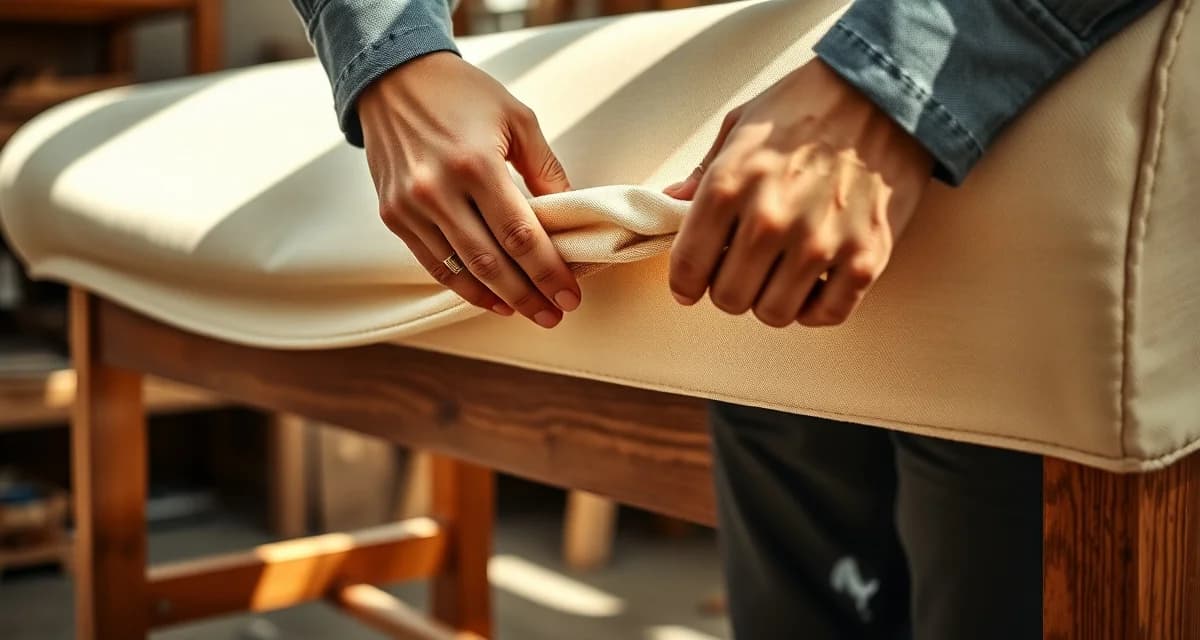
How to Reupholster a Bench: Hall Bench Window Seat and Storage
Storage bench hinge gaps that aren't planned in fabric cutting cause fabric tearing within 6-12 months. The hinge on a storage bench creates a stress point in the fabric at the exact location where the lid opens. If the fabric is cut to lie flat over the hinge without accounting for the hinge's range of motion, the fabric tears at the hinge point every time the lid opens more than a few degrees.
This guide covers three bench types: the standard hall or bedroom bench, the window seat bench, and the storage bench with a hinged lid.
TL;DR
- Successful reupholstery starts with a thorough frame and spring assessment before any fabric is ordered.
- Professional technique follows a consistent panel sequence: strip, repair frame, replace foam, then install fabric panels in the correct order.
- Pattern fabric requires centering and repeat alignment decisions made before cutting; errors discovered after cutting are expensive to correct.
- Professional labor time ranges from 12-20 hours depending on furniture style and fabric complexity.
- Foam selection matters as much as fabric selection; the right density and ILD creates the correct seating profile and longevity.
- Consistent tension on all panels and quality welt cording are the marks of professional finishing.
Standard Hall or Bedroom Bench
The most common bench upholstery job. A firm rectangular seat pad on a wood or metal base frame.
Assessment: Check the seat board for structural integrity (no cracks, no delamination if it's plywood). Check whether the base frame is stable. Bench frames that rock need to be addressed before upholstery, a rocking bench with new fabric still rocks.
Foam selection: Bench seats need firmer foam than sofa cushions because benches are often used as seating without a back support, and because the foam must hold firm for extended sit times. Use 2.0+ density, 40-45 ILD for most bench applications. Higher ILD than a sofa seat cushion.
Step-by-step:
- Remove the seat pad from the base (typically screws from beneath) or, if the bench is fully upholstered, begin tear-down from the dust cover.
- Remove existing fabric and foam.
- Cut new foam to the exact seat pad dimensions. Bond with spray adhesive.
- Wrap with Dacron: 1-2 layers, extending 2-3 inches down each side.
- Cut fabric: seat width + 6 inches x seat depth + 6 inches for a wrap configuration.
- Staple from center outward: front center, back center, sides from center outward.
- For square corners: miter fold as described in the ottoman guide. For shaped or curved bench ends, use the same radial relief cut technique from the round ottoman guide.
- Staple perimeter firmly at the underside.
- Reattach to base.
Window Seat Bench
Window seat benches often have side returns, sections of the seat that extend into the window alcove on each side. These side returns add fabric and complicate the cut plan.
Measuring the window seat: Measure the main seat width, depth, and the full return depth on each side (how far the seat extends into the alcove). The returns are not always symmetrical, measure each independently.
One-piece or two-piece construction: For window seats where the seat is one continuous piece including the returns, cut the foam and fabric as a connected T-shape or U-shape. For window seats where the main seat and returns are separate boards, treat them as separate pieces that coordinate in fabric.
Step-by-step for window seat with returns:
- Remove the seat if possible. Some window seats are built-in and can't be removed, in that case, work in place.
- Cut foam as a T-shape or U-shape to match the seat plan, with foam extending into each return.
- Cut fabric large enough to wrap the full connected seat shape, including all returns.
- For the return corners (the inside corners where the main seat meets each return), make a diagonal relief cut in the fabric at each inside corner. Cut from the fabric edge to within 1/4 inch of the corner point. This allows the fabric to fold cleanly around inside corners.
- Staple the main seat first, then the returns. Manage the inside corners with the relief cuts to get a clean fold.
Storage Bench With Hinged Lid
The storage bench requires one critical additional step that standard bench technique doesn't include: hinge gap planning.
The hinge problem: When a storage bench lid opens, the hinge area flexes. Fabric stapled over the hinge without clearance will catch on the hinge hardware, pull against it on every open, and eventually tear at the hinge location.
The solution: hinge clearance cuts. When cutting fabric for the back edge of the lid (the hinged edge), plan cuts that allow the fabric to avoid the hinge hardware.
Step-by-step for hinge gap:
- Before cutting fabric, measure the hinge location: how far from the back edge, and how wide each hinge is.
- Mark the hinge positions on your cut plan.
- At each hinge location, cut a small notch or tab in the back edge of the lid fabric. The notch should be wide enough (and set back from the edge far enough) that the fabric doesn't contact the hinge when the lid opens to full extension.
- For surface-mounted hinges (most common on bench lids), the notch is typically 1 inch wide and 1/2 inch deep at each hinge location.
- After upholstering the lid, open and close it fully to confirm fabric doesn't catch on the hinge.
Additional storage bench considerations:
- If the bench has a storage cavity, line the interior with a coordinating fabric or simple cambric for a finished look (and so stored items don't catch on rough wood).
- The front apron of the base (if visible) can be upholstered to match or contrast the lid.
- Check that the lid support chain (if present) is long enough to prevent the lid from opening so far it damages the upholstery.
For fabric yardage on window seat benches including side returns, use the fabric yardage calculator for benches. For full details on window seat return yardage, see the bench reupholstery guide.
Frequently Asked Questions
How do I reupholster a storage bench with a lid?
Upholster the lid as you would a standard bench pad, with one critical addition: plan hinge clearance cuts at each hinge location. Before cutting fabric, mark where the hinges fall on the lid's back edge. Cut small notches in the fabric at each hinge position (approximately 1 inch wide, 1/2 inch deep) so the fabric doesn't contact or catch on the hinge hardware when the lid opens. After upholstering, open and close the lid fully to confirm no fabric interference before delivering the piece.
How do I do a window seat?
Measure the main seat and any side returns separately. Cut foam to fit the full seat shape, including returns. Cut fabric large enough to wrap the entire seat including returns, with 3 inches of wrap on all sides. For inside corners where the main seat meets each return, make a diagonal relief cut from the fabric edge to within 1/4 inch of the corner, this allows clean folding around inside corners. Staple the main seat first, then manage the return sections. If the window seat is built-in and can't be removed, work in place.
What foam thickness for a bench seat?
For bench seats, use firmer foam than sofa cushions: 2.0 density or higher at 40-45 ILD for most applications. Firm foam is appropriate because bench seating doesn't have back support, users rely on the seat firmness more than on a sofa where the cushion is partly supported by the back. For decorative benches with very light use (end-of-bed accent benches), you can use softer foam (35-38 ILD). For high-use entryway benches or commercial bench applications, consider 50+ ILD for long-term performance.
What tools are required for professional reupholstery?
Professional reupholstery requires a heavy-duty staple gun (pneumatic or electric), a staple remover and tack puller, quality scissors and a rotary cutter, a sewing machine capable of sewing upholstery-weight fabric, foam cutting tools, and regulator pins for manipulating stuffing. For tufted work, a curved needle and tufting twine are also required. The quality of your tools directly affects the quality of the finished work, particularly at seams and edges.
How do I handle pattern matching across multiple panels?
Establish the dominant panel first (usually the inside back) and center the pattern motif there. Then cut each subsequent panel so the pattern aligns with the adjacent panel at the seam. Mark the pattern alignment point on each piece before cutting. For complex pieces, some upholsterers make a cutting plan on paper showing where each panel falls in the pattern before cutting any fabric. This investment in planning prevents the most common and costly pattern-matching errors.
Related Articles
Sources
- National Upholstery Association
- Association of Master Upholsterers and Soft Furnishers (AMUSF)
- Upholstered Furniture Action Council (UFAC)
- Furniture Today (trade publication)
Get Started with StitchDesk
Accurate reupholstery quotes require knowing your labor time, material costs, and overhead for each job type. StitchDesk helps upholstery shops build detailed, professional quotes that account for all cost factors, so every job is priced to cover costs and generate profit. Try StitchDesk free and bring accuracy to every estimate you send.