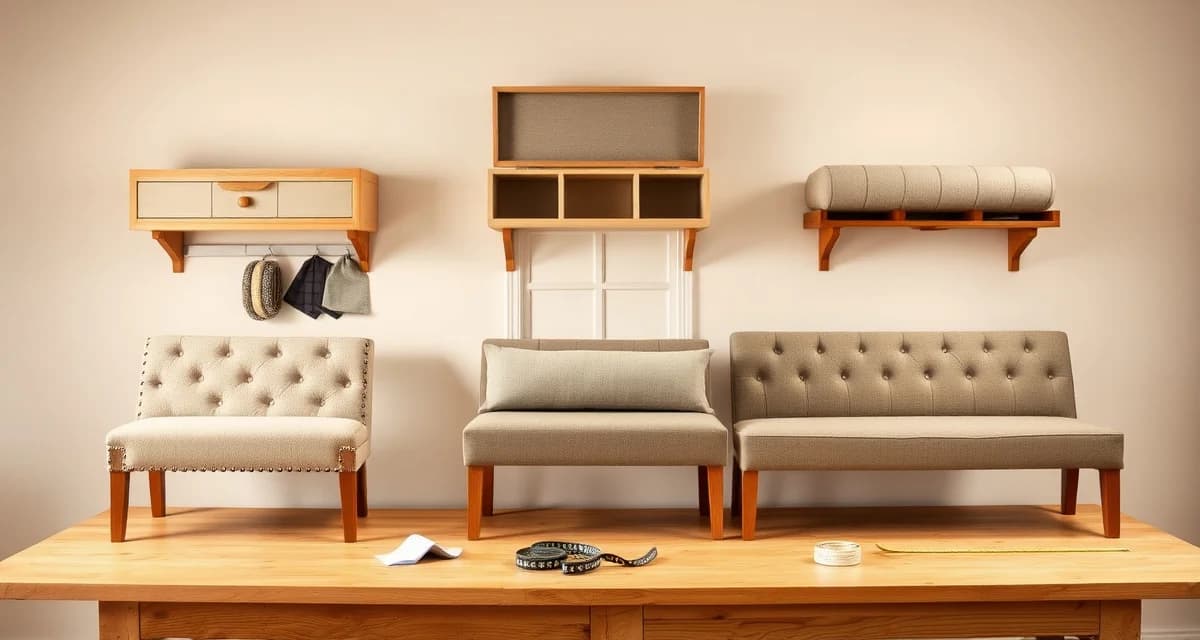
Bench Seating Fabric Yardage: Hall Bench Window Seat Storage Bench
Bench reupholstery is a category with more variation than the word "bench" suggests. The fabric needed for a narrow hall bench with a knife-edge seat is completely different from a window seat with arm returns and a box cushion. Lumping them together under one estimate is how you end up short.
Here are the five bench configurations you'll encounter most often, what makes each different, and the yardage ranges for each.
TL;DR
- For Bench Seating yardage depends on fabric width, construction details, pattern repeat, and nap direction.
- Plain 54-inch fabric requires a baseline calculation plus 10-15% waste allowance for a standard for bench seating job.
- Patterned fabric adds 20-35% to base yardage depending on repeat size and the number of cutting zones that must align.
- Directional fabrics add 15-25% over plain fabric because layout optimization is restricted by nap direction.
- Always verify fabric width before finalizing yardage; COM fabric often comes in non-standard widths.
- Calculating yardage at the quote stage, not mid-job, eliminates reorders and protects your profit margin.
Configuration 1: Hall Bench (No Back, No Arms)
The simplest bench in the category. A padded seat on a wood frame, typically 36 to 60 inches long. No back cushion, no arms, just the top and sides.
Panel map:
- Seat top (the padded surface)
- Front face (visible from the front, below the seat)
- Two end panels (visible from the sides)
- Optional: self-fabric welt around the seat edge
Yardage:
- 36-inch hall bench: 0.75 to 1 yard
- 48-inch hall bench: 1 to 1.25 yards
- 60-inch hall bench: 1.25 to 1.5 yards
If the bench has legs and the sides are partially open (no side panels), reduce these estimates by 15 to 25 percent depending on how much of the side structure is covered.
Configuration 2: Storage Bench (Hinged Lid)
A storage bench looks like a hall bench from the outside but the seat is a hinged lid. From a yardage standpoint, you're often covering just the top lid and possibly the front face, the interior is usually unlined or lined in a secondary fabric.
If the hinged lid has a padded seat with boxing:
- Lid top and boxing: 0.75 to 1.25 yards for a standard 48-inch storage bench
If the inside of the lid or the interior chest sides are also lined in face fabric (this happens on higher-end pieces): add 1 to 2 yards for the interior lining.
Configuration 3: Window Seat
Window seats vary considerably in whether they include arm returns at the ends. A simple window seat is essentially a very long bench cushion. A window seat with arm returns (the fabric extends up the sides to meet the window frame) is a different animal.
Simple window seat cushion, 60 to 72 inches long: 2 to 3 yards for a box cushion with 3 to 4-inch boxing. Knife-edge version: 1.5 to 2 yards.
Window seat with arm returns (both ends): Each arm return adds 0.5 to 1 yard depending on return height and depth. A 72-inch window seat with two arm returns: 3 to 5 yards total.
The arm returns are often what clients forget to mention when describing the piece over the phone. Ask specifically: "Does it have anything at the ends, or is it just the seat cushion?"
Configuration 4: Entryway Bench with Back
An upholstered bench that has an upholstered back panel, essentially a small settee or loveseat without arms. This is a considerably more complex piece than a simple bench seat.
Panel map:
- Seat cushion (top, bottom, boxing)
- Inside back panel
- Outside back panel
- Front rail (below seat)
- Two end panels
Yardage:
- 48-inch entryway bench with back, no arms: 3.5 to 4.5 yards
- 60-inch version: 4.5 to 5.5 yards
If this piece also has decorative legs visible (not covered by fabric), the sides and base panels are reduced, adjust accordingly.
Configuration 5: Banquette-Style Bench
A banquette or built-in bench at a kitchen table or bay window. Often has a back cushion and matching seat cushion but is built into the architecture. The fabric question is primarily about the cushion covers, not the bench frame (which is usually painted or stained wood).
For a 60-inch banquette with seat and back cushions:
- Seat cushion: 1.5 to 2 yards
- Back cushion (knife-edge at full width): 1.25 to 1.75 yards
- Total: 2.75 to 3.75 yards
Use the StitchDesk bench yardage calculator for precision beyond these ranges.
The Arm Return Add-On
The arm return is the most commonly missed yardage element on bench seating. When a window seat, built-in bench, or entry bench has fabric that extends up the sides, whether attached cushion returns or fixed fabric panels, those surfaces need to be measured and calculated separately.
Each arm return at a window seat adds 0.5 to 1 yard depending on how tall and deep the return is. Two returns = 1 to 2 yards added to your base cushion calculation. On a 2-yard job, that's potentially doubling your fabric order.
Frequently Asked Questions
How much fabric for a window seat bench?
A simple window seat box cushion (no arm returns) in a standard 60 to 72-inch length needs 2 to 3 yards for a 3 to 4-inch deep cushion in solid 54-inch fabric. If the window seat has arm returns at both ends, add 0.5 to 1 yard per return. A window seat with two arm returns can need 4 to 5 yards total. Confirm whether arm returns are included before finalizing your order.
How does a storage bench differ from a hall bench in yardage?
A storage bench typically uses similar yardage to a hall bench if you're only covering the exterior surfaces (lid top, front face, side panels). If the client also wants the interior of the storage chest lined in face fabric, add 1 to 2 yards for the interior panels. The hinged lid construction doesn't change the exterior fabric calculation.
What fabric is best for a window seat?
Performance fabric is a strong recommendation for window seats because they get consistent sun exposure. UV exposure over time fades standard residential fabric. Solution-dyed acrylic or performance polyester with UV resistance holds color much better. If the window has good UV-blocking glazing, this is less critical, but for south or west-facing windows with direct sun, performance fabric is the right call.
What is the biggest factor in yardage variation for this piece?
Pattern repeat is the biggest source of yardage variation. On plain fabric, the baseline calculation plus a 10-15% waste buffer is usually sufficient. Add a 13-inch pattern repeat and you may need 15-20% more. Add a 27-inch pattern repeat and the additional yardage can be 25-35% over the plain fabric calculation. Nap direction is the second-largest factor, typically adding 15-25% over plain fabric because layout optimization is restricted.
What should I do if I run short on fabric mid-job?
Stop cutting immediately when you realize you may run short. Calculate exactly how much additional fabric you need before contacting the supplier or client. If reordering from the same dye lot is possible, do so as quickly as possible because dye lots change. If a dye lot match is not available, contact the client before proceeding; visible dye lot differences on the same piece are unacceptable and must be disclosed. Document the situation and response in writing.
Sources
- National Upholstery Association
- Association of Master Upholsterers and Soft Furnishers (AMUSF)
- Upholstered Furniture Action Council (UFAC)
- Furniture Today (trade publication)
Get Started with StitchDesk
Getting yardage right on yardage for bench seating jobs is the difference between a profitable quote and an expensive reorder. StitchDesk's fabric calculator accounts for all the variables that cause errors: pattern repeat by zone, nap direction, fabric width, and cushion configuration. Start a free trial and see how accurate yardage calculation affects your bottom line.