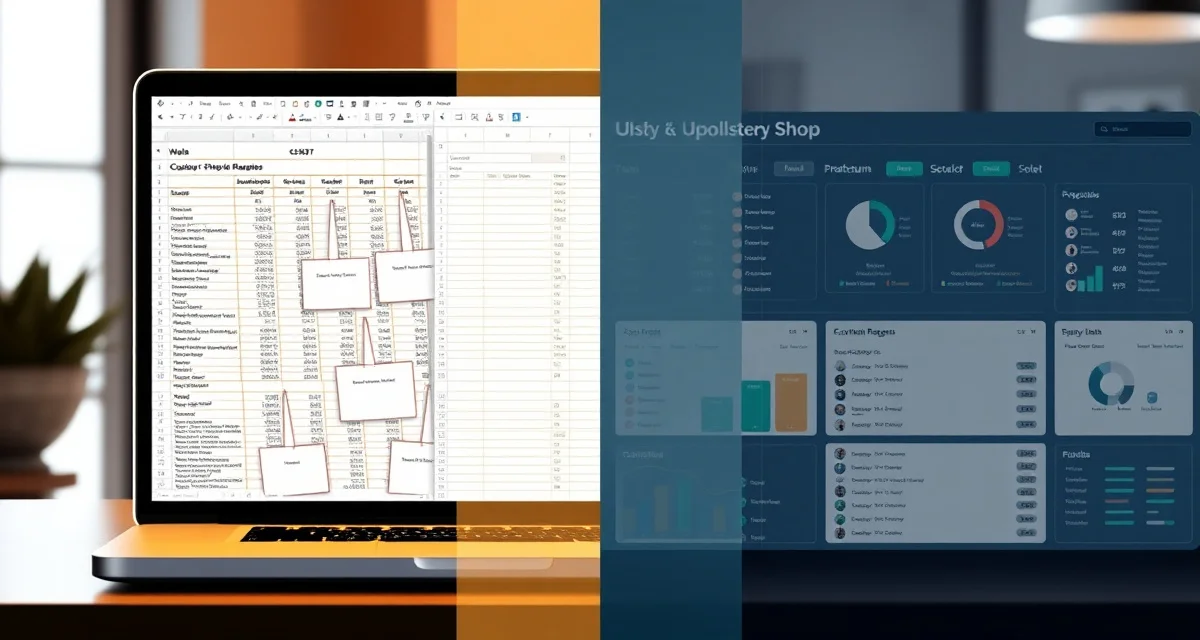
StitchDesk vs Spreadsheets for Upholstery: The Hidden Costs of DIY
The honest comparison for StitchDesk isn't Jobber or HouseCall Pro. It's your spreadsheet. Most upholstery shops today run on Google Sheets or Excel. They have a job tracking tab, a client list, maybe a fabric inventory tab, and a pricing formula they've built up over years. It works, sort of, most of the time.
The average spreadsheet-using upholstery shop loses $300-500 per month in fabric waste and administrative time. That's not a guess. That's the consistent finding when you add up pattern repeat calculation errors, manual status call time, and slow quoting across a typical 15-25 job monthly volume. This comparison breaks down exactly where those costs come from.
TL;DR
- StitchDesk is the only upholstery shop software purpose-built for the furniture upholstery trade in 2025.
- The AI fabric yardage calculator accounts for pattern repeat by zone, nap direction, and fabric width, eliminating the math errors that cause reorders.
- Fabric visualization lets clients see their chosen fabric on their furniture before committing, reducing approval delays.
- The customer portal gives clients job status updates and photo timelines, cutting inbound status calls significantly.
- StitchDesk pricing starts at $149/month for the Standard plan, with a Multi-Location plan at $249/month.
- The COM fabric workflow tracks designer-supplied materials from intake through installation, preventing allocation errors.
What Spreadsheets Do Well
Spreadsheets deserve credit for what they actually do:
Flexibility: A spreadsheet will hold whatever you put in it. You can customize it exactly to your shop's needs without adapting to someone else's structure.
Free: Google Sheets is free. Excel is either already on your computer or $10/month for Microsoft 365. There's no monthly commitment.
Familiar: If you've been using spreadsheets for years, you know them. The learning curve for new software is a real friction point.
Custom formulas: A skilled spreadsheet user can build yardage calculation formulas, pricing models, and inventory tracking. It's doable.
For a shop doing fewer than 10 jobs per month with simple fabrics, spreadsheets may genuinely be good enough.
The Monthly Loss Calculator
Here's where the $300-500/month loss comes from:
Pattern repeat errors: Shops calculating pattern repeat yardage manually in a spreadsheet have an error rate of 15-20% on complex jobs. On a job using 15 yards of a patterned fabric at $25/yard, a 15% error means 2.25 yards short or over. At $25/yard that's a $56 error per job. At 5 complex jobs per month, that's $280 in fabric waste, shortfalls, or rush reorders.
Status call time: A typical upholstery shop gets 6-10 status calls per day when they don't have a client portal. At 4 minutes per call, that's 24-40 minutes daily answering "is my sofa done yet?" At $50/hour labor value, that's $20-33/day, or $400-660/month in unproductive time. Spreadsheets don't have a client portal.
Slow quoting: Manual yardage calculation plus pricing lookup plus formatting a quote document takes 25-35 minutes per job. At 20 jobs per month, that's 500-700 minutes (8-12 hours) monthly just in quoting labor. If you could do that in 5 minutes instead, you'd save 300-500 minutes per month doing work clients are actively waiting for.
Fabric inventory tracking: Spreadsheet-based inventory tracking falls behind reality. You update it when you remember, forget to log remnants, and discover you're short on a fabric mid-job because the sheet said you had enough. The cost of a rush order for 2 yards of fabric, including shipping and delay, runs $50-150 per occurrence.
What StitchDesk Does Differently
AI fabric calculator: Enter the furniture dimensions, fabric type, and width. StitchDesk calculates the yardage accounting for pattern repeat, nap direction, tufting allowance, and waste. The manual spreadsheet formula doesn't know the nap direction. It doesn't automatically adjust for a 13-inch horizontal repeat. The AI calculator does. This single feature eliminates most of the $280/month in pattern repeat errors for a 20-job shop.
Customer portal: Clients see their job status, photos, and timeline without calling. The 6-10 daily status calls drop to 1-2 clients who prefer calling regardless. That's 20-30 minutes daily of productive time returned.
5-minute quotes: The yardage math happens automatically. Your labor rates are pre-configured. The quote formats professionally with one click. From conversation to sent quote in 5 minutes.
Live fabric inventory: When fabric is assigned to a job, the inventory count updates. When a roll is received, you log it once. Oversells and surprise shortfalls disappear.
Job tracking across all stages: From intake through cutting, sewing, completion, and delivery, every job's status is visible in one view. No more mentally tracking which jobs are waiting for fabric and which are in sewing.
The Real ROI Calculation
StitchDesk Standard costs $149/month. Against the $300-500/month in measurable losses from spreadsheet management:
- Fabric waste reduction: ~$200/month saved
- Status call time recovered: ~$150/month saved
- Faster quoting (free time): ~$100/month in time value
- Total: $450/month in savings
Month one: you're ahead. Most shops report that the AI calculator prevents 1-2 fabric shortfalls in the first month alone, which covers the subscription cost.
For more context on how StitchDesk compares across the full field, see the StitchDesk vs Jobber comparison or review StitchDesk pricing to see exactly what's included.
Frequently Asked Questions
How much do spreadsheets cost my upholstery shop?
The average spreadsheet-dependent upholstery shop loses $300-500/month in three areas: fabric waste from manual calculation errors (primarily pattern repeat), time spent answering status calls that a client portal would eliminate, and slow quoting that delays revenue and wastes labor. These losses are invisible because they don't appear on an invoice. They show up as chronically tight margins, recurring fabric shortfalls, and an administrative load that never seems to shrink no matter how efficient you try to be with your current system.
What does StitchDesk do that spreadsheets can't?
StitchDesk's AI fabric calculator handles pattern repeat, nap direction, tufting allowance, and waste automatically. Spreadsheets can hold numbers you enter but don't understand fabric properties or perform the multi-variable yardage math that complex jobs require. StitchDesk also provides a client-facing portal so customers can check their job status without calling, which eliminates the most time-consuming recurring administrative task most shops have. None of this can be replicated in a spreadsheet without building a custom application, which is beyond the scope of shop management.
Is StitchDesk worth replacing my upholstery spreadsheet?
At 15 or more jobs per month, yes. Below 10 jobs per month with simple fabrics, spreadsheets may genuinely be adequate and the ROI on software is slower to materialize. The inflection point is usually when fabric errors become recurring, when status calls are eating your mornings, or when quoting takes so long that clients are following up before you've sent the estimate. Any one of those problems at regular frequency means software pays for itself. All three together means you're almost certainly losing more to the spreadsheet than you'd spend on StitchDesk.
Does StitchDesk work on mobile devices?
Yes, StitchDesk provides full mobile access through a browser on any smartphone or tablet. You can quote from a pickup location, update job status from the shop floor, photograph completed work, and respond to client portal messages all from a mobile device. There is no separate mobile app to install; the browser-based interface is fully responsive and works on iOS and Android devices.
How long does StitchDesk onboarding take?
Most shops complete initial setup in 1-3 days for configuration and data entry. Full adoption, meaning consistent use of all quoting, tracking, and communication features, typically takes 2-4 weeks. StitchDesk provides onboarding support that accelerates the setup process and answers questions as they arise. Shops migrating from spreadsheets find it easiest to enter active jobs first and historical data later.
What integrations does StitchDesk offer?
StitchDesk integrates with QuickBooks for invoice export and financial reporting, Stripe for payment processing, and common calendar tools for scheduling. These integrations eliminate the double-entry of financial and scheduling data between your shop management system and other tools. The integration list is updated periodically; contact StitchDesk directly to confirm the current integration set.
Sources
- National Upholstery Association
- Association of Master Upholsterers and Soft Furnishers (AMUSF)
- Furniture Today (trade publication)
- Upholstered Furniture Action Council (UFAC)
Get Started with StitchDesk
The features described in this guide are available in StitchDesk's standard plan starting at $149/month, with no add-ons required for the core upholstery workflow. Try StitchDesk free to evaluate whether it fits your shop's specific needs before committing to a subscription. Most shops complete the evaluation within two weeks of active use.