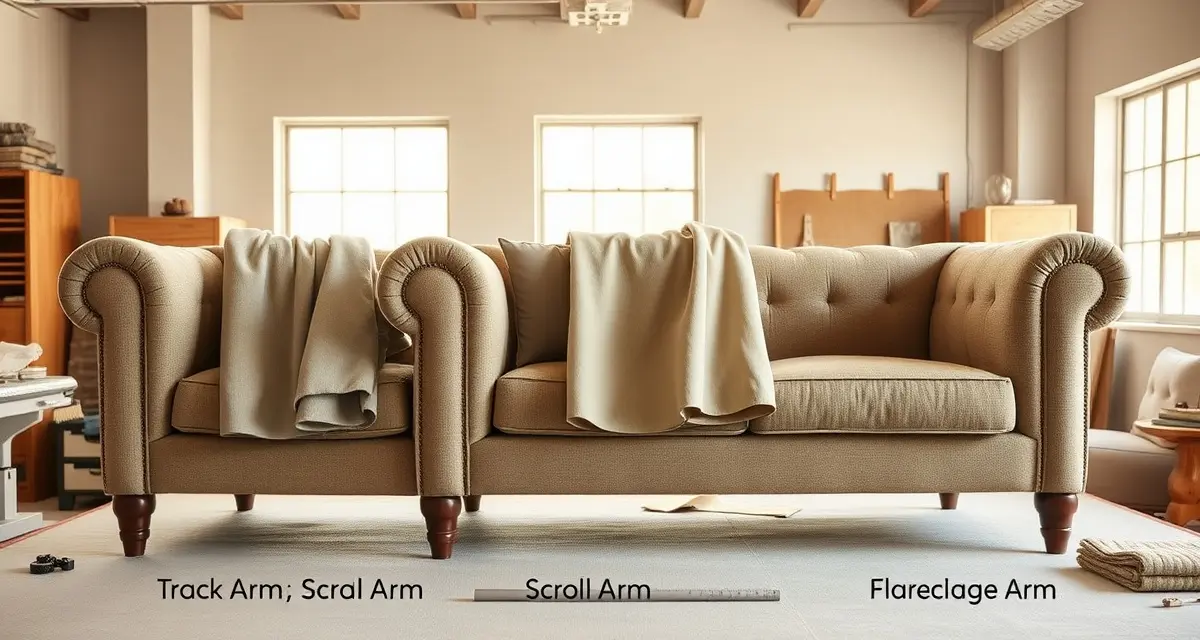
Upholstery Arm Yardage: Track Arm vs Scroll Arm vs Flared Arm
Scroll arms on a sofa use 1-1.5 more yards than track arms. That's a $30-60 difference in fabric cost at common upholstery fabric prices, and it's a consistent misquote when shops use a generic "sofa arm" allowance.
No existing content breaks down yardage difference by arm style. Most guides lump all arms together. This guide doesn't. Here's the arm style comparison matrix with fabric yardage contribution for six arm styles across sofa and chair scales.
TL;DR
- Arm Upholstery Calculation yardage depends on fabric width, construction details, pattern repeat, and nap direction.
- Plain 54-inch fabric requires a baseline calculation plus 10-15% waste allowance for a standard arm upholstery calculation job.
- Patterned fabric adds 20-35% to base yardage depending on repeat size and the number of cutting zones that must align.
- Directional fabrics add 15-25% over plain fabric because layout optimization is restricted by nap direction.
- Always verify fabric width before finalizing yardage; COM fabric often comes in non-standard widths.
- Calculating yardage at the quote stage, not mid-job, eliminates reorders and protects your profit margin.
Why Arm Style Changes Yardage
Arms look simple from the outside. But the inside of an upholstered arm is more complex than it appears. Each arm has at minimum four distinct fabric pieces: inside arm, outside arm, arm front (the boxing panel at the front), and the welt that borders all the arm seams.
What changes between arm styles:
- Surface area: Scroll and flared arms are physically larger than track arms, requiring more fabric to cover the same area.
- Panel count: Rolled and scroll arms require additional shaped pieces to cover the curved transition from arm top to arm face. These extra pieces don't exist on a flat track arm.
- Cutting geometry: Curved arms require cutting fabric around a curve, which generates offcut waste. Track arms cut as rectangles with minimal offcut.
- Welt length: More complex arm shapes have more seam edges, more seam edges means more welt. Welt fabric adds up.
The Six Arm Style Comparison
Track Arm
The simplest and most fabric-efficient arm style. The arm runs in a horizontal track from front to back with a straight, vertical front face. Inside arm and outside arm are near-rectangles.
Yardage per arm (sofa scale): 0.75-1 yard
Yardage for both arms on a sofa: 1.5-2 yards
T-Arm (Arm Pad)
A variation of the track arm with a padded top that sits on a flat arm shell. The arm pad itself requires fabric, but the shell beneath is covered in less visible fabric (or sometimes muslin). The effect is a padded armrest sitting on an arm structure.
Yardage per arm: 0.85-1.1 yards
Both arms on sofa: 1.7-2.2 yards
Flared Arm
A flared arm widens toward the front or top, creating a wedge shape. The widening requires larger panels, the inside arm and outside arm are trapezoidal, not rectangular. The trapezoidal cut generates corner waste.
Yardage per arm: 1-1.25 yards
Both arms on sofa: 2-2.5 yards
English Roll Arm
A rounded arm with a forward-rolling top edge. The roll requires an additional curved top panel that wraps over the roll and tucks down both sides. More panels means more cuts and more seam waste.
Yardage per arm: 1.1-1.4 yards
Both arms on sofa: 2.2-2.8 yards
Scroll Arm
The scroll arm curves forward dramatically at the top, creating an S-curve profile. This is the most fabric-intensive common arm style. The curve requires shaped bias-cut pieces that waste a real amount of fabric at the curved sections. The scroll front (the face of the curved arm viewed from the front) is its own shaped piece.
Yardage per arm: 1.25-1.6 yards
Both arms on sofa: 2.5-3.2 yards
Rolled (Chesterfield) Arm
The classic Chesterfield arm with a rounded, fully rolled top and front. Very similar to scroll in complexity. If the arm is also tufted (as on many Chesterfields), add another 20% for tufting waste on the arm panels.
Yardage per arm (untufted): 1.2-1.5 yards
Both arms on sofa (untufted): 2.4-3 yards
Arm Style Yardage Comparison Table
| Arm Style | Per Arm (Sofa) | Both Arms (Sofa) | Per Arm (Chair) | Both Arms (Chair) |
|---|---|---|---|---|
| Track arm | 0.75-1 yd | 1.5-2 yds | 0.5-0.6 yd | 1-1.2 yds |
| T-arm pad | 0.85-1.1 yd | 1.7-2.2 yds | 0.55-0.65 yd | 1.1-1.3 yds |
| Flared arm | 1-1.25 yd | 2-2.5 yds | 0.6-0.8 yd | 1.2-1.6 yds |
| English roll | 1.1-1.4 yd | 2.2-2.8 yds | 0.7-0.9 yd | 1.4-1.8 yds |
| Scroll arm | 1.25-1.6 yd | 2.5-3.2 yds | 0.75-1 yd | 1.5-2 yds |
| Rolled/Chesterfield | 1.2-1.5 yd | 2.4-3 yds | 0.75-0.95 yd | 1.5-1.9 yds |
How to Measure Arms for Yardage Calculation
For accurate arm yardage, measure:
- Inside arm: Height from seat level to arm top × depth from front to back of arm
- Outside arm: Height from floor level to arm top × depth from front to back
- Arm front: Height of arm front face × width of arm at front
- Arm top (for rolled/scroll only): The curved top panel, measure along the curve, not straight across
Add seam allowance (3/8 inch standard, 1/2 inch for pile fabrics) on all four sides of each panel.
The arm front and any curved top panels should be measured separately because they often can't be cut efficiently alongside the main arm panels.
Use the fabric yardage calculator sofa with arm style specified to get arm yardage included in the full sofa calculation. The how to measure sofa reupholstery guide has a panel-by-panel measurement walkthrough.
FAQ
How much fabric does a scroll arm use?
A single scroll arm on a sofa uses approximately 1.25-1.6 yards of fabric. Both arms together use 2.5-3.2 yards. The scroll arm is the most fabric-intensive common arm style because the curved scroll requires shaped bias-cut pieces that generate notable offcut waste. Compare this to 1.5-2 yards for both track arms on the same sofa, the scroll adds about 1-1.5 yards for the pair.
What is the yardage difference between track arms and scroll arms?
Track arms use 1.5-2 yards for a pair on a sofa. Scroll arms use 2.5-3.2 yards for a pair. The difference is approximately 1-1.5 yards per sofa. In fabric cost terms at $30/yard, that's $30-45 more for scroll arms, enough to warrant a separate line item in your quote rather than burying it in a generic "arm allowance."
How do I measure upholstery arms for fabric yardage?
Measure the inside arm from seat level to arm top × from arm front to arm back. Measure the outside arm from the floor (or base) to arm top × same depth. For the arm front, measure the face height × arm width at the front. For rolled or scroll arms, measure the curved top panel by following the curve with a flexible tape rather than measuring straight across. Add seam allowance on all four sides of each panel and calculate the area in square inches, then convert to yards.
What is the biggest factor in yardage variation for this piece?
Pattern repeat is the biggest source of yardage variation. On plain fabric, the baseline calculation plus a 10-15% waste buffer is usually sufficient. Add a 13-inch pattern repeat and you may need 15-20% more. Add a 27-inch pattern repeat and the additional yardage can be 25-35% over the plain fabric calculation. Nap direction is the second-largest factor, typically adding 15-25% over plain fabric because layout optimization is restricted.
Sources
- National Upholstery Association
- Association of Master Upholsterers and Soft Furnishers (AMUSF)
- Upholstered Furniture Action Council (UFAC)
- Furniture Today (trade publication)
Get Started with StitchDesk
Getting yardage right on arm upholstery calculation jobs is the difference between a profitable quote and an expensive reorder. StitchDesk's fabric calculator accounts for all the variables that cause errors: pattern repeat by zone, nap direction, fabric width, and cushion configuration. Start a free trial and see how accurate yardage calculation affects your bottom line.