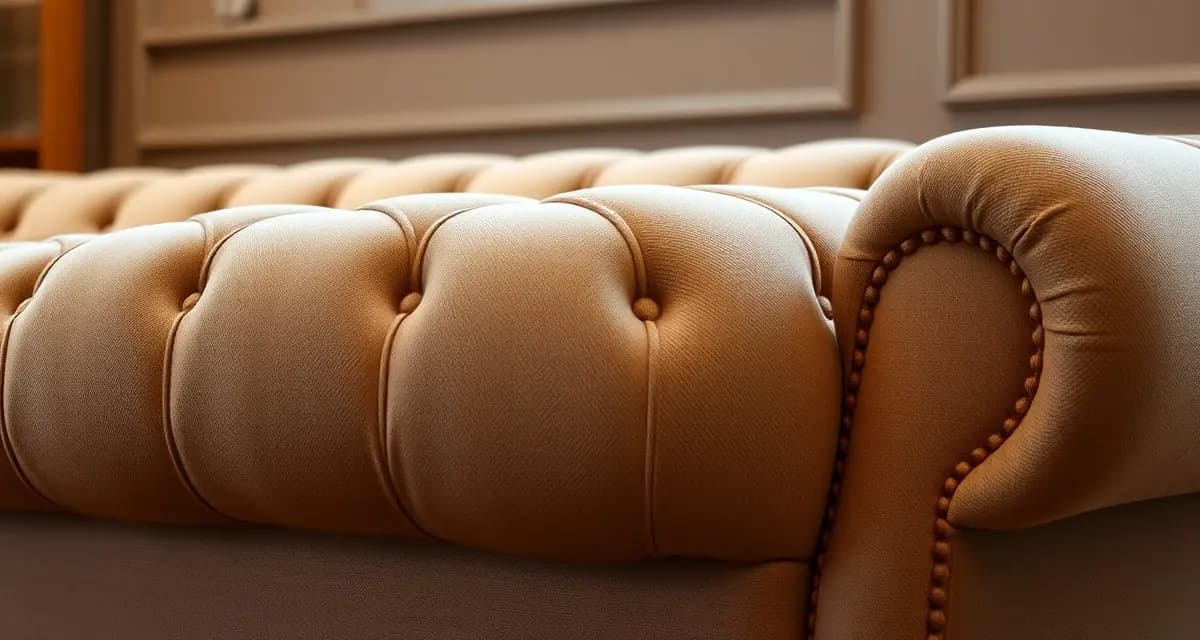
Chesterfield Sofa Fabric Yardage: Tufting and Rolled Arm Calculation
The Chesterfield is the most fabric-intensive standard sofa you'll work on. It's not even close. And the mistake shops make over and over again is starting their estimate from a generic sofa number and adding "a bit extra for tufting." That approach runs short. Every time.
The Chesterfield has two major compounding complexity factors that need to be calculated independently: the deep button tufting across the back and arms, and the rolled arm profile. Together, they add 4 to 6 yards over a flat Lawson sofa of the same dimensions. Separately, each adds 2 to 3 yards. You can't subtract for the overlap because they affect different panels.
TL;DR
- Chesterfield Sofa yardage depends on fabric width, construction details, pattern repeat, and nap direction.
- Plain 54-inch fabric requires a baseline calculation plus 10-15% waste allowance for a standard chesterfield sofa job.
- Patterned fabric adds 20-35% to base yardage depending on repeat size and the number of cutting zones that must align.
- Directional fabrics add 15-25% over plain fabric because layout optimization is restricted by nap direction.
- Always verify fabric width before finalizing yardage; COM fabric often comes in non-standard widths.
- Calculating yardage at the quote stage, not mid-job, eliminates reorders and protects your profit margin.
Why Chesterfields Always Use More Yardage
Start with the rolled arms. A standard Lawson arm is essentially a flat rectangle. You measure the inside arm, outside arm, and arm front as flat panels. On a Chesterfield, the arm rolls over at the top and continues partway down the front face. The fabric doesn't end at the top edge: it wraps around the roll. That means your inside arm panel needs extra height to accommodate the wrap depth, and your arm front panel needs to account for the curved transition at the roll.
For each arm, the rolled profile adds roughly 4 to 6 inches of extra panel height compared to a straight arm. Across two arms, you're adding 0.5 to 1 yard just from the arm geometry before you've touched the tufting calculation.
Now add button tufting. The Chesterfield is typically tufted on the inside back, the inside arms, and sometimes the seat front. Button tufting creates fabric pull: when you push a button through the fabric and tie it off behind, the surrounding material gathers between the buttons. That gathering uses fabric. The deeper the tuft (longer button tie-off), the more fabric is gathered and consumed.
On a heavily tufted Chesterfield back, button pull typically adds 10 to 20% to the back panel yardage. On a 3-cushion Lawson, the inside back panel might need 2.5 yards. On a Chesterfield with deep tufting on the same-sized back, that panel can need 3 to 3.5 yards.
Yardage Breakdown for a Chesterfield Sofa
These figures assume 54-inch fabric. Leather or vinyl will vary (see below).
80-84 inch Chesterfield (2 seat cushions):
- Base inside back with tufting: 3.5 to 4.5 yards
- Inside arms with roll and tufting (x2): 2.5 to 3.5 yards total
- Outside back: 2 to 2.5 yards
- Outside arms (x2): 1.5 to 2 yards total
- Seat cushions (x2): 3.5 to 4.5 yards
- Front border and base: 0.75 to 1 yard
- Arm fronts and arm tops (x2): 0.5 to 0.75 yards
- Welt: 0.5 to 1 yard
Total: 14 to 20 yards
90-96 inch Chesterfield (3 seat cushions):
Add approximately 2 to 3 yards to the 2-cushion estimate for the additional seat cushion and extended back panels. Expect 17 to 23 yards for a fully tufted 3-cushion Chesterfield in 54-inch fabric.
If you're using the Lawson yardage as a starting point, you need to add 4 to 6 yards minimum. Shops that don't do this adjustment run short, and re-ordering from a new dye lot is the worst outcome on a high-visibility piece like a Chesterfield.
Calculating Tufting Waste on the Chesterfield
The tufting waste calculation depends on button density, how many buttons per square foot of surface, and how deep the tuft pull is.
For typical Chesterfield diamond tufting with 4 to 5 inch button spacing:
Button pull waste factor: 15 to 20% additional fabric per tufted panel
To apply this:
- Calculate the flat panel yardage for the inside back as you would for a non-tufted sofa
- Multiply by 1.15 to 1.20 to get tufted panel yardage
- Do the same for each tufted arm panel
On a 3-cushion Chesterfield where the back and both arms are tufted, this calculation applies to three major panels. The compound effect is real.
Rolled Arms: Calculating the Wrap Depth
The roll on a Chesterfield arm typically has a radius of 3 to 5 inches. To calculate the extra fabric needed for the wrap:
Inside arm: Add the roll circumference to the panel height. For a 3-inch roll radius, the circumference of the quarter-circle is approximately 4.7 inches. Add that to your standard inside arm height measurement plus seam allowances.
Arm front: The arm front transitions from the arm face to the roll. Measure from the base of the arm front to the point where the roll curve ends on the front face of the arm, not just to where the straight arm profile would end.
Outside arm: The outside arm wraps from the outside surface up and over the roll. Measure from the bottom rail up to the top of the roll, not just to the top of the arm frame.
If you measure all three arm panels using standard straight-arm conventions, you'll cut each one short by 3 to 5 inches. Across 6 arm panels (inside, outside, front x2 arms), that's potentially 18 to 30 inches of shortfall, easily a half to three-quarters of a yard.
Chesterfield in Leather: Hide Count Conversion
Chesterfields are perhaps the most iconic leather sofa style, and leather is sold in hides rather than yards. For a full-leather Chesterfield:
- An 84-inch Chesterfield typically needs 5 to 7 hides
- A 96-inch piece needs 6 to 8 hides
- Deep tufting requires additional hide area for the extra material pulled into the buttons
Hides have unusable areas along the brand, belly, and leg edges. Budget for 15 to 20% wastage per hide beyond the cutting waste from tufting.
Best Fabrics for Chesterfield Sofas
Top-grain leather is the traditional choice and shows off tufting beautifully. The higher cost per hide makes accurate yardage calculation even more important.
Velvet is popular in jewel tones for upholstered Chesterfields. Nap direction adds the same 10 to 15% yardage premium you'd apply to any velvet job. On a Chesterfield, velvet and tufting together can push your yardage 25 to 30% above a flat velvet sofa estimate.
Performance fabrics work well for residential Chesterfields. Woven performance fabrics have no nap direction consideration, which is a practical advantage on a high-complexity piece.
Fabrics to avoid: Anything with a large horizontal pattern repeat that would need to be centered on the tufted back. That alignment problem is solvable but adds real waste and complexity.
Using the Sofa Fabric Yardage Calculator
Use the sofa calculator as your base, then add the tufting waste factor manually for Chesterfield-specific panels. For tufting waste calculation specifically, the Fabric Yardage for Tufted Upholstery guide walks through the button density calculation in detail.
How many yards for a Chesterfield sofa?
A standard Chesterfield sofa needs 14 to 23 yards of 54-inch fabric depending on size (2 or 3 seat cushions) and tuft depth. Most 3-cushion Chesterfields land in the 17 to 21 yard range. This is 4 to 6 yards more than a comparable Lawson sofa.
Does Chesterfield tufting require much extra fabric?
Yes. Button tufting on the back and arms of a Chesterfield adds 15 to 20% to those panel calculations individually. Combined with the rolled arm geometry, the tufting adds 2 to 3 yards on its own, before you account for the arm roll waste.
What is the best fabric for a Chesterfield sofa?
Leather is traditional and ages well with tufting. High-pile velvet gives a dramatic look but adds nap direction waste. Performance weaves are practical for family use. Avoid large pattern repeats if you want to keep the estimate manageable: pattern alignment on a tufted surface is genuinely difficult.
What is the biggest factor in yardage variation for this piece?
Pattern repeat is the biggest source of yardage variation. On plain fabric, the baseline calculation plus a 10-15% waste buffer is usually sufficient. Add a 13-inch pattern repeat and you may need 15-20% more. Add a 27-inch pattern repeat and the additional yardage can be 25-35% over the plain fabric calculation. Nap direction is the second-largest factor, typically adding 15-25% over plain fabric because layout optimization is restricted.
What should I do if I run short on fabric mid-job?
Stop cutting immediately when you realize you may run short. Calculate exactly how much additional fabric you need before contacting the supplier or client. If reordering from the same dye lot is possible, do so as quickly as possible because dye lots change. If a dye lot match is not available, contact the client before proceeding; visible dye lot differences on the same piece are unacceptable and must be disclosed. Document the situation and response in writing.
FAQ
Sources
- National Upholstery Association
- Association of Master Upholsterers and Soft Furnishers (AMUSF)
- Upholstered Furniture Action Council (UFAC)
- Furniture Today (trade publication)
Get Started with StitchDesk
Getting yardage right on chesterfield sofa jobs is the difference between a profitable quote and an expensive reorder. StitchDesk's fabric calculator accounts for all the variables that cause errors: pattern repeat by zone, nap direction, fabric width, and cushion configuration. Start a free trial and see how accurate yardage calculation affects your bottom line.