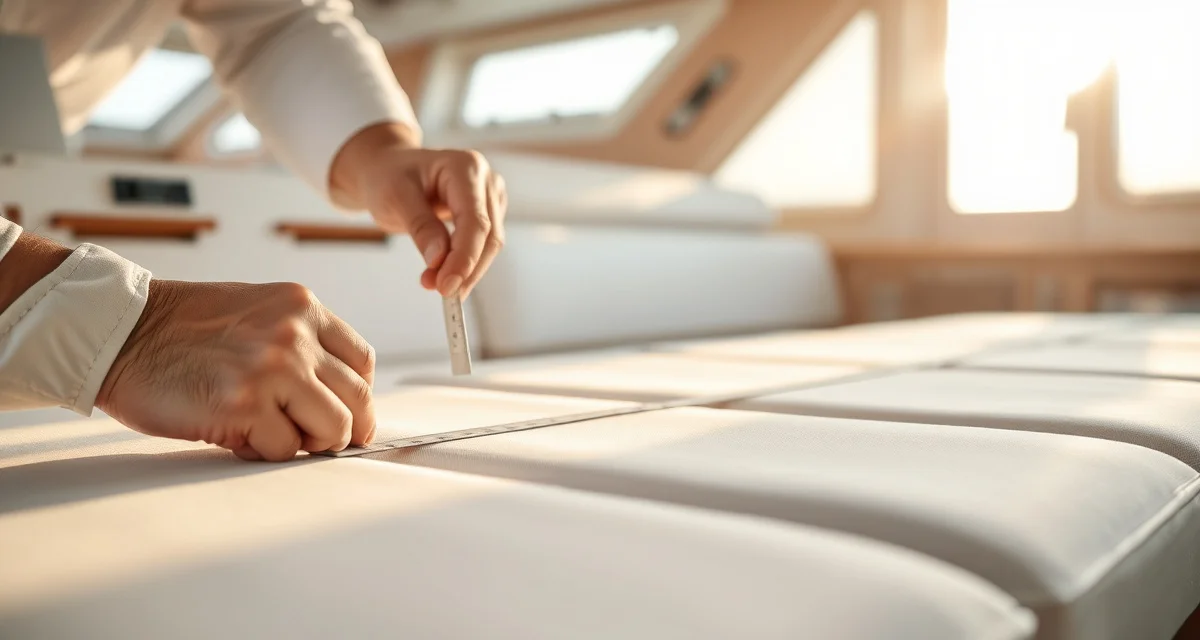
Fabric Yardage Calculator for Boat Upholstery: Marine Grade Layouts
Boat seat cushions need 25% more seam allowance than interior furniture to handle UV and water stress. That's not a guideline, it's the difference between seams that last 3 seasons and seams that fail in the first. And it changes your yardage calculation.
The fabric yardage calculator for boat upholstery accounts for marine-grade seam allowances, drain panel cuts, and the widths of UV-resistant vinyl and Sunbrella that are standard in marine applications. Shopflow is marine-first but its pricing is demo-gated, there's no self-serve option to just calculate yardage quickly.
TL;DR
- Marine upholstery fabric must meet UV, moisture, mildew, and salt-air resistance requirements that standard furniture fabric cannot meet.
- Solution-dyed acrylic is the industry standard for exterior marine cushions, rated for 2,000+ hours of UV exposure.
- Marine vinyl must be specifically formulated for marine use; standard furniture vinyl cracks and delaminates from UV and temperature cycling.
- Foam used in marine upholstery should be open-cell or perforated to allow water drainage and prevent mildew.
- All hardware (staples, snaps, screws) used in marine work must be marine-grade stainless steel to prevent rust staining.
- UV-stabilized polyester thread is required for all exterior marine seams; standard thread degrades rapidly in sun and salt environments.
Marine Upholstery vs Interior Upholstery: Key Differences
Marine upholstery operates in a much harsher environment than interior furniture. UV exposure, salt spray, constant moisture, and the mechanical stress of marine movement all put demands on seams and fabric that interior upholstery never faces.
This translates to specific calculation differences:
Wider seam allowances: Standard interior upholstery uses 3/8-inch seam allowances. Marine work should use 5/8 to 3/4 inch seam allowances at all exposed seams. On a typical boat cushion with 8-10 seams, the wider allowance adds 0.1-0.15 yards per cushion.
Drain panel cuts: Many marine cushions include drain holes or slots to allow rainwater to escape. These cuts in the bottom panel reduce the net usable area of the bottom panel. Calculate bottom panels at 10-15% less effective area than the full panel dimensions.
UV-resistant thread: Marine upholstery uses UV-resistant thread (typically polyester or similar) which can be slightly thicker than standard upholstery thread. Factor this into seam allowance planning.
Mildew-resistant consideration: Some marine fabrics are treated with mildew inhibitors that can affect how they accept dye or how they handle at seams. Always test-sew marine fabrics before committing to production.
Marine Fabric Widths and Options
The most common marine upholstery materials:
| Material | Typical Width | Applications |
|---|---|---|
| Sunbrella outdoor acrylic | 54 or 60 inches | Cushion covers, seating |
| Marine vinyl (vinyl) | 54 inches | Helm seats, fighting chairs, bench seating |
| Weblon/marine canvas | 60 or 62 inches | Covers, bimini tops (not seating) |
| Naugahyde marine | 54 inches | Interior cabin seating |
For seating upholstery, Sunbrella and marine vinyl are the most common choices. Sunbrella is preferred for its UV resistance and breathability. Marine vinyl is more waterproof and easier to clean but less breathable, not ideal for long tropical passages.
Calculating Yardage for Boat Cushions
Boat cushion yardage follows the same panel-by-panel approach as land-based cushions, with adjustments:
Top panel: Full dimensions plus 5/8-inch seam allowance on all sides.
Bottom panel: Full dimensions plus 5/8-inch seam allowance, then subtract 10-15% for drain cuts (if applicable). Some marine bottoms use drainage fabric (open mesh) for the center section, with solid fabric only at the perimeter, calculate only the perimeter solid area.
Boxing strips: Same as interior, but with 5/8-inch seam allowance instead of 3/8 inch. For a 4-inch boxing strip, this means cutting 5.25-inch strips instead of 4.75-inch strips.
Zipper backing: Marine zippers should have substantial zipper tape backing, budget an extra 0.5-inch width on the zipper panel compared to interior cushions.
Drain Panel Mode: How It Changes Yardage
Drain panel mode accounts for boat upholstery water drainage cuts that reduce net usable fabric. Here's how to apply it:
If your boat seat cushion bottom has three 1-inch drainage slots, each 20 inches long, the total area removed by the slots is 3 × (20 × 1) = 60 square inches. On a 60×20-inch cushion bottom, that's 60 ÷ 1,200 = 5% of the panel area removed.
For most marine cushion designs, the drainage reduction is 8-15% of the bottom panel area. Add 10-15% to your bottom panel fabric requirement to account for the fact that the drainage area fabric can't be used for the panel itself.
Yardage for Common Marine Applications
| Application | Typical Yardage |
|---|---|
| Helm seat cushion (single) | 1.5-2 yards |
| Bench seat cushion (6-foot bench) | 2.5-3.5 yards |
| Fighting chair full upholstery | 6-9 yards |
| Interior cabin settee (per 4 feet) | 3-4 yards |
| Full boat interior (average 25-foot) | 30-50 yards |
These figures are for solid material. Marine materials don't typically have pattern repeats, so pattern waste doesn't apply to most marine jobs.
The boat upholstery guide has material-specific guides for Sunbrella, marine vinyl, and specialty marine materials. Use the fabric yardage calculator in marine mode for seam allowance adjustment.
Related Articles
FAQ
How much fabric for boat seat upholstery?
A standard helm seat cushion needs 1.5-2 yards of marine fabric. A 6-foot bench seat cushion with backrest needs 2.5-3.5 yards. A full fighting chair upholstery job needs 6-9 yards. Full interior cabin seating on a 25-foot boat can require 30-50 yards total. These figures use 5/8-inch marine seam allowances, standard interior upholstery allowances (3/8 inch) will leave seams undersewn and prone to UV and water failure.
What type of fabric is used for boat upholstery?
Sunbrella solution-dyed acrylic is the most common marine seating fabric for UV resistance and breathability. Marine-grade vinyl (heavy-duty PVC vinyl) is preferred for high-contact areas, helm seats, and applications where water resistance takes priority over breathability. For interior cabin seating, Naugahyde marine vinyl or Sunbrella marine canvas are common. All marine fabric should be UV-stabilized, mildew-resistant, and rated for outdoor/marine exposure.
How do I calculate yardage for a boat bench seat?
Measure the bench seat as you would an interior furniture piece: top panel (length × depth), front boxing panel (length × height), rear boxing (usually where the cushion meets the back support), and two side gussets. Add 5/8-inch seam allowance on all sides. If the bottom panel has drain cuts, add 10-15% to the bottom panel calculation. For a 6-foot-long bench seat that is 20 inches deep and 6 inches tall, expect approximately 2.5-3.5 yards of material depending on whether a back cushion is included.
What hardware should be used in marine upholstery?
All hardware used in marine upholstery must be marine-grade stainless steel to prevent rust staining on fabric. This includes staples, snaps, grommets, and any screws or bolts used to attach cushion frames. Standard galvanized staples will rust within one season in a saltwater environment and leave brown stains that are very difficult to remove. The material cost difference between stainless and standard hardware is small relative to the cost of a remake.
How do I prevent mildew in boat cushions?
Use open-cell or perforated foam that drains rather than retains water. Choose fabrics with a documented mildew-resistance rating. Design removable cushion covers wherever practical so they can be removed and dried after heavy rain or spray. Treat all fabric surfaces with a marine-specific mildew inhibitor spray after installation. Annual cleaning with a marine-formulated cleaner removes mildew spores before they establish colonies.
Sources
- National Marine Manufacturers Association (NMMA)
- Marine Retailers Association of the Americas (MRAA)
- Association of Master Upholsterers and Soft Furnishers (AMUSF)
- National Upholstery Association
Get Started with StitchDesk
Marine upholstery jobs have specific material requirements and client expectations that standard shop management tools are not built for. StitchDesk gives marine upholstery shops a professional quoting and job management system with material tracking and client communication built in. Try StitchDesk free and bring organized shop management to your marine practice.