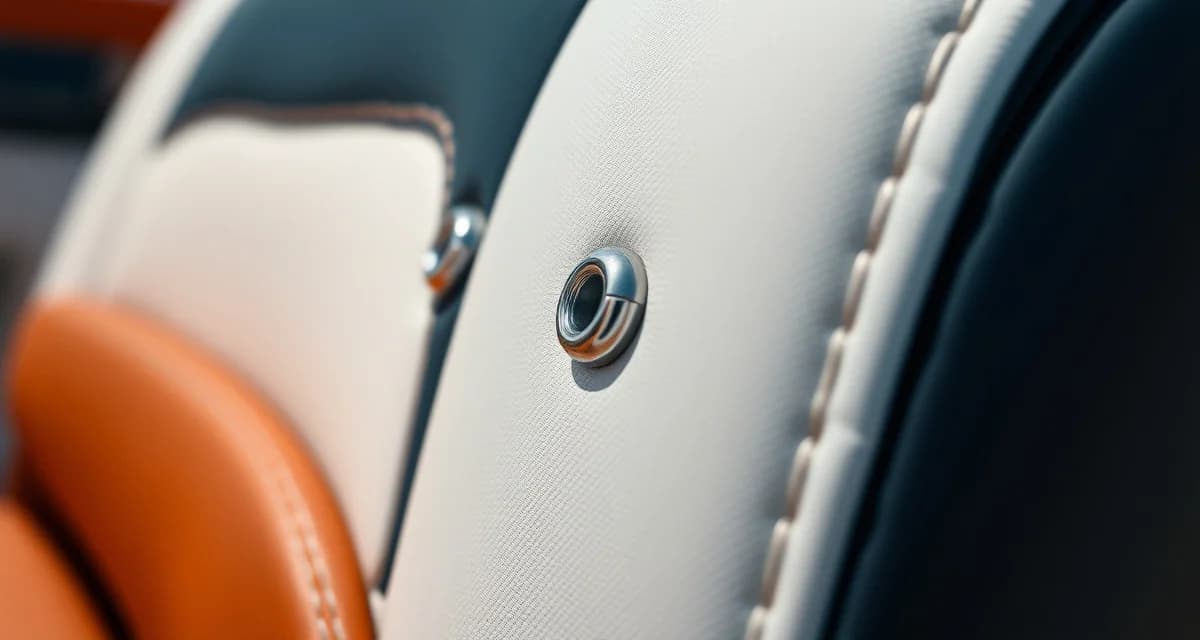
Boat Upholstery Guide: Marine Techniques for Interior and Exterior
Marine upholstery sewn with standard thread degrades within 2-3 seasons. The UV exposure and saltwater contact that affect all marine fabrics affect thread at least as aggressively. You can use the highest-quality marine vinyl in the world and sew it with standard polyester thread, and the seams will fail before the fabric does. UV-resistant thread isn't optional for marine work, it's as fundamental as the right fabric.
This guide covers interior and exterior boat seating construction, sunbed building, and the specific technique requirements that make marine upholstery different from residential work.
TL;DR
- Marine upholstery fabric must meet UV, moisture, mildew, and salt-air resistance requirements that standard furniture fabric cannot meet.
- Solution-dyed acrylic is the industry standard for exterior marine cushions, rated for 2,000+ hours of UV exposure.
- Marine vinyl must be specifically formulated for marine use; standard furniture vinyl cracks and delaminates from UV and temperature cycling.
- Foam used in marine upholstery should be open-cell or perforated to allow water drainage and prevent mildew.
- All hardware (staples, snaps, screws) used in marine work must be marine-grade stainless steel to prevent rust staining.
- UV-stabilized polyester thread is required for all exterior marine seams; standard thread degrades rapidly in sun and salt environments.
Marine Environment: What You're Building For
Boat interiors and exteriors face a combination of stresses that residential upholstery never encounters:
UV radiation: More intense on water (reflective amplification from the water surface) and for more hours per day than most residential applications. Even a boat stored indoors at a marina sees notable UV through open slips.
Saltwater: Salt crystals are abrasive. They work into seam lines and cut thread. Salt residue left to dry on vinyl or fabric accelerates surface degradation. Marine materials must be salt-tolerant.
Moisture cycling: Boat surfaces go from dry to wet to dry repeatedly, sometimes multiple times per day. Materials that absorb and hold moisture between cycles develop mold and structural failure.
Movement and vibration: Boat seating experiences constant vibration and the specific mechanical stress of people boarding and leaving while the boat is in motion. Seam strength requirements are higher than residential applications.
Mildew: Warm, humid, enclosed boat interiors are ideal mildew environments. Materials and construction must resist mildew actively, not just passively.
Interior Boat Seating
Helm chairs and helm seating:
The helm is high-traffic, high-sun exposure. Use marine vinyl with UV-resistant top coat as the primary material. Helm seating often includes non-slip material or textured vinyl on seat faces where the operator slides.
Helm cushions typically have minimal padding, 1-2 inches of foam, for compact construction that fits in tight helm stations. Use closed-cell foam for helm applications (unlike outdoor seating where reticulated foam is preferred), because the foam needs to hold its shape under repeated sitting and standing. Closed-cell foam doesn't compress the same way after repeated cycles.
Interior cabin seating:
Salon and cabin seating on larger boats can use slightly more interior-leaning materials, because the cabin provides notable UV protection. Fabric with outdoor ratings is appropriate for cabin seating, and some boaters prefer it for comfort. Marine-grade vinyl remains the most practical choice for any surface that might contact wet swimsuits or saltwater.
Construction for cabin seating is similar to residential except for thread, hardware, and foam choices:
- Use UV-stabilized thread even in protected interior applications
- Use stainless or plastic marine hardware on all closures
- Use closed-cell or semi-open-cell foam rated for marine environments
Exterior Boat Seating: Sundecks and Stern Seating
Exterior boat seating is fully exposed. Construction must handle everything.
Sundeck pad construction:
Sundecks and sun lounging areas are typically built from several zones:
- A firm cushion base of closed-cell foam (density 2.0-2.5, ILD 45-50 for firm support)
- An optional comfort topper layer of slightly softer foam (1.5 density, 35 ILD)
- Marine vinyl cover with drainage provisions
Sundecks are typically built to fit precisely in a recessed area of the boat deck. Measure the recess carefully, length, width, and depth, and build the cushion to fit precisely. A loose cushion on a sundeck moves under wave action.
Attachment methods for exterior cushions:
- Stainless snap buttons sewn into the cushion base, mating with snaps installed in the boat deck
- D-ring and tie-down strap systems
- Velcro, outdoor-grade only, with the hook side on the boat deck (not the cushion, where it catches on bathing suits)
Drainage on exterior cushions:
Unlike interior cushions, exterior boat cushions should have drainage provisions even with closed-cell foam, because rain accumulates on the cover surface and should drain rather than pool. Bottom-face drainage holes or side slits at the base of the boxing strip accomplish this.
Sunbed Construction
Sunbeds (fully custom-built lounging areas) are among the more specialized marine upholstery projects. They're common on center-console and offshore boats.
Sunbed design elements:
- Headrest: angled section at the head end, typically 15-20 degrees recline
- Main body: flat sleeping surface
- Leg section: sometimes flat, sometimes with slight incline
- Bolsters: optional arm-height bolsters at the sides
Foam layering for sunbeds:
- Base layer: 3-4 inch closed-cell foam, firm (45-50 ILD)
- Top comfort layer: 1-2 inch softer foam (30-35 ILD)
- Dacron wrap: 1 layer for slight softness at the top surface
Pattern matching across sunbed sections: If the sunbed has multiple sections (head + body, or body + leg extension), match pattern at section boundaries. On patterned marine vinyl, the pattern should flow across section seams without obvious breaks.
Marine-Specific Thread and Hardware
Thread: V-92 or V-138 UV-stabilized polyester thread for most marine seams. For maximum longevity in saltwater environments, PTFE (Teflon) thread is essentially immune to UV and salt degradation. Use PTFE on all exposed exterior seams.
Needles: Use heavier needles for marine vinyl (size 20-24 needle for heavy marine vinyl). Standard residential needles deflect in heavy vinyl and produce uneven stitching.
Hardware: All snaps, D-rings, and fasteners should be 316 stainless steel or marine-grade molded plastic (type varies by application). Standard hardware corrodes visibly in one season of saltwater exposure.
Backing fabric: The underside of marine cushions is often lined with a coordinating marine-grade backing fabric rather than cambric. Use marine-grade canvas or coordinating vinyl for the bottom face.
For marine fabric selection and yardage calculation, the boat upholstery fabric guide covers material choices in detail. For fabric yardage on boat seat cushions, use the boat upholstery yardage calculator.
Frequently Asked Questions
What thread is used for marine upholstery?
UV-stabilized polyester thread (V-92 or V-138 weight) is the standard for marine upholstery. Standard polyester thread degrades from UV exposure within 2-3 seasons in marine environments, leaving seams intact in appearance but failing in strength. PTFE (Teflon) thread is the premium choice for fully exposed exterior applications, it's immune to UV and salt degradation. Using UV-stabilized or PTFE thread throughout a marine job, not just on visible exterior seams, extends the full piece's lifespan considerably.
How do I build outdoor boat seat cushions?
Start with closed-cell foam (2.0-2.5 density, 45-50 ILD) at appropriate thickness. Cover with marine vinyl using UV-stabilized or PTFE thread. Install drainage provisions (bottom-face holes or base boxing slits) even though the foam is closed-cell, to allow rain accumulation to drain from the cover surface. Use stainless snaps or marine-grade Velcro for deck attachment. All hardware, snaps, D-rings, zippers, should be 316 stainless or marine-grade plastic.
What foam works best in marine environments?
For exterior boat seating and sundecks, use closed-cell foam (density 2.0-2.5) that doesn't absorb water. Unlike outdoor patio cushions where reticulated foam is recommended for drainage, boat seating primarily needs to resist water absorption altogether, not drain water that's already entered. Closed-cell foam at appropriate density provides firm support, doesn't absorb saltwater, and holds its shape through repeated compression cycles.
What hardware should be used in marine upholstery?
All hardware used in marine upholstery must be marine-grade stainless steel to prevent rust staining on fabric. This includes staples, snaps, grommets, and any screws or bolts used to attach cushion frames. Standard galvanized staples will rust within one season in a saltwater environment and leave brown stains that are very difficult to remove. The material cost difference between stainless and standard hardware is small relative to the cost of a remake.
How do I prevent mildew in boat cushions?
Use open-cell or perforated foam that drains rather than retains water. Choose fabrics with a documented mildew-resistance rating. Design removable cushion covers wherever practical so they can be removed and dried after heavy rain or spray. Treat all fabric surfaces with a marine-specific mildew inhibitor spray after installation. Annual cleaning with a marine-formulated cleaner removes mildew spores before they establish colonies.
Related Articles
- Automotive Upholstery Guide: Seats Headliners and Door Panels
- Automotive Upholstery Fabric Guide: Leather Vinyl and Alcantara
Sources
- National Marine Manufacturers Association (NMMA)
- Marine Retailers Association of the Americas (MRAA)
- Association of Master Upholsterers and Soft Furnishers (AMUSF)
- National Upholstery Association
Get Started with StitchDesk
Marine upholstery jobs have specific material requirements and client expectations that standard shop management tools are not built for. StitchDesk gives marine upholstery shops a professional quoting and job management system with material tracking and client communication built in. Try StitchDesk free and bring organized shop management to your marine practice.