Upholstery Sewing Techniques: Seams Zippers and Closures
Invisible zippers on cushion back seams create a cleaner finish than exposed zippers, the mark of professional work. But invisible zippers require the right foot, the right technique, and practice. Knowing which sewing technique to use for each type of seam, and how to execute each one correctly, is what separates upholstery sewing from general fabric sewing.
This guide covers the techniques you actually use in professional upholstery: structural seams, finishing options, zipper types, and hand-sewn closures.
TL;DR
- This guide covers the specific techniques, measurements, and decisions that determine quality outcomes in upholstery work.
- Planning and preparation before cutting begins is the most reliable way to avoid costly errors on any upholstery job.
- Fabric selection, yardage calculation, and structural assessment are the three decisions that most affect the final result.
- Experienced upholsterers develop consistent workflows that ensure quality and efficiency across every job type they handle.
- Documenting job details, material specifications, and client approvals protects both the shop and the client.
- The right tools, materials, and techniques for each job type make a measurable difference in quality and profitability.
Structural Seam Types
Plain Seam
The standard machine seam: two fabric layers placed right-sides together, stitched at the seam allowance, pressed open or to one side.
When to use: Most interior seams in upholstery work where the seam won't be visible in the finished piece and where the fabric doesn't require special treatment.
Standard specifications: 1/2-inch seam allowance, 3-4 stitches per inch, polyester thread matched to the dominant fabric color.
Finishing: Serge or overlock the seam allowance edges to prevent fraying. Press seams open whenever possible, a pressed-open seam distributes stress more evenly than a pressed-to-one-side seam on furniture that bears load.
Flat-Fell Seam
A flat-fell seam is a self-finishing seam where the seam allowance is folded back and topstitched down, enclosing the raw edges within the seam. The result is a seam with two parallel lines of topstitching visible on the face and no exposed raw edges on the reverse.
When to use: Visible seams on outdoor cushions (no exposed edges to fray or absorb moisture), on heavy vinyl or canvas where seam bulk is less of a concern, and on any surface that will be handled frequently where exposed seam allowances could catch.
Construction:
- Sew a plain seam at the correct allowance
- Press both allowances to one side
- Trim the under allowance to half width
- Fold the upper allowance over the trimmed allowance
- Press flat and topstitch through all layers
French Seam
A French seam encloses the raw edges inside the seam itself. Used on delicate fabrics or where a completely clean interior is required.
When to use: Lightweight, loosely woven fabrics that fray easily at the cut edge. Less common in upholstery than in garment sewing, but appropriate for specific delicate-fabric applications.
Welt Seam (Corded Piping)
The welt seam inserts a cord-filled fabric tube between two fabric layers at a seam line, creating a defined, raised seam edge.
When to use: Cushion perimeter seams on residential sofas and chairs, seat-to-back seam on cushioned pieces, any seam where a defined edge is part of the design aesthetic. Welt is the most visible seam technique in residential upholstery, done well, it's the mark of professional work.
Construction:
- Cut welt fabric on the bias (45 degrees to grain), this allows the welt to curve smoothly at corners
- Fold welt fabric over the cord with right side out and stitch close to the cord using a zipper or welt foot
- Pin welt to the right side of one fabric panel with the cord seam line matching the seam line
- Stitch in the ditch of the welt stitch line
- Place the second panel right-side down over the welt
- Stitch through all layers at the seam line
- Grade the seam allowances to reduce bulk
See also the welt upholstery guide for the full welt construction process.
Zipper Types and Installation
Exposed Zipper
An exposed zipper is installed on the outside surface of a cushion cover, visible when the cushion is in use. It's practical and fast to install but gives a less refined finish.
When to use: Back seams on seat cushions where the zipper faces the sofa back and isn't typically visible. Also appropriate for commercial or outdoor cushions where function over appearance is the priority.
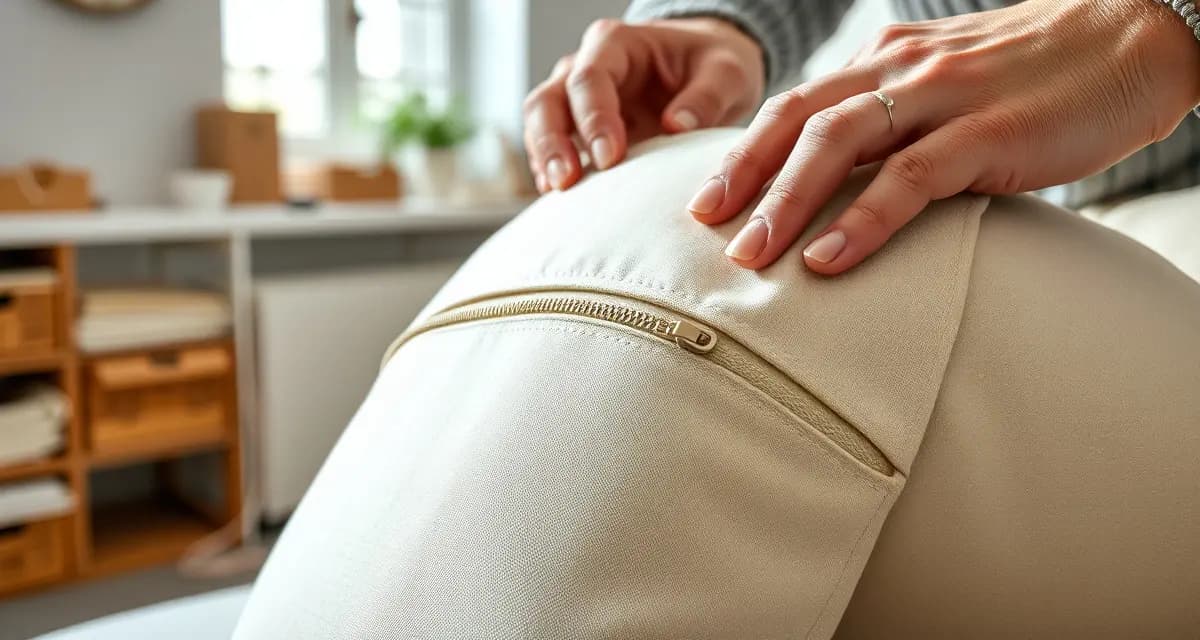
Invisible (Concealed) Zipper
An invisible zipper curls the zipper teeth back so the coils are hidden when closed, leaving only a seam line visible from the face of the fabric.
When to use: Any cushion where the zipper closure will be visible in use. On a 3-cushion sofa where cushions are sometimes turned over, all seam positions can be visible, invisible zippers create a clean result regardless of how the cushion is positioned.
Installation requires an invisible zipper foot, a specific presser foot that holds the zipper coils open during sewing so the machine stitch lands close to the coil, which is what makes the closure invisible when closed.
Installation process:
- Unroll the zipper coil with a warm iron (briefly) so the coil lies flat, this makes installation easier
- Using the invisible zipper foot, stitch from the zipper pull end toward the bottom stopper, stitching directly beside the coil
- Install the second fabric panel the same way on the other side of the zipper
- At the zipper end, remove from the machine with enough thread to close the seam below the zipper stop
- Stitch the remaining seam below the zipper stop with a regular zipper foot
The result when zipped: only a continuous seam line visible, no zipper pull showing from the face.
Hand-Sewn Closures
Slipstitch (Ladder Stitch)
The slipstitch closes a seam invisibly from the face. It's used to close cushion covers after inserting the form, and to attach trim or gimp where glue isn't suitable.
Construction:
- Fold under both fabric edges at the seam allowance and press
- Thread a curved upholstery needle with strong thread double-stranded
- Starting at one end of the opening, anchor the thread
- Pass the needle horizontally through the fold of one side (running inside the fold, catching no visible stitches on the face)
- Cross to the opposite fold and repeat
- When drawn up, the stitch closes the gap without any visible thread on either face
A well-executed slipstitch is invisible from both sides of the seam at normal viewing distance.
Blind Stitch for Padding
The blind stitch is used to compress and define the edge of upholstered furniture, particularly to create a sharp edge on a seat front or a defined form on an arm front.
This is a hand technique using a double-pointed upholstery needle and twine, passing through the foam or batting inside the fabric to pull the stuffing into a defined position.
Machine Setup for Upholstery Sewing
Needle: Size 16-18 for most upholstery fabrics. Size 18-21 for leather and heavy vinyl. Size 14 for lighter microfiber.
Stitch length: 3-4 stitches per inch (SPI) for most seams. 2-3 SPI for delicate or loosely woven fabrics. 4-5 SPI for leather.
Thread tension: Balanced tension produces a stitch where the thread joins exactly at the seam line with no loops showing on either side. Test on a scrap of your specific fabric before beginning the seam.
Thread: Polyester thread for most applications. Cotton thread is appropriate only for natural fiber fabrics where polyester's different flexibility could create stress concentrations. Waxed thread for hand sewing on leather.
The upholstery seam techniques guide covers seam finishing and specific seam applications in more depth.
Related Articles
FAQ
How do I sew upholstery seams professionally?
Professional upholstery seaming requires matched thread and needle size to the fabric, consistent seam allowance throughout the seam, correct stitch length for the fabric weight, and finished seam allowances (serged or pinked) to prevent fraying. For any seam that bears stress or will be visible, test your thread tension on a fabric scrap before beginning. Press seams open when possible, it distributes stress more evenly than pressed-to-one-side seams. For welt seams (the most common visible seam in upholstery), use the correct welt foot and stitch in the ditch consistently.
When should I use an invisible zipper in upholstery?
Use an invisible zipper for any cushion closure that will be visible in the finished piece in normal use. Seat cushions on a sofa with cushions that are sometimes reversed or repositioned benefit most from invisible zippers, any face of the cushion can show, and the invisible zipper creates a clean result regardless. Invisible zippers require a specific invisible zipper foot for proper installation; standard zipper feet leave visible stitching. For back seams on seat cushions that face the sofa back and won't be visible in use, an exposed zipper is practical and saves installation time.
How do I hand-sew a slipstitch closure for upholstery?
Fold under and press both seam edges at the seam allowance. Thread a curved upholstery needle with strong thread doubled and knot the end. Anchor the thread at one end of the opening. Pass the needle through the fold of one side, running inside the fold so no stitch shows on the face. Cross to the opposite fold and repeat. Draw up the thread after every few stitches to close the gap. Continue to the end of the opening and secure with several small stitches. A correct slipstitch is invisible from both sides; the thread runs entirely inside the two folded edges rather than crossing the opening visibly.
What are the most common mistakes to avoid in this type of work?
The most common mistakes are underestimating material requirements, starting work before the frame is fully assessed and repaired, and skipping the centering and alignment checks before cutting. Each of these is far more expensive to correct after cutting has begun than to prevent at the planning stage. Taking an extra 15-30 minutes at the assessment and planning stage pays dividends throughout the job.
How do I get the best results from a professional upholsterer?
Come to the consultation with clear measurements, photos of the piece, and an idea of the room's color scheme and intended use. Be specific about how the piece will be used: high traffic, pets, children, or outdoor exposure all affect fabric recommendations. Provide fabric samples or accept guidance on appropriate options for your use case. Approve the proof carefully and ask to see the fabric on the piece before final installation if you are uncertain about a pattern or color choice.
Sources
- National Upholstery Association
- Association of Master Upholsterers and Soft Furnishers (AMUSF)
- Upholstered Furniture Action Council (UFAC)
- Furniture Today (trade publication)
Get Started with StitchDesk
Running a successful upholstery shop means getting the details right on every job. StitchDesk gives you purpose-built tools for quoting, fabric calculation, job tracking, and client communication, all in one place designed specifically for the trade. Start a free trial and see how StitchDesk supports quality work from intake to delivery.