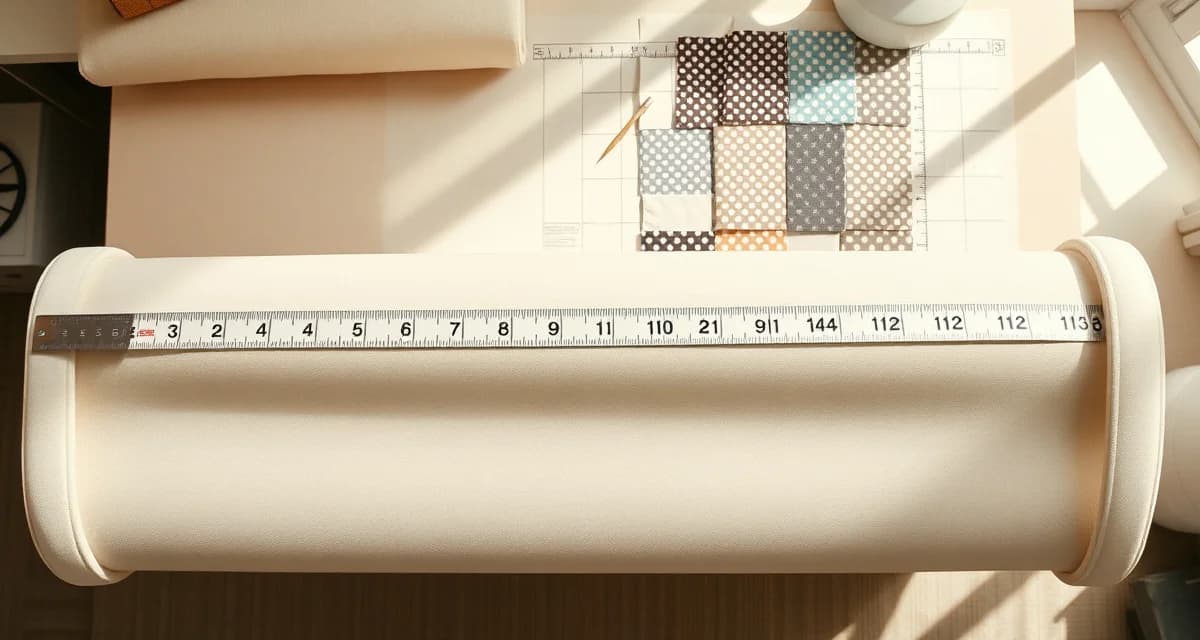
How to Calculate Yardage for 54-Inch Upholstery Fabric
54-inch fabric is the standard in residential upholstery. Most supplier catalogs spec their fabric at 54 inches. Most yardage charts are built around 54 inches. When someone asks you "how much fabric do I need?" and doesn't tell you the width, 54 inches is what you assume, and you're right about 80% of the time.
But assuming isn't calculating. Knowing how to use 54-inch width in your actual yardage math means you can catch the jobs where the fabric is actually 52 inches (surprisingly common in online boutiques) or where the client brings 60-inch-wide COM and your 54-inch estimate left money on the table.
TL;DR
- Fabric Width 54 Inch yardage depends on fabric width, construction details, pattern repeat, and nap direction.
- Plain 54-inch fabric requires a baseline calculation plus 10-15% waste allowance for a standard fabric width 54 inch job.
- Patterned fabric adds 20-35% to base yardage depending on repeat size and the number of cutting zones that must align.
- Directional fabrics add 15-25% over plain fabric because layout optimization is restricted by nap direction.
- Always verify fabric width before finalizing yardage; COM fabric often comes in non-standard widths.
- Calculating yardage at the quote stage, not mid-job, eliminates reorders and protects your profit margin.
Step 1: Understand What 54 Inches Means for Your Cutting Layout
54 inches is the usable cutting width. That's the width from selvedge edge to selvedge edge, though in practice you typically lose 0.5–1 inch per side to the selvedge, giving you a usable cut width of 52–53 inches.
For planning purposes, use 52 inches as your net usable width. This affects how many panels you can fit side by side on one horizontal row of fabric.
How this plays out on a sofa:
An inside back panel for a standard 84-inch sofa might be 36 inches wide and 24 inches tall. At 52-inch usable width, you can't fit two inside back panels side by side (72 inches total would exceed 52 inches). You cut one panel per row, and the remaining 16 inches of width on that row is used for smaller pieces, welt cording strips, front border panels, narrow arm pieces.
Understanding this nesting logic is why 54-inch fabric doesn't automatically save money on very wide pieces. The inside back panel still occupies a full 24-inch row of the bolt even though it doesn't use the full 52-inch width. The leftover width on that row either gets used for smaller pieces or becomes waste.
Step 2: Calculate Panels by Zone
Here's the zone-by-zone approach for a standard 84-inch 3-cushion sofa in 54-inch plain fabric:
Inside back: 36 x 24 inches. One panel per row. Row length needed: 24 inches = 0.67 yards.
Outside back: 36 x 24 inches. One panel per row. Row needed: 24 inches = 0.67 yards.
Inside arm L and R: Each approximately 24 x 22 inches. Two arms fit side by side at 48 inches combined width (fits within 52 usable inches). Row needed: 22 inches = 0.61 yards.
Outside arm L and R: Each approximately 24 x 14 inches. Two outside arms fit side by side. Row needed: 14 inches = 0.39 yards.
Seat cushion faces (3 cushions): Each approximately 24 x 24 inches. Two cushions fit per row, third cushion in next row. Rows needed: 24 inches + 24 inches = 48 inches = 1.33 yards.
Seat cushion boxing strips: Combined length approximately 120 inches at 5-inch height. These can be cut from leftover widths on other rows or as a dedicated strip. Approximately 0.5–0.75 yards.
Deck: Approximately 78 x 20 inches. May cut as decorative fabric or cambric. If decorative: approximately 0.65 yards.
Front border: 78 x 8 inches. Fits in the margin of other rows or as a dedicated strip. 0.25 yards.
Welt cording: 20–25 linear yards of welt at 2.5-inch bias strips. Approximately 1.25–1.5 yards of bias cuts.
Total plain fabric, 54-inch width: Approximately 6.87–7.1 yards of calculated panels. Add 10% cutting buffer: 7.5–7.75 yards. Practical order: 8 yards.
This is a basic calculation. Actual yardage varies based on arm style, back style, and specific measurements.
Step 3: Adjust for Pattern Repeat
For a 13.5-inch repeat on the same sofa:
Each zone's cut must start at a repeat boundary. Calculate the remainder for each zone:
- Inside back: 24-inch panel in a 13.5-inch repeat = 1 full repeat (13.5") + 10.5" remainder. Next zone skips 3 inches (to complete the repeat).
- Seat cushion: 24-inch panel = same. Skips 3 inches.
- Across 10 zones with similar panel heights: approximately 10 x 2 inches average skip = 20 inches = 0.55 yards.
Add 0.55 yards to the plain-fabric total for a 13.5-inch repeat. Practical addition: 1 yard (include buffer for centering decisions).
For a 27-inch repeat:
- More zones where the skip is larger (up to 26 inches per zone if a panel is just slightly over one repeat).
- Add 1.5–2.5 yards to the plain-fabric total. Practical addition: 2–3 yards.
Step 4: Adjust for Nap Direction
Toggle nap direction on in your calculation and add 15–20% to the base calculated yardage. The reason: you lose the optimization option of rotating panels to nest efficiently. Every panel must run the same direction.
For the same sofa in velvet (nap, no pattern):
- Plain fabric: 8 yards
- Nap-adjusted: 9.5–10 yards
For velvet with a 13.5-inch repeat:
- Plain: 8 yards + repeat waste 1 yard = 9 yards
- Nap-adjusted: 9 yards x 1.15 = 10.35 yards. Round to 11 yards.
Step 5: COM Width Verification
When a client brings COM fabric, your first step before anything else is measuring the actual width. Don't assume 54 inches. Boutique fabric, remnants, and international fabrics often come in at 47, 48, 52, or 60 inches.
If the COM is 48 inches instead of 54 inches:
- Net usable width drops from 52 inches to 46 inches
- The arm panels that fit two-per-row at 52-inch width no longer fit, you need 2 rows instead of 1
- Add approximately 1.5–2 yards to the sofa calculation above
If the COM is 60 inches:
- Net usable width increases to approximately 58 inches
- More pieces fit in the margin space of each row
- Save approximately 0.5–1 yard compared to the 54-inch calculation
Always measure. Always confirm with the client before telling them their fabric is sufficient.
Common Mistakes When Calculating 54-Inch Yardage
Using gross width instead of net width. 54 inches is the bolt width. Your usable cutting width after selvedge is 52–53 inches. Use 52 inches for planning.
Forgetting welt cording yardage. Welt cording from bias-cut strips adds 1–1.5 yards to a sofa. It's easy to calculate the upholstery panels correctly and forget the cording entirely.
Ignoring seam allowance. Each panel has 0.5-inch seam allowance on each edge. A panel that finishes at 22 inches needs 23 inches of cut length. This affects how many rows you need per zone.
Assuming 54-inch fabric on COM jobs. Don't. Measure.
Related Articles
FAQ
Why is 54 inches the standard upholstery fabric width?
54-inch width became the industry standard because it accommodates the most common furniture panel widths with minimal waste. An inside back panel for most sofas fits within 54 inches, arm panels typically fit two-per-row, and cushion faces have manageable waste. The 54-inch standard emerged from commercial weaving practices and has been consistent for decades because it works well for the range of pieces upholsterers cut.
Does fabric width change how many yards I need?
Yes, significantly. 48-inch fabric can require 15–25% more yardage than the same job in 54-inch fabric because fewer panels fit per row and more rows are needed. 60-inch fabric typically saves 8–12% compared to 54-inch. The difference is most pronounced on wide panels like inside backs, seat cushion faces, and outside arms. For narrow pieces like front borders and welt cording, width differences matter less.
How do I convert a 54-inch yardage estimate to 48-inch fabric?
There's no universal conversion factor because it depends on the specific panel widths for your piece. The safest approach is to recalculate from scratch with the actual width. As a rough rule of thumb, add 15–20% to a 54-inch estimate when converting to 48-inch fabric, with the understanding that this is an approximation and the real number may be higher on pieces with wide panels.
What is the biggest factor in yardage variation for this piece?
Pattern repeat is the biggest source of yardage variation. On plain fabric, the baseline calculation plus a 10-15% waste buffer is usually sufficient. Add a 13-inch pattern repeat and you may need 15-20% more. Add a 27-inch pattern repeat and the additional yardage can be 25-35% over the plain fabric calculation. Nap direction is the second-largest factor, typically adding 15-25% over plain fabric because layout optimization is restricted.
What should I do if I run short on fabric mid-job?
Stop cutting immediately when you realize you may run short. Calculate exactly how much additional fabric you need before contacting the supplier or client. If reordering from the same dye lot is possible, do so as quickly as possible because dye lots change. If a dye lot match is not available, contact the client before proceeding; visible dye lot differences on the same piece are unacceptable and must be disclosed. Document the situation and response in writing.
Sources
- National Upholstery Association
- Association of Master Upholsterers and Soft Furnishers (AMUSF)
- Upholstered Furniture Action Council (UFAC)
- Furniture Today (trade publication)
Get Started with StitchDesk
Getting yardage right on width 54 inch jobs is the difference between a profitable quote and an expensive reorder. StitchDesk's fabric calculator accounts for all the variables that cause errors: pattern repeat by zone, nap direction, fabric width, and cushion configuration. Start a free trial and see how accurate yardage calculation affects your bottom line.