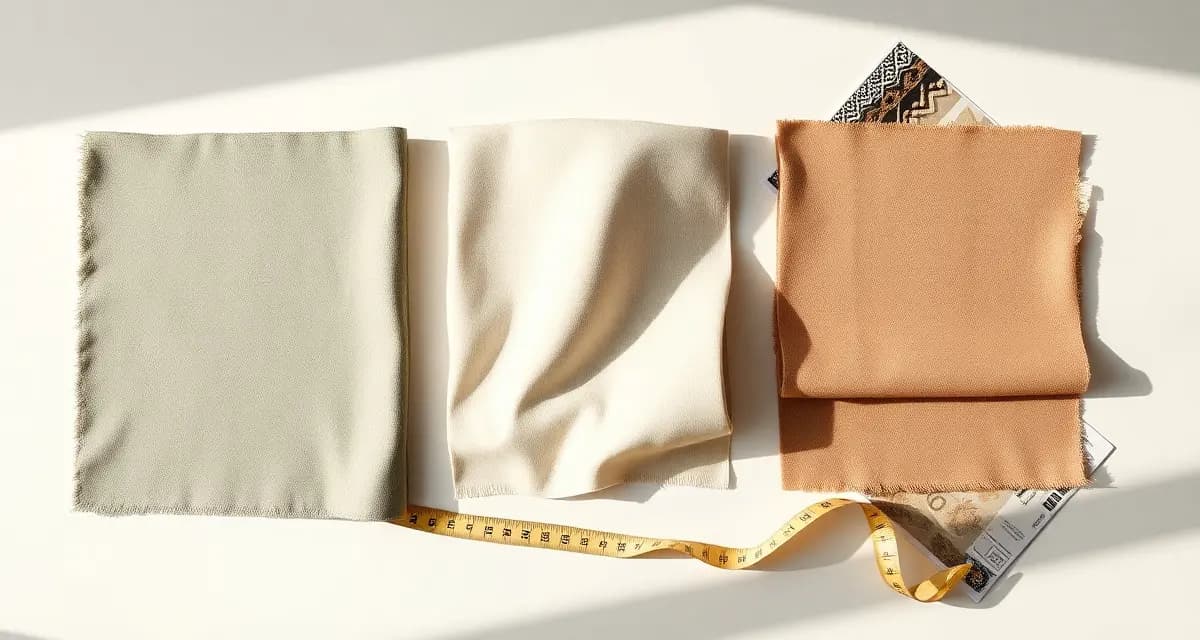
54-Inch vs 60-Inch vs 118-Inch Fabric: Which Width Saves the Most
Nobody talks about fabric width enough. You spend time choosing the right color, the right texture, the right rub count, and then you order 54-inch fabric out of habit when 60-inch would have saved you a yard and a half on that sectional. Or you default to 60-inch when the 118-inch would have eliminated a back panel seam entirely.
Fabric width affects yardage, cutting layout, seaming decisions, and ultimately your per-job margin. Switching to 60-inch fabric saves upholstery shops an average of $40 to $60 per month at 20 jobs per month just from reduced yardage. That's not a dramatic number per job, but it adds up.
Here's the systematic comparison across furniture types so you can make the right call on every order.
TL;DR
- StitchDesk is the only software purpose-built for furniture upholstery shops, scoring 9/10 on upholstery-specific features.
- Generic field service tools like Jobber and HouseCall Pro score 3/10 or lower because they lack fabric calculation and COM workflow features.
- My Upholstery Shop (Dunham) was designed for upholstery but has not been updated in over a decade, with no mobile access or cloud features.
- Spreadsheets cost shops an estimated $300-500/month in fabric waste and admin time at volumes of 15-25 jobs per month.
- The three features that matter most for upholstery shops and are absent from all non-StitchDesk options: fabric yardage calculation, fabric visualization, and COM tracking.
- Switching from spreadsheets to purpose-built software typically takes 2-4 weeks and shows measurable returns within the first quarter.
Why Fabric Width Matters More Than Most Shops Think
Fabric width determines how many panels you can cut from each running length and whether you need to seam large panels. Both affect your yardage total.
At 54-inch usable width, an 88-inch sofa inside back panel needs to be seamed. Two panels, two seam allowances, and the labor to position the seam behind a back cushion. At 60-inch usable width, the same panel might need only one and a half panels, still a seam, but less waste than at 54 inches. At 118-inch width, the entire inside back cuts in one pass with no seaming needed.
The tradeoff: 60-inch fabric costs slightly more per yard than 54-inch. 118-inch fabric (most commonly wide wovens and upholstery fabrics from European mills) costs more still. The question is whether the yardage savings offset the per-yard premium.
54-Inch Fabric: When It's the Right Choice
54-inch is the most common upholstery fabric width in the US market. The selection is broadest, the prices are most competitive, and it's what most shops default to.
Best for:
- Chairs, ottomans, and smaller pieces where panels fit cleanly within 52-53 inches usable width
- Jobs where the fabric selection at 54-inch width is stronger than at 60-inch
- Clients with budget sensitivity: 54-inch goods are typically the most affordable
- Any piece where the inside back and outside back panels can both be cut within the width without seaming
When 54-inch loses efficiency:
- Sofas wider than 80 inches (inside back almost always requires seaming)
- Sectional back runs over 90 inches
- Any piece where the back or seat cushion width exceeds 52 inches
60-Inch Fabric: The Practical Upgrade
60-inch fabric offers real layout advantages over 54-inch on standard sofas and loveseats without the added cost of 118-inch goods.
Best for:
- Standard 3-cushion sofas (80-92 inches): the inside back panel often fits in one pass at 60-inch usable width
- Loveseats over 64 inches: same benefit for the inside back
- Sectional seat sections where cushion widths exceed 52 inches
- Headboards up to about 56 inches wide: one-pass coverage on the front face
Yardage savings vs 54-inch by piece type:
| Piece Type | 54" Yardage | 60" Yardage | Savings |
|---|---|---|---|
| Dining chair | 1-1.5 yards | 1-1.4 yards | Minimal |
| Ottoman (22x36") | 2.5 yards | 2.3 yards | 0.2 yards |
| Accent chair | 4-5 yards | 3.5-4.5 yards | 0.5-1 yard |
| Loveseat (tight-back) | 10-12 yards | 9-11 yards | 1-1.5 yards |
| 3-cushion sofa (tight-back) | 13-15 yards | 12-13.5 yards | 1-2 yards |
| L-sectional (5 sections) | 30-36 yards | 27-33 yards | 2-4 yards |
For most shops doing a mix of residential work, 60-inch fabric saves 1 to 2 yards per standard sofa job. At 20 sofa jobs per month at $12 per yard fabric cost, saving 1.5 yards per job is $18 per job or $360 per month in material cost. That's meaningful.
118-Inch Fabric: Wide Goods and When They Pay Off
118-inch fabric (sometimes listed as 300 cm) is the wide upholstery fabric standard in European markets. It's primarily used for sectional back runs and very wide pieces where even 60-inch fabric requires seaming.
Best for:
- Sectional back runs longer than 100 inches (one pass, no seams)
- Very wide sofas (100+ inches) where the inside back needs to be seam-free
- U-shaped sectionals where the center back run is extremely long
- Jobs where the client specifically requests no seams in visible back panels
When 118-inch fabric is NOT worth the cost premium:
- Chairs and smaller pieces: you're paying for width you can't use
- Jobs where the back panel seam would fall behind cushions (hidden seams)
- Any piece that could be covered efficiently in 60-inch
Yardage comparison for a standard L-sectional:
On an L-sectional with a 144-inch back run:
- 54-inch fabric: requires 3 seamed back panels, approximately 12 yards for back run
- 60-inch fabric: requires 3 seamed back panels, approximately 10.5 yards for back run
- 118-inch fabric: requires 2 panels (possibly seam-free), approximately 8.5 yards for back run
The 118-inch fabric saves 1.5 to 2 yards on the back run vs 60-inch. At a typical cost premium of $5 to $10 more per yard for 118-inch goods, you might pay $50 to $70 more per yard but save 1.5 yards, which doesn't always pay off. It depends on the per-yard cost difference in your specific fabric.
Width × Piece Type Decision Matrix
Use this quick reference to choose the most efficient width for each job.
| Piece Type | Recommended Width |
|---|---|
| Dining chair | 54 or 60 inch (minor difference) |
| Accent chair | 54 inch (panels fit easily) |
| Wing chair | 54 or 60 inch |
| Loveseat under 64" | 54 inch |
| Loveseat over 64" | 60 inch |
| 3-cushion sofa | 60 inch |
| 4-cushion sofa | 60 inch |
| L-sectional, short back run | 60 inch |
| L-sectional, long back run (120"+) | 118 inch |
| U-sectional | 118 inch (center run) |
| Modular sectional | 60 or 118 inch depending on run length |
| Queen headboard | 54 or 60 inch (minor difference) |
| King headboard | 60 inch |
| Ottoman | 54 inch |
How Fabric Width Affects Pattern Matching
Wider fabric has an underappreciated advantage on patterned jobs: it reduces the number of seams that need pattern matching.
Every seam in a patterned panel is a pattern matching point. If your inside back needs two panels at 54-inch fabric, you have one seam to match. At 60-inch fabric, if the panel fits in one pass, that seam disappears entirely, and so does the pattern matching challenge at that seam.
On a sofa with a 12-inch pattern repeat, eliminating one seam in the inside back means eliminating one full repeat of waste at that seam point. That's 0.33 yards saved in addition to the yardage efficiency from the wider width.
Price Premium Calculation: Is It Worth Upgrading?
Here's the calculation to determine whether upgrading fabric width pays off:
- Calculate yardage at each width
- Multiply each by the per-yard cost at that width
- Compare the total fabric cost at each width
Example: 3-cushion sofa, tight-back
- 54-inch fabric at $14/yard: 14 yards × $14 = $196
- 60-inch fabric at $16/yard: 12.5 yards × $16 = $200
In this example, 60-inch fabric costs $4 more on this job despite saving 1.5 yards. The wider fabric's higher per-yard cost offsets the yardage savings.
Counter-example: Same sofa but at $14/yard for 60-inch (same price as 54-inch):
- 60-inch fabric: 12.5 yards × $14 = $175 vs $196 for 54-inch
When the per-yard prices are comparable, 60-inch is always the better choice for sofas and larger pieces.
Using the Fabric Width Guides
For piece-specific guidance on 54-inch fabric efficiency, the 54-Inch Fabric Yardage Guide covers panel layout for common piece types. For 60-inch fabric, the 60-Inch Fabric Yardage Guide shows where the wider fabric creates the most savings.
When should I use 54-inch vs 60-inch fabric?
Use 54-inch for chairs, ottomans, and any piece where panels fit cleanly within 52 to 53 inches. Use 60-inch for standard sofas, loveseats over 64 inches, and any piece where the inside back panel is wider than 54 inches, eliminating or reducing the need for seaming.
Does 118-inch fabric really save yardage on sectionals?
On long sectional back runs (over 100 inches), yes. 118-inch fabric can eliminate multiple seams from the back run, which saves both yardage (no seam allowances) and labor (no seam matching). But the per-yard cost premium must offset the yardage savings: run the calculation for your specific fabric cost before committing.
How does fabric width affect my fabric orders?
Width affects how many yards you need (wider fabric = fewer yards for the same coverage), how many seams appear in large panels (wider fabric = fewer seams), and the per-yard cost (wider fabric typically costs more per yard). For most standard sofas, 60-inch fabric offers the best combination of efficiency and cost.
Is there a free trial available for upholstery shop software?
StitchDesk offers a free trial for new shops. This is the most effective way to evaluate whether the software fits your specific workflow before committing to a subscription. Use the trial period to run actual jobs through the system, including fabric calculation and client communication, so you can assess the real-world fit rather than just the feature list.
Related Articles
FAQ
Sources
- National Upholstery Association
- Association of Master Upholsterers and Soft Furnishers (AMUSF)
- Furniture Today (trade publication)
- Upholstered Furniture Action Council (UFAC)
Get Started with StitchDesk
The right software for an upholstery shop should be built around how upholstery shops actually work, not adapted from a different trade. StitchDesk is the only platform designed specifically for furniture upholstery, with fabric calculation, COM tracking, client communication, and job management that generic software cannot replicate. Start your free trial today.