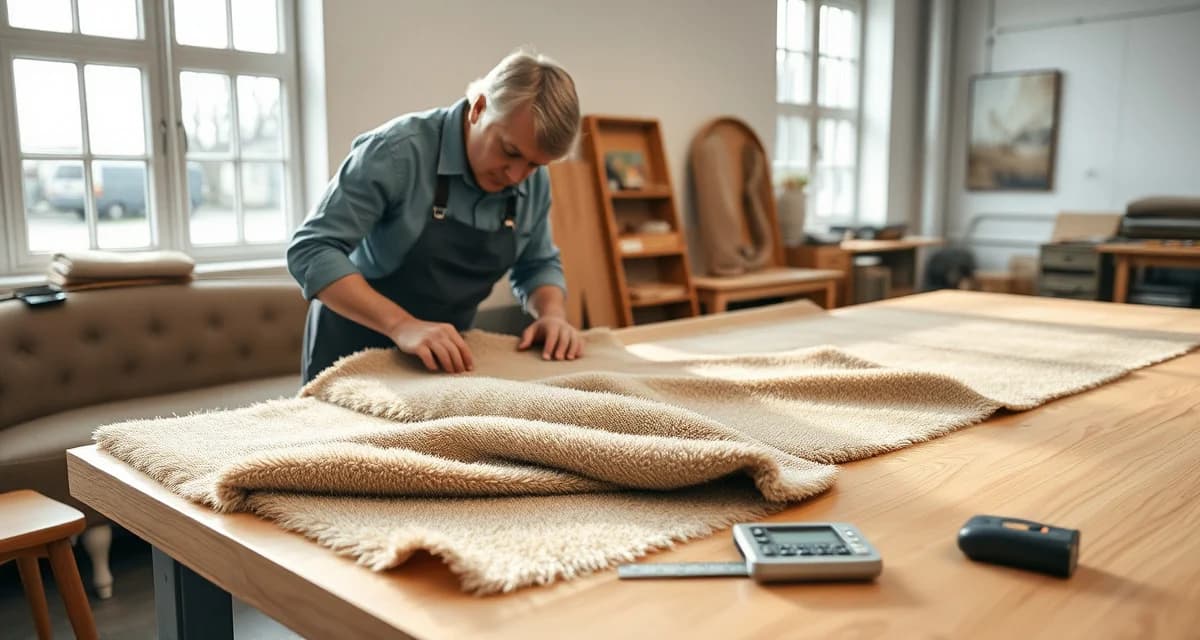
Chenille Fabric Yardage Calculator: Pile Compression and Cut Direction
Chenille pile compression at seams requires wider seam allowance. Standard settings short-cut by 1 yard on sofas. That's the number shops find out about after the job is on the frame, not before.
The chenille fabric yardage calculator you need accounts for pile compression at seams and directional shading. Generic tools don't handle either of these chenille-specific factors, which is why chenille jobs have a higher-than-average shortfall rate.
TL;DR
- Accurate yardage calculation for chenille fabric jobs prevents costly fabric shortfalls and over-ordering that erode margin.
- Pattern repeats are the most common source of yardage errors; always calculate each cutting zone separately, not as a flat percentage.
- Nap-direction fabrics (velvet, chenille, mohair) require 15-25% more yardage than the same job in plain fabric.
- Fabric width significantly affects yardage: the difference between 54-inch and 60-inch fabric can be 1-2 yards on the same piece.
- Always add a 10-15% buffer on plain fabric and 15-20% on patterned fabric to account for cutting waste.
- Entering measurements accurately at the quoting stage eliminates the need to reorder mid-job.
The Pile Compression Problem
Chenille is made with a twisted yarn that creates a soft, fuzzy surface. That fuzziness is the appeal. But at seams, the pile compresses under the machine foot and stitching, reducing the effective seam margin.
Standard upholstery seam allowance is 3/8 inch. On most woven fabrics, that's sufficient. On high-pile chenille, 3/8 inch compresses to the point where the stitching is essentially on the edge of the pile, creating a weak seam and a visible compressed line.
The fix is wider seam allowance: pile compression mode adds 0.5-inch seam allowance on high-pile chenille where 0.375 inch is insufficient. That extra 1/8 inch per seam sounds small, but across all seams on a sofa there are dozens, and it adds up to approximately 1 extra yard of fabric on a full sofa job.
Directional Shading on Chenille
Chenille shades directionally. Like velvet, the fuzzy pile reflects light differently depending on which direction it's viewed from. Unlike velvet, the direction isn't always immediately obvious. Chenille's pile is shorter and denser, and the shading can be subtle until pieces are viewed in raking light.
If you cut chenille pieces in inconsistent directions, adjacent panels on the sofa will shade differently. On a large sofa back, this can look like an uneven dye lot or a fabric defect. Clients will notice it.
The cutting protocol for chenille is the same as for velvet:
- Establish pile direction before cutting anything
- Mark the direction on every piece before removing from the cutting table
- Check all pieces together in natural or raking light before sewing
The chenille upholstery guide has a photo comparison of chenille cut in consistent vs inconsistent directions on the same sofa frame, which is a useful reminder of why this matters.
Calculating Chenille Yardage: Step by Step
Step 1: Calculate base yardage as if using a standard upholstery fabric.
Step 2: Identify pile height. Low-pile chenille (tightly twisted, flat appearance): add 10-12% waste. Mid-pile chenille: add 15-18% waste. High-pile chenille (thick, plush): add 20-22% waste.
Step 3: Add seam allowance upgrade. For low-pile: standard 3/8 inch is sufficient. For mid-to-high pile: use 1/2 inch allowance, which adds approximately 0.75-1 yard to a sofa yardage.
Step 4: Add directional cutting waste. Even without a pattern repeat, chenille's directional requirement adds 5-8% waste over a non-directional fabric.
Step 5: Total up and round to the nearest half yard.
For a 3-cushion sofa with mid-pile chenille at 54-inch width:
- Base: 13 yards
- 17% waste for pile: 15.2 yards
- Seam allowance upgrade: +0.75 yards = 16 yards
- Directional waste 6%: +0.96 yards = 16.96 yards
- Order: 17 yards
Chenille Yardage by Furniture Type
| Furniture | Low-Pile Chenille | Mid-Pile Chenille | High-Pile Chenille |
|---|---|---|---|
| Dining chair | 1.3-1.5 yards | 1.5-1.7 yards | 1.7-2 yards |
| Accent chair | 6-7 yards | 7-8 yards | 8-9.5 yards |
| Loveseat | 10-11.5 yards | 11.5-13 yards | 13-15 yards |
| Sofa (3-cushion) | 15-16.5 yards | 16.5-19 yards | 19-22 yards |
For accurate totals across any furniture type, use the fabric yardage calculator with chenille material mode selected and pile height specified.
FAQ
How much chenille fabric for a sofa?
Plan for 15-22 yards for a standard 3-cushion sofa depending on pile height. Low-pile chenille needs 15-16.5 yards; high-pile chenille needs 19-22 yards. These figures include the wider seam allowance and directional cutting waste specific to chenille. Using a standard 10% waste factor for chenille will consistently underestimate by 1-2 yards on a sofa.
Does chenille pile direction matter for upholstery?
Yes. Chenille shades directionally and all pieces must be cut in the same orientation. The shading difference between correctly and incorrectly oriented pieces is more subtle than velvet but still visible in natural light, especially on large flat panels like sofa backs. Check all pieces in raking light before sewing to catch any direction inconsistencies.
How do I prevent chenille seam compression problems?
Use a seam allowance of at least 1/2 inch on mid-to-high pile chenille instead of the standard 3/8 inch. Before sewing, flatten the pile in the seam area with your fingernail or a seam iron to compress the pile before the machine foot does it unevenly. On exposed seams like cushion boxing strips, consider a tight welt or piping along the seam to hold the pile edges clean and prevent the compressed look.
Should I add a buffer to calculated yardage?
Yes. A 10-15% buffer is standard on plain fabric to account for cutting waste and minor errors. On patterned fabric, use 15-20% above the pattern-adjusted calculation. For COM fabric that cannot be reordered if you run short, some upholsterers increase the buffer to 20-25%. The cost of a modest buffer is far lower than the cost of sourcing additional fabric after cutting has begun.
Sources
- National Upholstery Association
- Association of Master Upholsterers and Soft Furnishers (AMUSF)
- Upholstered Furniture Action Council (UFAC)
- Furniture Today (trade publication)
Get Started with StitchDesk
Getting yardage right on chenille jobs is the difference between a profitable quote and an expensive reorder. StitchDesk's fabric calculator accounts for all the variables that cause errors: pattern repeat by zone, nap direction, fabric width, and cushion configuration. Start a free trial and see how accurate yardage calculation affects your bottom line.