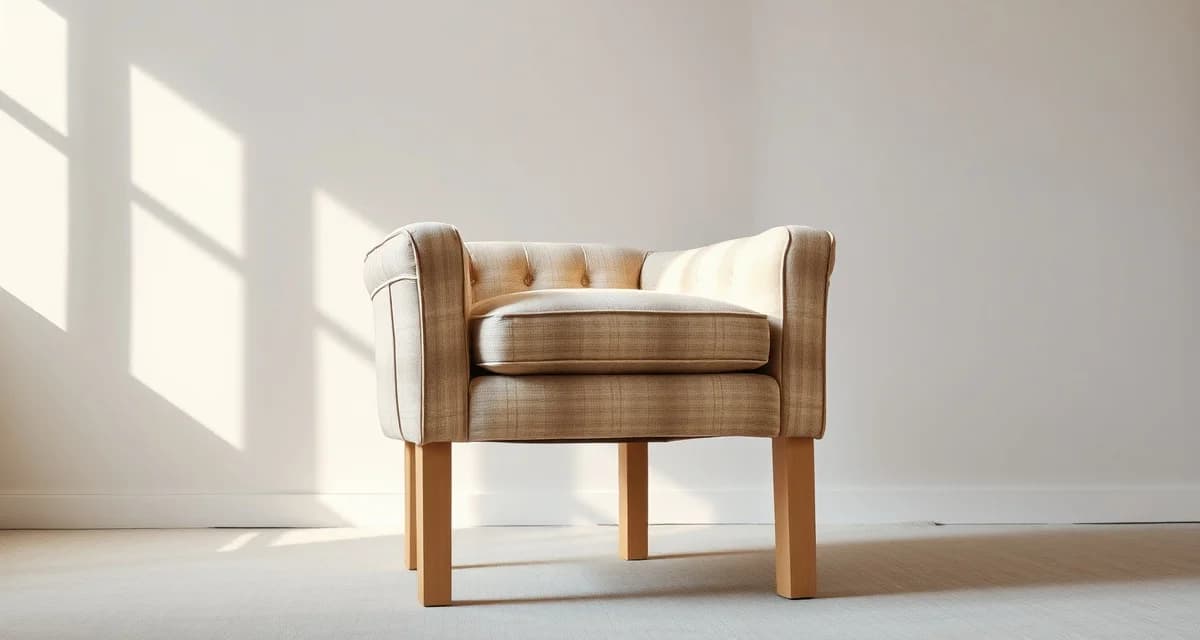
Parsons Chair Fabric Yardage Calculator: Tight Upholstery Every Surface
The Parsons chair is fully upholstered on every surface, including the legs. That's not a minor detail, it's the defining characteristic of the style and the most commonly missed calculation in Parsons chair yardage estimates.
Every leg has four sides that need to be covered. On a set of four Parsons chairs, that's 16 legs × 4 sides × height and width of each leg face. Leg panels add 0.25 to 0.5 yards per chair. A 6-chair set means 1.5 to 3 yards of missed yardage if you skip the leg panels in your calculation.
TL;DR
- Parsons Chair yardage depends on fabric width, construction details, pattern repeat, and nap direction.
- Plain 54-inch fabric requires a baseline calculation plus 10-15% waste allowance for a standard parsons chair job.
- Patterned fabric adds 20-35% to base yardage depending on repeat size and the number of cutting zones that must align.
- Directional fabrics add 15-25% over plain fabric because layout optimization is restricted by nap direction.
- Always verify fabric width before finalizing yardage; COM fabric often comes in non-standard widths.
- Calculating yardage at the quote stage, not mid-job, eliminates reorders and protects your profit margin.
What Is a Parsons Chair?
A Parsons chair is a fully upholstered dining or side chair with straight, squared-off lines and no exposed wood frame. Unlike most dining chairs where the legs are wood, metal, or another material left exposed, the Parsons chair wraps the entire chair, including all four legs, in fabric.
The result is a sleek, monolithic look where the fabric is the visual statement. The squared silhouette means every surface is a rectangle, which makes the cutting straightforward once you have all the panels accounted for.
Panel Breakdown: What Makes Parsons Different
A standard fully-upholstered arm chair has:
- Inside back
- Outside back
- Seat
- Inside arms (x2)
- Outside arms (x2)
- Arm fronts (x2)
- Front border
A Parsons chair (dining/side chair, typically armless) adds:
- Seat (same)
- Inside back
- Outside back
- Front border
- Side panels (x2), the side faces of the chair body
- Four leg panels on each of four legs = 16 leg face panels total
The leg panels are small, typically 1.5 to 3 inches wide and 16 to 20 inches tall (depending on leg height). But there are 16 of them per chair. They add up.
Leg Panel Yardage Calculation
For each leg:
- Measure leg width (front face): typically 1.5 to 2.5 inches
- Measure leg depth (side face): typically 1.5 to 2.5 inches
- Measure leg height: typically 16 to 22 inches
- Each leg has 4 faces (front, back, two sides)
All 4 leg faces per leg: (2 × leg width + 2 × leg depth) × leg height = total square inches per leg
For a typical 2-inch square Parsons leg at 18 inches tall:
- Perimeter: 8 inches × 18 inches = 144 square inches per leg
- 4 legs per chair = 576 square inches = 0.11 square yards
At 54-inch fabric, this leg area converts to approximately 0.25 yards per chair when you account for cutting layout inefficiency. On a 6-chair set, that's 1.5 yards. Missed because leg panels are easy to overlook.
Parsons Chair Yardage by Set Size
These figures assume a standard dining Parsons chair (no arms) in solid 54-inch fabric.
| Set Size | Yardage (Solid) | With 9" Pattern Repeat |
|---|---|---|
| Single chair | 2.5-4 yards | 3.5-5 yards |
| 4-chair set | 10-16 yards | 14-22 yards |
| 6-chair set | 15-24 yards | 21-33 yards |
| 8-chair set | 20-32 yards | 28-44 yards |
Why the wide range? The variation comes from leg panel cutting efficiency. Parsons chairs with narrower legs generate more waste per leg panel because each strip cut is narrow and wastes more fabric width. Chairs with wider legs (2.5 inches or more) cut more efficiently from standard fabric width.
Pattern Matching on Parsons Chairs
Parsons chairs in patterned fabric are visually impactful, the clean silhouette and full-fabric coverage show off the pattern well. But the pattern matching requirements are extensive.
Each visible surface should have the pattern positioned consistently:
- Seat: centered on seat face
- Inside back: centered on back face
- Outside back: should coordinate with inside back alignment
- Side panels: should relate to back panel positioning
- Legs: ideally show a consistent pattern position at the same height
On a dining set, every chair should show the same pattern position on the same panels. This means cutting each panel from the same repeat reference point across all chairs.
For Parsons chairs with a 9-inch pattern repeat, budget 1 to 1.5 yards per chair over the solid estimate, same compounding repeat waste principle as dining chairs generally, but amplified by the additional surface count per chair.
How to Measure a Parsons Chair
Step 1: Measure the main panels. Seat width and depth. Inside back width and height. Outside back width and height. Front border width and height.
Step 2: Measure the side panels. Side panel width (from front face to back face of the chair body) and height.
Step 3: Measure each leg. Width of each leg face (measure all four faces separately, they may not be equal). Height from floor to seat rail or chair base.
Step 4: Add seam allowances. 0.5 inch per side for fabric seams. No tuck-in needed (Parsons chairs are tight upholstery, fabric staples or glues to the frame).
Step 5: Lay out panels by width. At 54-inch fabric, see which panels can run side by side. Leg panels are narrow enough that multiple legs can be cut from one row of fabric width.
Efficient Leg Panel Cutting
The key to efficient leg panel cutting is batching. Don't cut one leg's panels at a time. Cut all 16 leg panels (for one chair) from a single fabric strip.
If each leg panel is 2 inches wide × 18 inches tall, cut a strip of fabric 18 inches tall (or 0.5 yards) and then cut individual 2-inch strips from that row. At 54 inches usable width, you get 27 leg panel strips from one cut. That covers all four legs of almost 7 chairs.
Batching leg panel cuts across a full set is one of the best efficiency moves on a Parsons chair set order.
Arm Parsons Chairs (Occasional Style)
Some versions of the Parsons aesthetic are applied to arm chairs, creating a fully upholstered arm chair with the same squared, no-exposed-frame construction. These add inside arm, outside arm, and arm front panels to the calculation.
For a Parsons-style arm chair:
Base yardage: 4.5 to 6.5 yards (per chair)
The arm panels add 1.5 to 2 yards over the armless dining chair version. Leg panels remain the same calculation.
Using the Chair Fabric Yardage Calculator
The chair calculator includes Parsons-style selection with leg wrap panels included in the calculation. Enter your actual leg dimensions rather than estimating, the leg panel yardage is sensitive to exact measurements across a large set. For full dining chair yardage guidance, the Dining Chair Reupholstery Yardage Guide covers the full range of dining chair styles.
How much fabric for a Parsons chair?
A single Parsons dining chair (armless) needs 2.5 to 4 yards of 54-inch solid fabric. The range depends on leg dimensions and chair proportions. For sets, budget approximately 3 yards per chair as a working estimate before measuring.
Do Parsons chair legs need separate fabric?
Yes. Every leg surface on a Parsons chair is upholstered, and those surfaces need to be calculated and cut as distinct panels. Each chair has four legs with four faces each, 16 small panels per chair. They're easy to miss but add 0.25 to 0.5 yards per chair to your total.
How many yards for a set of 6 Parsons chairs?
A 6-chair Parsons set in solid 54-inch fabric typically needs 15 to 24 yards. The wide range reflects variations in chair size, leg dimensions, and cutting efficiency. For patterned fabric with a 9-inch repeat, budget 21 to 33 yards to account for centering waste across the set.
What is the biggest factor in yardage variation for this piece?
Pattern repeat is the biggest source of yardage variation. On plain fabric, the baseline calculation plus a 10-15% waste buffer is usually sufficient. Add a 13-inch pattern repeat and you may need 15-20% more. Add a 27-inch pattern repeat and the additional yardage can be 25-35% over the plain fabric calculation. Nap direction is the second-largest factor, typically adding 15-25% over plain fabric because layout optimization is restricted.
FAQ
Sources
- National Upholstery Association
- Association of Master Upholsterers and Soft Furnishers (AMUSF)
- Upholstered Furniture Action Council (UFAC)
- Furniture Today (trade publication)
Get Started with StitchDesk
Getting yardage right on yardage parsons chair jobs is the difference between a profitable quote and an expensive reorder. StitchDesk's fabric calculator accounts for all the variables that cause errors: pattern repeat by zone, nap direction, fabric width, and cushion configuration. Start a free trial and see how accurate yardage calculation affects your bottom line.