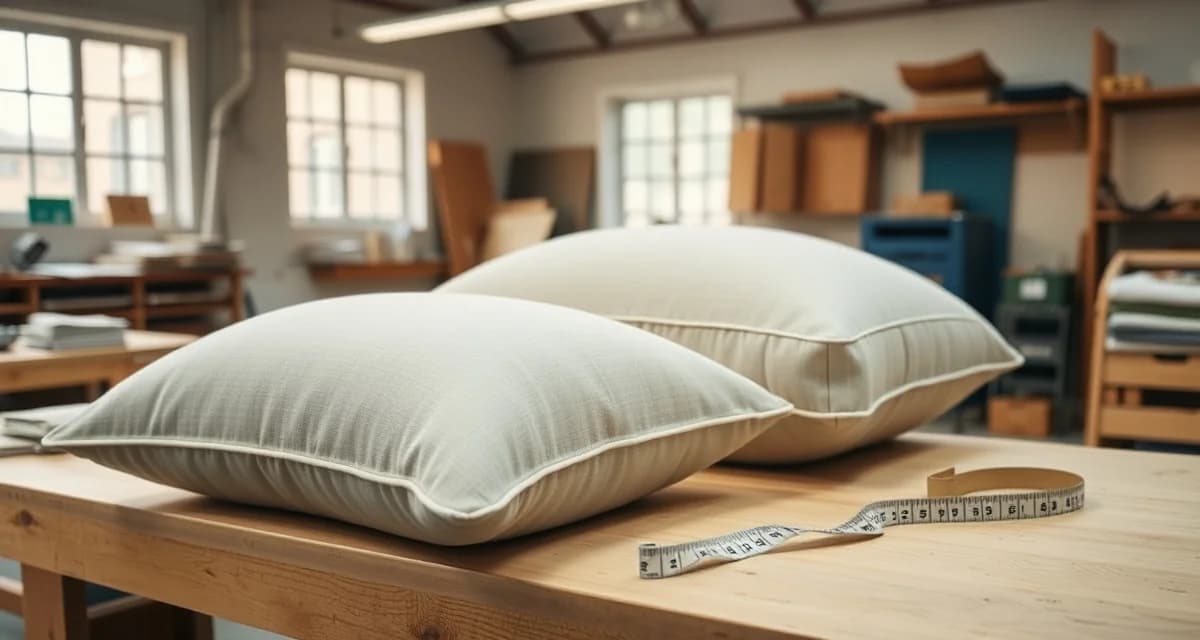
Knife Edge Cushion Fabric Yardage vs Box Cushion
Cushion style affects your fabric order more than most clients realize. A knife-edge cushion and a box cushion the same size need different yardage, different cutting layouts, and different seam placement. Getting the two confused when calculating can leave you short, or put you in the awkward position of explaining to a client why the cushion style changed.
The short version: box cushions use 15 to 20 percent more fabric than knife-edge cushions the same size. Here's why, and what it means for your calculations.
TL;DR
- Knife Edge Cushion yardage depends on fabric width, construction details, pattern repeat, and nap direction.
- Plain 54-inch fabric requires a baseline calculation plus 10-15% waste allowance for a standard knife edge cushion job.
- Patterned fabric adds 20-35% to base yardage depending on repeat size and the number of cutting zones that must align.
- Directional fabrics add 15-25% over plain fabric because layout optimization is restricted by nap direction.
- Always verify fabric width before finalizing yardage; COM fabric often comes in non-standard widths.
- Calculating yardage at the quote stage, not mid-job, eliminates reorders and protects your profit margin.
What Is a Knife-Edge Cushion?
A knife-edge cushion has two face panels (top and bottom) sewn together around the perimeter. No boxing strip. The edge of the cushion tapers to a point, or more accurately, to a relatively thin seam, at the perimeter. The insert is fitted to the cover and the seam runs right at the edge of the cushion's footprint.
Knife-edge cushions are most common on:
- Back cushions and throw pillows
- Tight-back sofa and chair cushions
- Some modern and minimalist designs that want a clean, low-profile look
The absence of a boxing strip is what makes knife-edge more fabric-efficient. Two panels and a perimeter seam. That's the whole construction.
What Is a Box Cushion?
A box cushion has three distinct fabric components:
- Top face panel
- Bottom face panel
- Boxing strip: the band of fabric that runs around the perimeter between top and bottom, creating the defined "box" shape
The boxing strip has depth equal to the cushion thickness, typically 3 to 6 inches for seat cushions, 2 to 4 inches for back cushions. That additional panel is where the extra yardage comes from.
Most seat cushions on residential sofas are box cushions because the defined edge gives a more structured, furniture-store look. Seat cushions that need to hold their shape under weight benefit from the box construction.
Yardage Comparison for the Same Cushion Size
Let's use a standard 26 x 24-inch seat cushion in 54-inch fabric as the example:
Knife-edge version:
- Top panel: 26 x 24 inches
- Bottom panel: 26 x 24 inches
- Total fabric used: approximately 0.75 yards
Box cushion version (5-inch boxing):
- Top panel: 26 x 24 inches
- Bottom panel: 26 x 24 inches
- Boxing strip: 5 inches x 100 inches (perimeter) = runs across nearly a full width of fabric
- Zipper panel: portion of boxing strip at back edge
- Total fabric used: approximately 0.9 to 1 yard
That's a difference of 0.15 to 0.25 yards per cushion. For a 3-cushion sofa, that's 0.45 to 0.75 yards, close to half a yard of additional fabric just because of cushion edge style.
For the cushion yardage comparison in StitchDesk's sofa seat cushion calculator, you can toggle between knife-edge and box cushion to see exactly how the style affects your total order.
When Cushion Thickness Changes the Equation
The boxing strip depth is tied directly to cushion thickness. A slim 3-inch boxing uses less fabric than a deep 6-inch boxing for the same footprint cushion. On sofas with deep, plush seat cushions, the boxing strip can actually become one of the bigger fabric consumers on the whole piece.
If you're switching a client's sofa from standard 4-inch cushions to deep 6-inch down-wrapped cushions, that extra 2 inches of depth across the full perimeter of three seat cushions adds up to real yardage.
Always confirm cushion thickness with the client before finalizing the order. It's not a detail you want to discover at the cutting stage.
Pattern Alignment Differences
Pattern centering also differs between the two styles. On a box cushion, the pattern should be centered on both the top face and front boxing strip, two separate alignment points. On a knife-edge cushion, you're centering on one surface (the top face, which is also the most visible panel).
For a centered medallion pattern on a box cushion, you need the medallion centered on the top, and you need the boxing pattern to align with where it meets the top panel at the seam. This takes more planning and can add yardage compared to the same fabric on a knife-edge cushion.
Back Cushions Are Almost Always Knife-Edge
Back cushions for pillow-back sofas are typically knife-edge rather than box, which is why back cushion yardage is lower than seat cushion yardage even for similar sizes. If your client has a sofa where the back cushions look "puffy" and rounded rather than structured, they're probably knife-edge.
For a standard back cushion at 22 x 22 inches knife-edge: 0.5 yards each.
For a standard back cushion at 22 x 22 inches if converted to box (3-inch boxing): 0.65 yards each.
Frequently Asked Questions
How much fabric for a knife-edge cushion vs box cushion?
A standard 26 x 24-inch knife-edge seat cushion needs approximately 0.7 to 0.8 yards of 54-inch fabric. The same cushion as a box cushion with 5-inch boxing needs 0.9 to 1 yard. The difference is the boxing strip, which runs around the full perimeter of the cushion. On a 3-cushion sofa, that adds up to 0.5 to 0.75 yards total.
Does knife-edge upholstery use less fabric?
Yes, consistently. Because knife-edge construction has only two face panels and no boxing strip, it uses 15 to 20 percent less fabric for the same cushion footprint. The savings are proportionally larger on thicker cushions, where the box cushion boxing strip uses even more yardage.
What is a knife-edge cushion in upholstery?
A knife-edge cushion is a pillow-style cushion where the top and bottom fabric panels are sewn together at the perimeter with no boxing strip between them. The edge of the cushion tapers to a seam rather than having a defined vertical side. It's most common on back cushions, throw pillows, and modern furniture that wants a clean, low-profile aesthetic.
What is the biggest factor in yardage variation for this piece?
Pattern repeat is the biggest source of yardage variation. On plain fabric, the baseline calculation plus a 10-15% waste buffer is usually sufficient. Add a 13-inch pattern repeat and you may need 15-20% more. Add a 27-inch pattern repeat and the additional yardage can be 25-35% over the plain fabric calculation. Nap direction is the second-largest factor, typically adding 15-25% over plain fabric because layout optimization is restricted.
Related Articles
Sources
- National Upholstery Association
- Association of Master Upholsterers and Soft Furnishers (AMUSF)
- Upholstered Furniture Action Council (UFAC)
- Furniture Today (trade publication)
Get Started with StitchDesk
Getting yardage right on yardage knife edge cushion jobs is the difference between a profitable quote and an expensive reorder. StitchDesk's fabric calculator accounts for all the variables that cause errors: pattern repeat by zone, nap direction, fabric width, and cushion configuration. Start a free trial and see how accurate yardage calculation affects your bottom line.