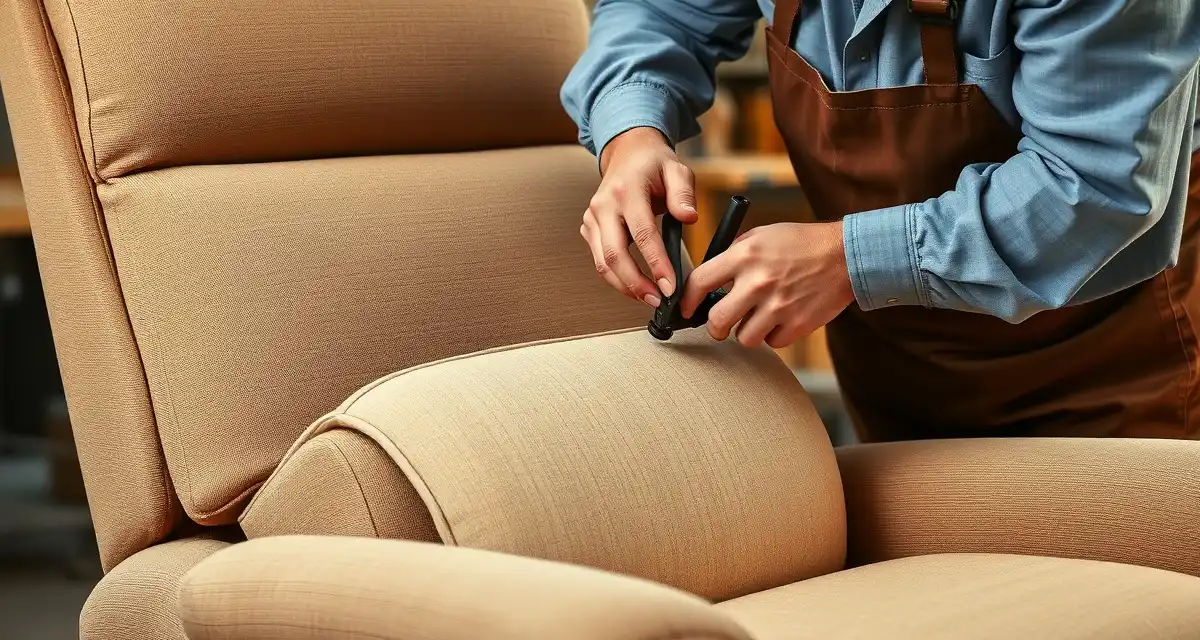
Recliner Reupholstery Guide: Mechanism-Safe Professional Technique
Recliner callbacks for mechanism binding are the most expensive warranty call in upholstery, $100 to $200 to diagnose and reopen seams. The binding happens when fabric gets installed too close to a pivot point or when a panel is pulled too tight across a moving part. The recliner works fine during the post-upholstery test and fails after 2 weeks of use. Getting the panel sequence and clearance zones right the first time prevents this outcome entirely.
TL;DR
- Successful reupholstery starts with a thorough frame and spring assessment before any fabric is ordered.
- Professional technique follows a consistent panel sequence: strip, repair frame, replace foam, then install fabric panels in the correct order.
- Pattern fabric requires centering and repeat alignment decisions made before cutting; errors discovered after cutting are expensive to correct.
- Professional labor time ranges from 12-20 hours depending on furniture style and fabric complexity.
- Foam selection matters as much as fabric selection; the right density and ILD creates the correct seating profile and longevity.
- Consistent tension on all panels and quality welt cording are the marks of professional finishing.
Recliner Mechanism Types
Before working on any recliner, identify the mechanism type. Each has different clearance requirements.
Manual push-back recliners: The back reclines from pressure applied by the sitter. The mechanism is a simple cam or spring system. Relatively few pivot points. The main concern is fabric at the back base connection and at the arm rest attachment.
Manual handle-pull recliners: A handle on the side of the chair releases the footrest and allows the back to recline. The handle mechanism connects to linkage inside the arm. The access point for this linkage is the most important clearance zone.
Wallhugger recliners: The base slides forward as the back reclines, allowing the chair to operate close to a wall. The base rail has a sliding mechanism that's distinct from standard recliners. Bottom panel fabric must not restrict base movement.
Power recliners: Motor-driven movement. Motor housing and wire routing paths need to be clear of fabric. Wires must route through the chair without being pinched.
Pre-Work Mechanism Documentation
Before touching the fabric:
- Operate the recliner through its full range of motion
- Observe where the mechanism arms move during operation
- Identify pivot points, the bolts or pins around which linkage rotates
- Mark pivot point locations on the inside with chalk or tape
Pivot points must be kept clear of fabric by 2-3 inches. Fabric stapled within 2 inches of a pivot point will be contacted by the rotating arm during operation.
The 5-Check Pre and Post Protocol
Before reupholstery (5 pre-checks):
- All mechanism pivot points identified and marked
- Handle operation tested and confirmed smooth
- Footrest extension tested and confirmed smooth
- Reclining motion tested and confirmed smooth
- Power recliners: all wires routed and accessible
After reupholstery (5 post-checks):
- Open recliner to full recline, smooth without resistance?
- Close recliner from full recline, smooth?
- Extend footrest, smooth?
- Retract footrest, smooth?
- Operate 5 consecutive cycles, any increasing resistance?
If any post-check reveals binding, identify and correct before adding dust cover.
Panel Installation Sequence
1. Seat deck and seat platform. Staple seat fabric well clear of the mechanism mounts at the front and sides. On most recliners, the forward mechanism mounts are at the front corners of the seat frame. Keep staple lines 3 inches back from these points.
2. Inside arms (both). Inside arm fabric on recliners must account for the mechanism access area. On handle-pull recliners, the mechanism access is typically at the right inside arm. Either leave this area temporarily unsecured or plan an access flap here (recommended).
3. Mechanism access flap (recommended). At the mechanism access point (usually right inside arm on manual handle recliners), create a small fabric flap. Sew a simple flap from matching fabric, attach at the top edge with hand stitching, and secure the bottom edge with pressure snaps or hook-and-loop. This allows service access without reopening the full inside arm.
4. Inside back. Standard installation, tucked behind inside arms.
5. Footrest panels. The footrest has a top cover (visible when extended), side boxing, and a bottom panel. The bottom panel must not be stapled near the mechanism linkage connection points. Test footrest operation with the bottom panel in place before finalizing.
6. Outside arms. Keep staple lines clear of mechanism arm paths. Identify where mechanism arms travel during full recline before stapling the outside arm.
7. Outside back. Standard close panel.
8. Dust cover. Applied ONLY after all 5 post-checks pass. The dust cover seals the mechanism from access. Don't seal it until you're confident everything is working correctly.
Power Recliner Specifics
Power recliners have motors, wiring harnesses, and control panels in addition to mechanical linkage. Additional considerations:
Wire routing: All wires from the motor must be routed through the chair without contact with rotating linkage. Route wires along frame rails and secure with wire clips or light staples (not through the wire, alongside it). Wires pinched by moving parts will eventually chafe through.
Control panel access: The client needs to be able to reach the control panel after reupholstery. The panel is typically on the arm or along the front rail. The panel position must not be covered by fabric.
Motor compartment: The motor compartment at the base of the chair needs to stay ventilated. Don't staple fabric that closes off the motor compartment.
For mechanism assessment and what to check when the recliner comes in, see the how to reupholster a recliner guide. For fabric yardage on recliners, use the recliner fabric yardage calculator.
Frequently Asked Questions
How do I protect the recliner mechanism when reupholstering?
Mark all pivot points before starting work and maintain 2-3 inch clearance zones around each pivot point with your staple lines. Install a mechanism access flap at the handle or mechanism access point (usually right inside arm). Test the mechanism after every panel installation, don't wait until you've closed the outside panels to discover a binding issue. Apply the dust cover only after all post-checks confirm smooth operation.
What panel do I install last on a recliner?
The dust cover goes on last, after all panels are complete and all 5 mechanism post-checks pass. Among the main panels, the outside back goes on after the outside arms. The footrest bottom panel is installed before the outside arms (so you can check footrest operation while still having adjustment access). The access flap, if you add one, is part of the inside arm installation.
How do I test a recliner after reupholstering?
Run 5 complete cycles of the full operation: open to full recline, close, extend footrest, retract footrest. On the 5th cycle, note whether the operation feels the same as the first cycle, any increase in resistance indicates binding starting to develop. For manual recliners, test handle operation specifically. For power recliners, test both the footrest and the back independently and then together. If anything binds, identify the cause (usually a fabric edge near a pivot point) and correct before adding the dust cover.
What tools are required for professional reupholstery?
Professional reupholstery requires a heavy-duty staple gun (pneumatic or electric), a staple remover and tack puller, quality scissors and a rotary cutter, a sewing machine capable of sewing upholstery-weight fabric, foam cutting tools, and regulator pins for manipulating stuffing. For tufted work, a curved needle and tufting twine are also required. The quality of your tools directly affects the quality of the finished work, particularly at seams and edges.
In what order should upholstery panels be installed?
The correct panel sequence varies by furniture type, but the general principle is inside panels before outside panels, starting from the bottom up. For a sofa: deck first, then inside arms, inside back, seat cushions, back cushions, outside arms, outside back, front arm panels, then dust cover. For a chair: seat platform, inside back, inside arms, outside arms, outside back, then dust cover. Deviating from the correct sequence can make later panels impossible to install cleanly.
Related Articles
- Chaise Lounge Reupholstery Guide: Professional Technique
- Leather Upholstery Guide: Hides Grades and Professional Technique
Sources
- National Upholstery Association
- Association of Master Upholsterers and Soft Furnishers (AMUSF)
- Upholstered Furniture Action Council (UFAC)
- Furniture Today (trade publication)
Get Started with StitchDesk
Accurate reupholstery quotes require knowing your labor time, material costs, and overhead for each job type. StitchDesk helps upholstery shops build detailed, professional quotes that account for all cost factors, so every job is priced to cover costs and generate profit. Try StitchDesk free and bring accuracy to every estimate you send.