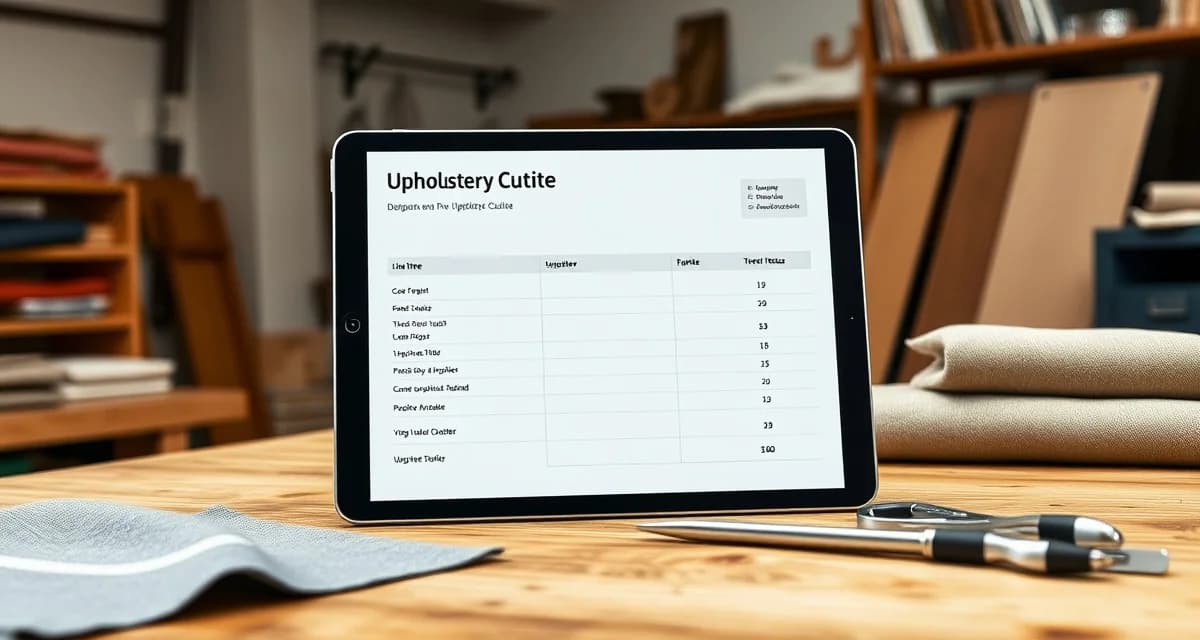
Professional Reupholstery Quote Template: 12 Line Items Every Quote Needs
Itemized quotes with 8 or more line items close at a 35% higher rate than single-price quotes. Clients trust the breakdown. A quote that shows labor, fabric, supplies, and any extras separately signals that you know exactly what the job involves. A single number, "your sofa, $1,400", gives a client nothing to evaluate except the number itself.
The 12-item quote template below covers every component of a standard reupholstery job. Use it for every quote, regardless of size.
TL;DR
- Accurate pricing requires knowing your actual labor rate (overhead + target wage + profit margin), not a rough estimate.
- Most shops undercharge by failing to account for pattern repeat waste, frame repair time, and non-billable admin overhead.
- A documented pricing structure with itemized line items builds client trust and reduces negotiation friction.
- Fabric markup of 20-40% over cost is standard practice in residential upholstery shops.
- Premium work (leather, tufting, custom trim) warrants a premium labor rate, which should be explicit in your quote structure.
- Consistent pricing with clear line items also makes it easier to analyze profitability by job type over time.
The 12 Line Items
Line 1: Piece description
"[Client name], 3-cushion Lawson sofa, approximately 84 inches, walnut legs"
This is the header of the quote, what the job is. Be specific enough that both you and the client know exactly which piece this quote covers.
Line 2: Scope of work
"Full reupholstery, all exterior panels, seat cushions, and back cushions. Frame in good condition at intake, no repairs required."
Or: "Seat cushion replacement only, foam and cover on all 3 seat cushions."
Be explicit about what's included and what's not. Disputes often start with scope misunderstandings: the client thought you were doing the outside back, you quoted only the inside.
Line 3: Fabric description and source
"Sunbrella Performance Linen, Dove Gray, 18 yards, sourced by shop"
Include the fabric name, colorway, and yardage. If the client is supplying fabric (COM), note: "Client-supplied fabric (COM), 18 yards minimum required, delivery to shop required before production begins."
Line 4: Fabric cost
"Fabric: 18 yards × $14/yard = $252"
Show the per-yard cost and total. Don't obscure the fabric cost in the labor line. Transparency here builds trust.
Line 5: Fabric markup / sourcing fee
"Sourcing and ordering: $76"
Or simply roll the markup into the fabric line and show the total fabric line at the marked-up price. Either approach is acceptable, what matters is that the fabric isn't being quoted at cost with zero service value attached.
Line 6: Pattern repeat allowance (when applicable)
"Pattern repeat allowance: 2 additional yards for 12-inch vertical repeat = $28"
When the fabric has a pattern repeat, this line makes clear that the additional yardage requirement is deliberate and has been calculated, not a mistake in the original estimate.
Line 7: Labor, production
"Labor (estimated 13 hours × $90/hour): $1,170"
Break out the labor estimate. Clients who understand that skilled upholstery takes 12+ hours accept the price differently than clients who see $1,400 with no explanation.
Line 8: Supplies
"Supplies (foam, welt cord, cambric, thread): $85"
A flat supply estimate is fine. You don't need to itemize every staple strip, but showing a supplies line is more professional than hiding it in labor.
Line 9: Any frame repairs or additional work
"Frame repair (left front leg joint re-glued): $35"
This line is conditional, only used when repairs were discovered at intake or during teardown. If you discover repairs after intake, present a supplemental quote for approval before proceeding.
Line 10: Pickup/delivery (if applicable)
"Local pickup/delivery: $65"
If you offer pickup and delivery, show it as a line item rather than bundling it into labor. Clients who choose to deliver their own piece understand they're declining this service.
Line 11: Total
"Total: $1,611"
The total should be easy to find, don't bury it in the middle of the quote.
Line 12: Deposit required and payment terms
"Deposit required to confirm: $500 (fabric order will be placed upon receipt of deposit)"
"Balance due at pickup: $1,111"
Be explicit about when you need the deposit and what you'll do with it (order the fabric). Be explicit about when the balance is due.
Presenting the Quote: Format Options
Email quote: A clean email with the 12 items listed clearly works for most clients. Subject line: "Quote for [Client Name] [Piece Type], [Your Shop Name]". Include your shop name, phone, and website in the signature.
PDF quote: Generates a more formal impression. Use a template (Google Docs, Canva, Word) to format the 12 line items with your logo, and attach as PDF. This is worth doing for jobs over $500.
Software-generated quote: If you use StitchDesk, the quoting system generates a formatted PDF quote from the job record, including all line items, deposit requirements, and your shop branding. For the quoting workflow, see the StitchDesk quoting system guide. For the full pricing methodology behind these numbers, see the how to price reupholstery jobs guide.
What to Include at the Bottom of Every Quote
After the 12 line items, include a brief terms section:
Validity: "This quote is valid for 30 days. Fabric pricing is subject to availability."
Deposit policy: "Production begins upon receipt of deposit and fabric arrival. Deposit is non-refundable once fabric has been ordered."
Change orders: "Any changes to scope of work after deposit will be quoted as a change order before proceeding."
Estimated timeline: "Estimated production time is 2-3 weeks from fabric arrival."
These four lines handle 90% of potential disputes before they become disputes.
Quote Delivery Timing
Speed matters. Shops that send a written quote within 2 hours of a site visit close 55% of jobs, versus 30% for next-day quotes. The client's interest is at its peak immediately after the site visit. A quote in hand while they're still thinking about the piece is a quote that gets read and acted on.
If you can't produce a full written quote within 2 hours, develop a rapid-quote system: capture the job details on a template during the visit and send a draft quote immediately, noting that the final confirmed quote will follow. A draft closes faster than nothing.
Frequently Asked Questions
What should a professional upholstery quote include?
A professional upholstery quote should include: piece description, scope of work (what's included and excluded), fabric description and yardage, fabric cost (or COM note), fabric markup or sourcing fee, pattern repeat allowance if applicable, labor estimate broken out by hours and rate, supplies estimate, any frame repairs, delivery fee if applicable, total price, deposit amount and payment terms, quote validity period, and estimated timeline. The combination of line items signals that you've actually calculated the job rather than guessing, and itemized quotes close at considerably higher rates than single-number quotes.
How do I create an itemized reupholstery estimate?
Build the estimate from the 12 line items starting with the piece and scope, then fabric, then labor, then supplies and extras. For labor, estimate the hours for the specific piece type (not a generic sofa estimate) and multiply by your labor rate. For fabric, calculate the yardage including any pattern repeat allowance, then apply your markup. For supplies, use a fixed estimate based on job type (dining chair supplies are different from a sofa supplies estimate). Total the components and add deposit and payment terms. The full quote can be in a formatted email, a PDF template, or generated directly from shop management software.
Can I use a template for all my upholstery quotes?
Yes, a template is the recommended approach. A consistent template ensures no line items are forgotten, creates a professional impression, and makes quoting faster because the structure is already built. Customize the line items for each job (specific piece, specific fabric, specific hours estimate) but use the same 12-item structure every time. Clients who receive professional, consistent quotes are more likely to return for future jobs. Over time, your quoting template also becomes the basis for job cost tracking, comparing the quote to actual costs after job completion.
How do I set an hourly labor rate for my upholstery shop?
Start with your actual cost per hour: divide total monthly overhead (rent, utilities, insurance, supplies, equipment) by your billable hours per month, then add your target wage per hour. Apply a profit margin of 20-35% on top of that base. Most residential upholstery shops in 2025 bill $65-120/hour depending on location and specialization. Urban markets and shops specializing in antiques or premium leather command the higher end of that range.
How do I handle clients who want to negotiate the price?
The most effective response to price negotiation is to explain what the price covers, not to simply lower it. Walk the client through the labor time, fabric cost, and any structural work required. If the client needs a lower price, offer to adjust the scope (simpler fabric, no welt cording, tight seat instead of loose cushion) rather than discounting the same work. Discounting without scope changes devalues your labor and creates an expectation of discounting on future jobs.
Sources
- National Upholstery Association
- Association of Master Upholsterers and Soft Furnishers (AMUSF)
- Upholstered Furniture Action Council (UFAC)
- Furniture Today (trade publication)
Get Started with StitchDesk
Pricing confidence comes from knowing your actual costs and communicating them clearly in every quote. StitchDesk helps upholstery shops build detailed quotes, track job costs against estimates, and develop pricing that protects margins across every job type. Try StitchDesk free and bring precision to your pricing.