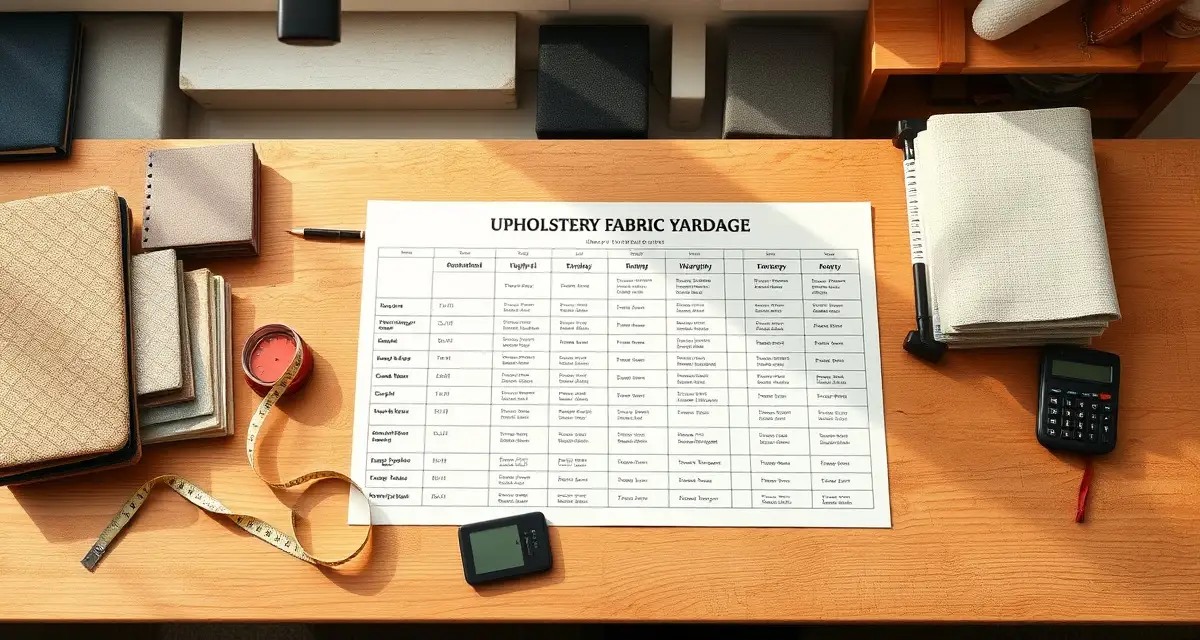
Upholstery Fabric Yardage Chart: Quick Reference for Every Furniture Type
This chart gives you a fast reference for the most common upholstery jobs. Use it for initial client conversations, not for final order quantities. For accurate orders, especially with pattern repeats or COM fabric, use the StitchDesk calculator, which accounts for your actual measurements and fabric details.
All yardage below is for 54-inch fabric. Adjust for other widths as noted.
TL;DR
- Upholstery Chart yardage depends on fabric width, construction details, pattern repeat, and nap direction.
- Plain 54-inch fabric requires a baseline calculation plus 10-15% waste allowance for a standard upholstery chart job.
- Patterned fabric adds 20-35% to base yardage depending on repeat size and the number of cutting zones that must align.
- Directional fabrics add 15-25% over plain fabric because layout optimization is restricted by nap direction.
- Always verify fabric width before finalizing yardage; COM fabric often comes in non-standard widths.
- Calculating yardage at the quote stage, not mid-job, eliminates reorders and protects your profit margin.
Sofa Yardage Chart
| Sofa Type | Plain Fabric | Small Repeat (13") | Large Repeat (27"+) | Velvet (no pattern) |
|---|---|---|---|---|
| 2-cushion sofa (72") | 11–14 yards | 13–16 yards | 16–20 yards | 13–17 yards |
| 3-cushion sofa (84") | 14–18 yards | 16–20 yards | 19–24 yards | 17–22 yards |
| 3-cushion sofa (96") | 16–20 yards | 18–23 yards | 22–27 yards | 19–24 yards |
| Sofa with skirt | Add 2–3 yards to above | | | |
| Sleeper sofa | Add 3–5 yards to standard sofa | | | |
Loveseat Yardage Chart
| Loveseat Type | Plain Fabric | Small Repeat | Large Repeat | Velvet |
|---|---|---|---|---|
| Standard loveseat (60") | 7–9 yards | 8.5–11 yards | 11–14 yards | 9–11 yards |
| Loveseat with skirt | Add 1.5–2 yards | | | |
Chair Yardage Chart
| Chair Type | Plain Fabric | Small Repeat | Large Repeat | Velvet |
|---|---|---|---|---|
| Dining chair (seat only) | 0.75–1 yard | 1–1.25 yards | 1.25–1.5 yards | 1–1.25 yards |
| Side chair (seat + back) | 1.5–2 yards | 1.75–2.5 yards | 2.5–3 yards | 1.75–2.5 yards |
| Parsons chair | 3–4 yards | 3.5–5 yards | 5–6.5 yards | 3.5–5 yards |
| Club chair | 4.5–6 yards | 5.5–7.5 yards | 8–10 yards | 5.5–7 yards |
| Barrel chair | 4.5–6 yards | 5.5–7.5 yards | 7.5–10 yards | 5.5–7.5 yards |
| Wing chair | 6–9 yards | 8–11 yards | 11–14 yards | 7.5–11 yards |
| Bergere chair | 5–7 yards | 6–8.5 yards | 9–12 yards | 6–8.5 yards |
| Accent chair (small) | 3.5–5 yards | 4.5–6 yards | 6–8 yards | 4.5–6 yards |
| Recliner | 7–9 yards | 8.5–11 yards | 11–14 yards | 8.5–11 yards |
Sectional Yardage Chart
Sectional yardage varies significantly by configuration. These are per-piece estimates, total yardage is the sum of all pieces plus transition waste.
| Piece Type | Plain Fabric | Large Repeat Addition |
|---|---|---|
| Corner unit | 10–14 yards | Add 3–5 yards |
| 3-seat sofa section | 10–14 yards | Add 3–5 yards |
| 2-seat loveseat section | 7–9 yards | Add 2–3 yards |
| Armless chair section | 4–6 yards | Add 1.5–2.5 yards |
| Chaise section | 8–11 yards | Add 2.5–4 yards |
| Between-section pattern transition |, | Add 2–4 yards |
Total L-shape sectional (sofa + chaise): 22–30 yards plain. 30–40 yards with 27-inch repeat.
Total U-shape sectional (corner + two sofa sections): 35–50 yards plain. 48–68 yards with 27-inch repeat.
Headboard Yardage Chart
| Headboard Type | Twin | Full | Queen | King |
|---|---|---|---|---|
| Flat upholstered | 2–2.5 yards | 2.25–3 yards | 2.5–3.25 yards | 3.5–4.5 yards |
| Button-tufted | 2.5–3.5 yards | 3–4 yards | 3.5–4.5 yards | 5–6 yards |
| Channel-tufted | 2.25–3 yards | 2.75–3.5 yards | 3–4 yards | 4–5 yards |
| Add for velvet (nap) | +0.5 yards | +0.5–0.75 yards | +0.75–1 yard | +1–1.5 yards |
Ottoman Yardage Chart
| Ottoman Type | Yardage |
|---|---|
| Small rectangular (18 x 18", 14" tall) | 1.5–2 yards |
| Medium square (24 x 24", 18" tall) | 2–2.5 yards |
| Large rectangular (36 x 24", 18" tall) | 2.5–3 yards |
| Large round (30" diameter, 18" tall) | 2.75–3.5 yards |
| Tufted (any size) | Add 15–25% |
Bench Yardage Chart
| Bench Type | Yardage |
|---|---|
| 36-inch bench, flat | 1.5–2 yards |
| 48-inch bench, flat | 2–2.5 yards |
| 60-inch bench, flat | 2.25–3 yards |
| 72-inch bench, flat | 2.75–3.5 yards |
| Add for back panel | +0.5–0.75 yards |
| Add for welting | +0.25–0.5 yards |
Using This Chart vs. Calculating
Use this chart for:
- Client consultations before measurement
- Ballpark estimates over the phone
- Verifying that a calculated number is in the right range
Don't use this chart for:
- Final orders, too much variation within each range
- COM jobs, fabric width may differ from 54 inches
- Patterned fabrics, the pattern repeat adds are approximate ranges
- Unusual sizes or styles outside the common parameters
For all final orders, run the StitchDesk calculator with actual measurements. The chart gets you in the conversation. The calculator gets you to the order.
Related Articles
FAQ
How accurate are upholstery yardage charts?
Yardage charts give a reliable range for initial estimates but can't account for the specific dimensions of your piece, the fabric width, or the exact pattern repeat. The ranges in charts are typically accurate within 1–2 yards for standard pieces in plain fabric. For patterned fabric or unusual sizes, the range widens and the chart becomes less useful. Always confirm with a measurement-based calculation before ordering.
Why does the same sofa show such different yardage needs?
Two sofas described as "84-inch 3-cushion sofas" can differ significantly in arm style (scroll arms vs. track arms, the arm profile changes how much fabric each arm panel requires), back height (a 36-inch high back needs more inside back fabric than a 28-inch back), cushion style (T-cushions require more fabric than straight cushions), and whether there's a skirt. These details don't change the description but they change the yardage by 1–3 yards. The chart shows the full range, the calculator narrows it down for your specific piece.
Do yardage charts account for fabric width?
Most standard charts assume 54-inch fabric. If your fabric is 48 inches, add 15–20% to the chart estimate. If your fabric is 60 inches, subtract 5–8%. These are approximations, for accurate conversion, recalculate with the actual width rather than adjusting the chart number.
What is the biggest factor in yardage variation for this piece?
Pattern repeat is the biggest source of yardage variation. On plain fabric, the baseline calculation plus a 10-15% waste buffer is usually sufficient. Add a 13-inch pattern repeat and you may need 15-20% more. Add a 27-inch pattern repeat and the additional yardage can be 25-35% over the plain fabric calculation. Nap direction is the second-largest factor, typically adding 15-25% over plain fabric because layout optimization is restricted.
What should I do if I run short on fabric mid-job?
Stop cutting immediately when you realize you may run short. Calculate exactly how much additional fabric you need before contacting the supplier or client. If reordering from the same dye lot is possible, do so as quickly as possible because dye lots change. If a dye lot match is not available, contact the client before proceeding; visible dye lot differences on the same piece are unacceptable and must be disclosed. Document the situation and response in writing.
Sources
- National Upholstery Association
- Association of Master Upholsterers and Soft Furnishers (AMUSF)
- Upholstered Furniture Action Council (UFAC)
- Furniture Today (trade publication)
Get Started with StitchDesk
Getting yardage right on upholstery chart jobs is the difference between a profitable quote and an expensive reorder. StitchDesk's fabric calculator accounts for all the variables that cause errors: pattern repeat by zone, nap direction, fabric width, and cushion configuration. Start a free trial and see how accurate yardage calculation affects your bottom line.