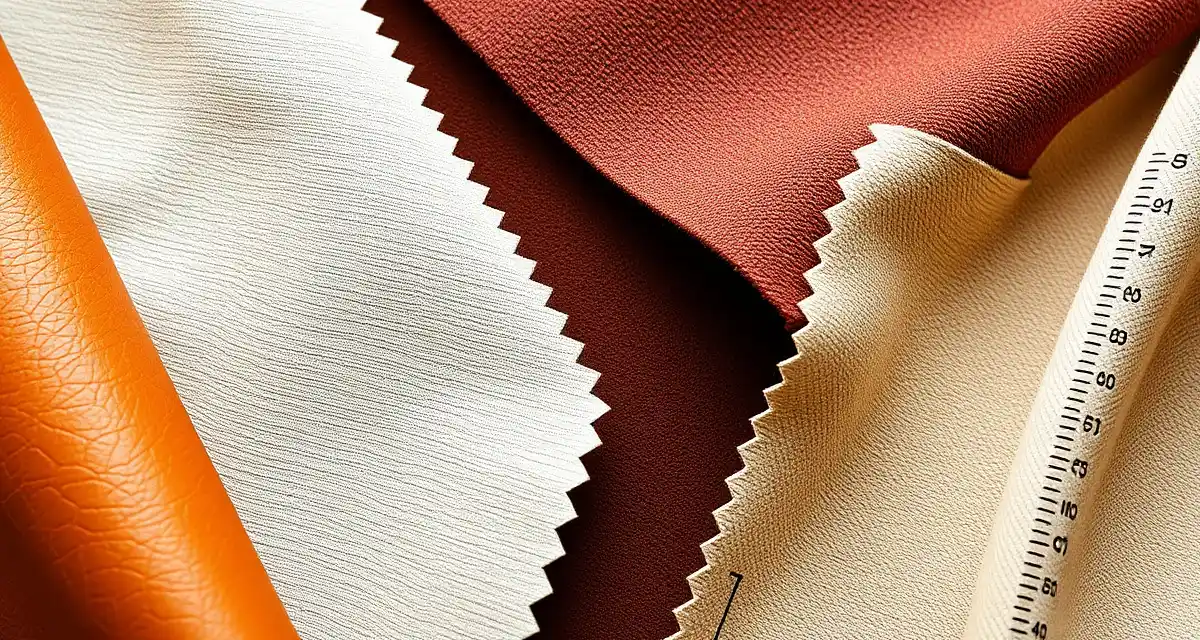
Upholstery Seam Allowance Guide: What Every Fabric Type Needs
Half an inch. That's the seam allowance most upholstery guides tell you to use. Cut everything with a half-inch seam allowance and you'll be fine. Except you won't, not on leather, not on vinyl, not on loose-weave chenille.
Using 0.5-inch seam allowance on leather instead of 0.375 inches wastes 0.25–0.5 yards per piece. On a large sofa, that's enough to tip a job into reorder territory. This guide covers the correct seam allowances for 12 fabric types, why each requires what it does, and how seam allowance affects your total yardage estimate.
TL;DR
- Understanding seam allowance properties helps you select the right material for each client's specific use case and budget.
- Durability ratings (double-rub count) are the standard measure of upholstery fabric longevity: 15,000+ for light use, 30,000+ for heavy residential, 100,000+ for commercial.
- Fabric cleaning codes (W, S, WS, X) determine what cleaning methods are safe and should be communicated to every client at handoff.
- Pattern repeat, nap direction, and fabric width are the three variables that most affect yardage requirements on any piece.
- COM fabric should always be verified for rub count and cleaning code before acceptance.
- Fabric performance in real use depends on the application: a fabric rated for light residential use will fail quickly in high-traffic settings.
Why Seam Allowance Isn't One-Size-Fits-All
Seam allowance in upholstery serves two functions. It gives you enough fabric to sew a secure seam, and it provides trimming allowance so the finished seam doesn't fray, shift, or create bulk.
Different fabrics have different behaviors at the seam:
- Leather and vinyl don't fray, so they don't need fraying insurance
- Heavy fabrics like denim or canvas need larger allowances because the seam sits farther from the edge to prevent bulk
- Loose-weave fabrics like chenille unravel quickly, needing larger allowances trimmed back after sewing
- Stretch fabrics need more allowance to prevent seam stress pulling the edge free
One seam allowance standard fails at least half these cases.
The Seam Allowance Standard by Fabric Type
Woven Upholstery Fabrics (General)
Standard seam allowance: 0.5 inches (1.27 cm)
This is the baseline for most woven polyester, acrylic, and blended upholstery fabrics. The fabric has moderate fray resistance and enough body to sew cleanly at half an inch. Trim to 3/8 inch after sewing on curved seams to reduce bulk.
Velvet
Standard seam allowance: 0.5 inches
Velvet follows the same half-inch standard but requires special handling. The pile compresses at the seam foot, which can cause seam drift, the two pieces shifting as you sew. Use a walking foot, pin generously, and plan for a slight trim after sewing. On crushed velvet, 0.5 inches is adequate; on cut velvet, consider 5/8 inches to account for pile height at the seam edge.
Chenille
Standard seam allowance: 0.625 inches (5/8 inch)
Chenille is one of the most fray-prone upholstery fabrics. The chenille tufts can unravel quickly once cut, and that unraveling can reach back toward the seam. Use 5/8-inch allowance and serge or overlock immediately after cutting. Don't let cut chenille panels sit exposed overnight.
Leather (Genuine)
Standard seam allowance: 0.375 inches (3/8 inch)
Leather doesn't fray. At all. There's no thread structure to unravel, it's a skin. A half-inch seam allowance on leather is simply wasted material. Use 3/8 inch, which gives you enough to sew a clean seam and trim back to 1/4 inch after sewing to reduce bulk at the fold. On thick hides (3–4 oz and up), skive (thin) the seam allowance before folding.
The fabric yardage calculator allows you to set seam allowance by material type so leather yardage calculates correctly at 3/8 inch rather than defaulting to the woven-fabric standard.
Vinyl and PVC
Standard seam allowance: 0.375 inches (3/8 inch)
Same logic as leather, no fraying. Vinyl seams are often glued and then sewn rather than pinned, because pins create visible holes. Use 3/8-inch allowance, glue the seam, then topstitch or sew. On heavy marine vinyl, trim to 1/4 inch after sewing to prevent stiff seam ridges.
Microfiber (Smooth)
Standard seam allowance: 0.5 inches
Smooth microfiber behaves like a standard woven fabric at the seam. Half an inch works. It doesn't fray aggressively but doesn't have the heavy body of chenille.
Microfiber (Suede Finish)
Standard seam allowance: 0.5 inches, with pile consideration
Suede microfiber has a directional nap, similar to velvet. The seam allowance is the same, but take the nap direction into account when planning seam orientation. Seams running across the nap are more visible than seams running with it.
Linen
Standard seam allowance: 0.625 inches (5/8 inch)
Linen frays enthusiastically. Even tightly woven linen upholstery fabric will unravel at cut edges if left unsealed. Use 5/8 inch, serge immediately, and don't cut corners with serging on linen. Some upholsterers use 3/4 inch on medium-weight linen for extra security.
Canvas and Duck Cloth
Standard seam allowance: 0.625 inches (5/8 inch)
Heavy canvas needs extra allowance because the thick material creates bulk at the seam fold. Use 5/8 inch and press seams open when possible. On outdoor canvas (used for marine or patio furniture), flat-fell seams give additional strength, this requires 1 inch of allowance for the flat-fell fold.
Boucle
Standard seam allowance: 0.75 inches (3/4 inch)
Boucle has an open, loopy weave that unravels more than almost any other upholstery fabric. Cut edges need immediate serging and a generous allowance. Three-quarter inch is the safe standard. Don't treat boucle like a standard woven fabric, the loop construction means each cut loop is a potential unravel point.
Jacquard
Standard seam allowance: 0.5 inches
Jacquard is a woven fabric with an integrated pattern. Seam allowance is the same as standard woven fabric, but pay close attention to pattern alignment at seams. When you need pattern matching at a seam on jacquard, the seam allowance itself must be factored into the pattern repeat calculation, the seam allowance is consumed fabric that doesn't show on the finished piece.
Performance Fabric (Crypton, Sunbrella, Revolution)
Standard seam allowance: 0.5 inches
Performance fabrics are engineered for stability. They resist fraying better than most naturals and hold seams well. Use the standard half-inch allowance. On outdoor performance fabric like Sunbrella, outdoor thread is a bigger concern than seam allowance, use UV-resistant thread rated for exterior use.
How Seam Allowance Affects Total Yardage on a Sofa
Let's run the math. A standard three-cushion sofa has roughly 18–22 cut panels before accounting for welt and minor pieces. Each panel has four edges, but typically only two or three edges involve sewn seams.
At 0.5-inch seam allowance on a sofa with 20 panels:
- Average panel height: 30 inches, width: 22 inches
- Seam allowances per panel: typically add 1 inch total to each dimension
- Net yardage added by seam allowances: approximately 0.75–1 yard
If you switch to 3/8-inch seam allowance (leather or vinyl job):
- Net yardage added: approximately 0.5–0.75 yards
- Savings: 0.25–0.5 yards per sofa
Over a full sofa's worth of leather panels, using the wrong seam allowance standard (0.5 inch on leather) means ordering 0.25–0.5 yards more than needed on every job. That's wasted money you never recover.
The velvet nap direction guide covers the additional layer of seam planning required when fabric direction constrains your seam orientation choices.
Seam Allowance in Welt Cording
Welt cording uses its own seam allowance calculation. The welt strip itself is cut on the bias and wrapped around cord. The seam allowance for attaching welt to a panel is typically 1/2 inch, measured from the center of the cord to the cut edge of the welt strip.
Cut your welt strips 1.25–1.5 inches wide to leave enough allowance on both sides of the cord for clean attachment. Too narrow and the welt pulls away from the seam. Too wide and you create bulk under the upholstery surface.
FAQ
What seam allowance do I use for upholstery?
The standard seam allowance for most woven upholstery fabrics is 1/2 inch (0.5 inches). However, leather and vinyl use 3/8 inch because they don't fray. Chenille, linen, and boucle use 5/8 to 3/4 inch because they fray aggressively. Heavy canvas and duck cloth use 5/8 inch to manage bulk. Use the right standard for the material in front of you, not a one-size number.
Does leather need a different seam allowance than fabric?
Yes. Leather uses 3/8-inch seam allowance rather than the standard 1/2 inch for woven fabrics. Leather doesn't fray, it has no thread structure to unravel, so there's no need for the extra allowance width that protects woven fabrics at cut edges. After sewing, trim leather seams back to 1/4 inch to reduce bulk at the fold. On thick hides, skive the seam allowance area before sewing.
How does seam allowance affect total yardage on a sofa?
Seam allowances add approximately 0.75–1 yard to a standard three-cushion sofa at the 1/2-inch standard. On a leather sofa using 3/8-inch allowance, this drops to 0.5–0.75 yards. The difference, 0.25–0.5 yards, matters on every leather job. Calculate seam allowance into your panel dimensions before ordering, not as an afterthought. A panel cut at 0.5-inch seam allowance that should have been cut at 3/8-inch is simply waste.
How do I explain fabric choices to a client?
Start with use case: how the piece will be used, who will use it, and whether pets or children are factors. Then narrow by durability requirement (rub count) and cleaning preference (cleaning code). Once practical requirements are set, move to aesthetics: color, texture, pattern. Clients who understand why certain fabrics are recommended are more confident in their choices and less likely to question cost differences between options.
How do I verify fabric quality before accepting a COM order?
Check the fabric label or request a spec sheet from the supplier. Verify: double-rub count (for durability), cleaning code (for maintenance), width (for yardage calculation), and whether the fabric is dry-clean only or has any special handling requirements. For velvet or nap fabrics, confirm the nap direction and whether the fabric is prone to crushing. Document your findings in the job record before beginning work.
Sources
- National Upholstery Association
- Association of Master Upholsterers and Soft Furnishers (AMUSF)
- Upholstered Furniture Action Council (UFAC)
- Furniture Today (trade publication)
Get Started with StitchDesk
Helping clients choose the right fabric is a core part of the job, and having accurate yardage calculations and fabric records at hand makes those conversations faster and more confident. StitchDesk keeps fabric data, yardage calculations, and client records in one place so you spend less time on paperwork and more time on the work itself. Try StitchDesk free.